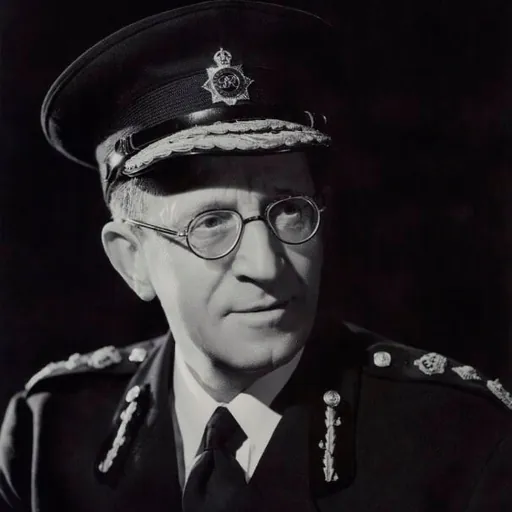
Harold Scott
English Commissioner of the Metropolitan Police
About Harold Scott
Lived 1887 – 1969 (aged 81). Harold Scott was a British police officer, head teacher and civil servant.
Sir Harold Richard Scott (24 December 1887 – 19 October 1969) was Commissioner of the Metropolitan Police from 1945 to 1953.
Scott was born in Banbury, Oxfordshire and brought up in Bruton, Somerset. He was educated at Sexey's School and later at Jesus College, Cambridge. In 1911, he joined the Home Office as a civil servant, where he worked in various capacities including Secretary to the Labour Resettlement Committee (1918–1919) and Chairman of the Prison Commission (1932–1939). With the outbreak of the Second World War, Scott's work took on a more military capacity, as he joined London's Civil Defence Administration until he was appointed as Permanent Secretary of the Ministry of Aircraft Production in 1943.
In late 1944, the Home Secretary Herbert Morrison asked Scott to accept the post as Metropolitan Police Commissioner when the war was over. The appointment in 1945 caused a stir in police circles—Scott was the first Commissioner without a police or military background since Sir Richard Mayne (who had been a lawyer when appointed). Unlike all subsequent commissioners, he was not a career police officer.
Scott's administration background served him well in some of the more managerial aspects of the Commissionership, and he managed some considerable cost savings for the Met. He also improved the public relations outlook of the service, including granting Ealing Studios unprecedented assistance in the production of the film The Blue Lamp, which was to lead to the TV series Dixon of Dock Green, which painted a rosy view of the Metropolitan Police fostered by Jack Warner's portrayal of genial PC George Dixon.
Scott presided over several high-profile cases during his time with the Met, including the Derek Bentley trial for the murder of police officer PC Sidney Miles.
In 1951, Scott introduced a police cadet training scheme for young people aged between 16 and 18.
Scott retired in 1953, and thereafter wrote several books related to crime and policing including The Concise Encyclopedia of Crime and Criminals (1962). The section house at Limehouse Police Station, which was completed at the end of World War II, was named in his honour. An inscription is still present beside the entrance doors in Birchfield Street.
In popular culture In 2022, Scott was portrayed by Tim Key in the British-American film See How They Run.
Don’t just read it —
keep it.
Full-length biographies made to live with: read them, listen on the way to work, watch them tonight.
- E-book
- Audio
- Video
Instant download · yours to keep · every purchase keeps this site free
Important facts
People in Harold Scott's life
Named in this biography and alive at the same time



Related people
Same field, nearest in time


Contemporaries
People whose lives overlapped Harold Scott's






Frequently asked questions
Who was Harold Scott?
English Commissioner of the Metropolitan Police (1887–1969)
When was Harold Scott born?
Harold Scott was born on 24 December 1887 in Banbury.
When did Harold Scott die?
Harold Scott died on 19 October 1969 in Minehead.
What was Harold Scott's occupation?
Harold Scott was a police officer, head teacher and civil servant.
What nationality was Harold Scott?
Harold Scott was British.
Sources & further reading
· DBpedia: Harold Scott (police commissioner)
Cite this page
APA: Biography.guide. (2026). Harold Scott. https://biography.guide/harold-scott-police-officer/
MLA: "Harold Scott." Biography.guide, https://biography.guide/harold-scott-police-officer/.
Chicago: "Harold Scott." Biography.guide. https://biography.guide/harold-scott-police-officer/.
Data last updated: 2026-09-24 · Spot an error? Report a correction.
Portrait: Wikimedia Commons · author & licence
Page generated 2026-09-27 05:08 UTC