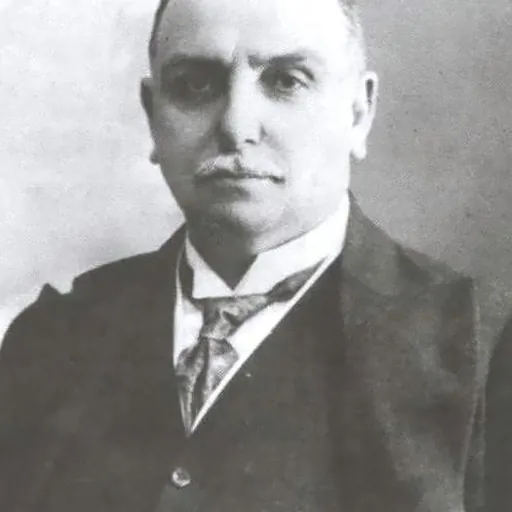
Krikor Zohrab
Armenian writer, politician and opinion journalist
About Krikor Zohrab
Lived 1861 – 1915 (aged 54). Krikor Zohrab was a Turkish and Armenian writer, opinion journalist, lawyer, politician, patron of the arts and short story writer.
Krikor Zohrab (; 26 June 1861 – 1915) was an Armenian writer, politician, and lawyer from Constantinople. At the onset of the Armenian genocide he was arrested by the Turkish government and sent to appear before a military court in Diyarbakır. En route, at a locality called Karaköprü or Şeytanderesi on the outskirts of Urfa, he was murdered by a band of known brigands under the leadership of Çerkez Ahmet, Halil and Nazım some time between 15 and 20 July 1915.
Life Zohrab was born into a wealthy family in Beşiktaş, Constantinople on 26 June 1861. His early education was completed at a local Armenian Catholic school. He graduated from Galatasaray High School with a degree in civil engineering, but did not go on to work in that field. Instead, he enrolled in a newly opened law school, the Imperial University of Jurisprudence (today: Istanbul University Faculty of Law), and received his law degree in 1882.
Zohrab became a known lawyer in the courts of the Ottoman Empire. He later became a professor of law at the university. At age 27, Zohrab married Clara Yazejian, and fathered two daughters and two sons. One of the daughters, Dolores Zohrab Liebmann, eventually became an American philanthropist.
Krikor Zohrab was successful in defending many Armenians charged with a variety of political and criminal offenses between 1895-96. During the defense of a Bulgarian revolutionary he accused a Turkish official of torture. As a result, he was disbarred and forced to live abroad.
To serve the Armenian cause, Zohrab wrote a paper in French called "La question arménienne à la lumière des documents" (The Armenian question in light of documents), published in 1913 under the pseudonym Marcel Léart in Paris. It dealt with aspects of the hardships endured by the Armenian populace and denounced the government's inaction.
Publications
Zohrab wrote many articles in Armenian daily newspapers such as Masis (Մասիս), Hairenik (Հայրենիք), and Arevelk (Armenian: Արեւելք). One of his famous articles, entitled "Broom," criticized Armenian nationals and works saying they needed some "sweeping" to bring them back to order.
Writing style
Zohrab is often regarded as a pioneering figure in the Armenian short story tradition. He was influenced by the French realism movement propelled by such writers as Guy de Maupassant, Alphonse Daudet and Émile Zola.
Zohrab drew heavily on his own experiences. His writing frequently focused on the physical and psychological characteristics of his subjects, conveying personality through descriptions of faces and gestures. His prose style tended toward brevity and compression, using short, dense passages to depict tragedy or illustrate character.
Arrest and assassination
During the mass arrests and execution that would signal the start of the Armenian Genocide in and around 24 April 1915, Zohrab was working to try to stop the atrocities. As a member of Parliament, he tried to contact the Turkish authorities and to plea for the immediate cessation of the massacres. He even contacted his supposed friend Talaat Pasha to protest and asked for redress, but to no avail. On 1 June 1915, he demanded explanations for the massacres inflicted on the Armenians in the eastern provinces from both Talaat and the secretary general of the Committee for Union and Progress (CUP) Mithat Şükrü Bleda and mentioned that one day he would demand an explanation for these actions in the Ottoman Parliament. This would be the last time they would meet. Some integrants within his immediate circle strongly encouraged him to leave the country, but Zohrab refused. but Talaat Pasha insisted on having the pair court martialed. They were then dispatched to Urfa and remained there for some time in the house of a Turkish deputy friend. Later, they were taken under police escort and taken to Diyarbakır by car. They were murdered by the well-known band of brigands led by Cherkes Ahmet, Halil and Nazım, at a locality called Karaköprü or Şeytanderesi in the outskirts of Urfa, some time between 15 July and 20 July 1915. The murderers were tried and executed in Damascus by Cemal Pasha in September 1915, and the assassinations became the subject of a 1916 investigation by the Ottoman Parliament led by Artin Boshgezenian, the deputy for Aleppo.
Don’t just read it —
keep it.
Full-length biographies made to live with: read them, listen on the way to work, watch them tonight.
- E-book
- Audio
- Video
Instant download · yours to keep · every purchase keeps this site free
Important facts
People in Krikor Zohrab's life
Named in this biography and alive at the same time


Related people
Same field, nearest in time


Contemporaries
People whose lives overlapped Krikor Zohrab's



Frequently asked questions
Who was Krikor Zohrab?
Armenian writer, politician and opinion journalist (1861-1915)
When was Krikor Zohrab born?
Krikor Zohrab was born on 26 June 1861 in Beşiktaş.
When did Krikor Zohrab die?
Krikor Zohrab died on 19 July 1915 in Şanlıurfa.
What was Krikor Zohrab's occupation?
Krikor Zohrab was a writer, opinion journalist, lawyer, politician, patron of the arts and short story writer.
What nationality was Krikor Zohrab?
Krikor Zohrab was Turkish and Armenian.
Sources & further reading
Cite this page
APA: Biography.guide. (2026). Krikor Zohrab. https://biography.guide/krikor-zohrab/
MLA: "Krikor Zohrab." Biography.guide, https://biography.guide/krikor-zohrab/.
Chicago: "Krikor Zohrab." Biography.guide. https://biography.guide/krikor-zohrab/.
Data last updated: 2026-09-23 · Spot an error? Report a correction.
Portrait: Wikimedia Commons · author & licence
Page generated 2026-09-27 05:06 UTC