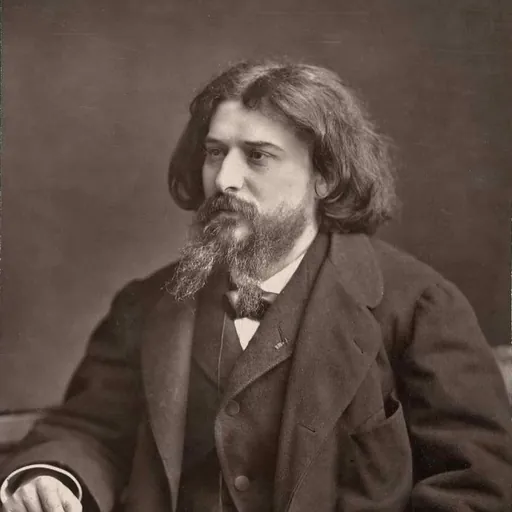
About Alphonse Daudet
Lived 1840 – 1897 (aged 57). Alphonse Daudet was a French writer, playwright, poet, novelist, autobiographer and screenwriter.
Louis Marie Alphonse Daudet (; 13 May 184016 December 1897) was a French novelist and writer of short stories. He was the husband of Julia Daudet and father of Edmée, Léon and Lucien Daudet.
Early life Daudet was born in Nîmes, France, on 13 May 1840.
Literary career
In 1866, Daudet's Lettres de mon moulin (Letters from My Windmill), written in Clamart, near Paris, and alluding to a windmill in Fontvieille, Provence , won the attention of many readers. The first of his longer books, Le Petit Chose (1868), did not, however, produce popular sensation. It is, in the main, the story of his own earlier years told with much grace and pathos. The year 1872 brought the famous Aventures prodigieuses de Tartarin de Tarascon, and the three-act play L'Arlésienne. But Fromont jeune et Risler aîné (1874) at once took the world by storm. It struck a note, not new certainly in English literature, but comparatively new in French. His creativeness resulted in characters that were real and also typical. –Tartarin de Tarascon, Tartarin sur les Alpes, Port-Tarascon–and the short stories, written for the most part before he had acquired fame and fortune, constitute his life work. Having lost his virginity at the age of twelve, he then slept with his friends' mistresses throughout his marriage. Daudet would undergo several painful treatments and operations for his subsequently paralysing disease. His journal entries relating to the pain he experienced from tabes dorsalis are collected in the volume In the Land of Pain, translated by Julian Barnes. He died in Paris on 16 December 1897, and was interred at that city's Père Lachaise Cemetery.
The story of Daudet's earlier years is told in his brother Ernest Daudet's Mon frère et moi. There is a good deal of autobiographical detail in Daudet's Trente ans de Paris and Souvenirs d'un homme de lettres, and also scattered in his other books. The references to him in the Journal des Goncourt are numerous. The main character of Le Nabab was inspired by a Jewish politician who was elected as a deputy for Nîmes. Daudet campaigned against him and lost. Daudet counted many antisemitic literary figures amongst his friends, including Edouard Drumont, who founded the Antisemitic League of France and founded and edited the anti-Semitic newspaper La Libre Parole. It has been argued that Daudet deliberately exaggerated his links to Provence to further his literary career and social success (following Frederic Mistral's success), including lying to his future wife about his "Provençal" roots.
Numerous colleges and schools in contemporary France bear his name and his books are widely read and several are in print.
Works Major works, and works in English translation (date given of first translation). For a complete bibliography see . Les Amoureuses (1858; poems, first published work). Le Petit Chose (1868; English: Little Good-For-Nothing, 1885; or Little What's-His-Name, 1898). Lettres de Mon Moulin (1869; English: Letters from my Mill, 1880, short stories). Tartarin de Tarascon (1872; English: Tartarin of Tarascon, 1896). L'Arlésienne (1872; novella originally part of Lettres de Mon Moulin made into a play) Contes du Lundi (1873; English: The Monday Tales, 1900; short stories). Les Femmes d'Artistes (1874; English: Artists' Wives, 1896). Robert Helmont (1874; English: Robert Helmont: the Diary of a Recluse, 1896). Fromont jeune et Risler aîné (1874; English: Fromont Junior and Risler Senior, 1894). Jack (1876; English: Jack, 1897). Le Nabab (1877; English: The Nabob, 1878). Les Rois en Exil (1879; English: Kings in Exile, 1896).
L'Evangéliste (1883; English: The Evangelist, 1883). Sapho (1884 ); (English: Sappho , 1886). Tartarin sur les Alpes (1885; English: Tartarin on the Alps, 1891). La Belle Nivernaise (1886; English: La Belle Nivernaise, 1892, juvenile). L'Immortel (1888; English: One of the Forty, 1888). Port-Tarascon (1890; English: Port Tarascon, 1890). Rose and Ninette (1892; English: Rose and Ninette, 1892).
La Doulou (1930; English: In The Land of Pain, 2003; translator: Julian Barnes). The Last Lesson
Don’t just read it —
keep it.
Full-length biographies made to live with: read them, listen on the way to work, watch them tonight.
- E-book
- Audio
- Video
Instant download · yours to keep · every purchase keeps this site free
Important facts
People in Alphonse Daudet's life
Named in this biography and alive at the same time
Related people
Same field, nearest in time

Contemporaries
People whose lives overlapped Alphonse Daudet's

Frequently asked questions
Who was Alphonse Daudet?
French novelist, playwright, and poet (1840–1897)
When was Alphonse Daudet born?
Alphonse Daudet was born on 13 May 1840 in Nîmes.
When did Alphonse Daudet die?
Alphonse Daudet died on 16 December 1897 in Paris.
What was Alphonse Daudet's occupation?
Alphonse Daudet was a writer, playwright, poet, novelist, autobiographer and screenwriter.
What nationality was Alphonse Daudet?
Alphonse Daudet was French.
Sources & further reading
Cite this page
APA: Biography.guide. (2026). Alphonse Daudet. https://biography.guide/alphonse-daudet/
MLA: "Alphonse Daudet." Biography.guide, https://biography.guide/alphonse-daudet/.
Chicago: "Alphonse Daudet." Biography.guide. https://biography.guide/alphonse-daudet/.
Data last updated: 2026-09-24 · Spot an error? Report a correction.
Portrait: Wikimedia Commons · author & licence
Page generated 2026-09-27 05:08 UTC