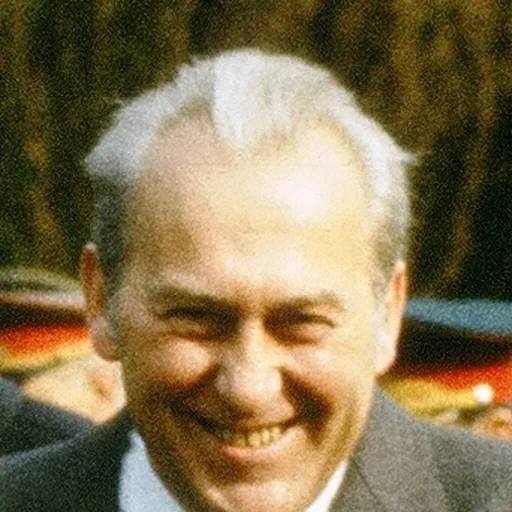
About Konrad Naumann
Lived 1928 – 1992 (aged 63). Konrad Naumann was a German politician and fDJ functionary (GDR).
Konrad Naumann (25 November 1928 – 25 July 1992) was an East German politician. He built his career; initially, in regional politics, but between 1966 and 1986 he was important nationally as a member of the Central Committee of the country's ruling SED (party). At times, Naumann was the unofficial number two to General Secretary Erich Honecker and seen as his potential successor.
He was also appointed in May 1976 a member of the party's Politburo. Most Politburo members remained in post till they died. Naumann was unusual in finding himself relieved of his Politburo (and other party) duties while still alive, following a speech in October 1985 which was felt to be insufficiently supportive of the party line.
Life
Early years Konrad Naumann was born in Leipzig during the final years of what later came to be known as the Weimar period. His father was a financial auditor and his mother worked in garment manufacturing. He attended junior school in Holzhausen, on the east side of Leipzig, till 1931, and then middle school in Engelsdorf, a couple of miles to the north. His senior school, which he attended formally till 1945, was also in Leipzig. In 1939 became a member and later a group leader in the "Deutsches Jungvolk", by now part of the Hitler Youth organisation. In 1944 his class was conscripted as Luftwaffenhelfer which by this stage in the war had become in most respects a schoolboy branch of the army. Early in 1945 he was stationed in nearby Bad Lausick. Shortly before the Americans arrived in April/May 1945 he deserted. Then, early in 1948, he was accused of "political mistakes" and relieved of his party functions, following which he obtained a job as an assistant mechanic in the lignite (brown coal) mines at Hirschfelde on the eastern side of Saxony. In 1951 Naumann was sent to Moscow, signalling that he had been identified for future promotion. Between 1951 and 1952 he studied at Moscow's Komsomol Academy. Between 1952 and 1957 he served as First Secretary with the FDJ regional leadership in Frankfurt (Oder), was on the candidates list for membership of the regional SED (party) leadership team and a district councillor.
The senior politician In 1963 Konrad Naumann was listed as a candidate for membership of the Party Central Committee. In September 1966 he became one of its 131 members.
Within the Central Committee, in 1973 Naumann was a candidate for Politburo membership. He joined the politburo in 1976. The next year he married, as her third husband, the actress Vera Oelschlegel. The extent and nature of the relationship between Naumann and Oelschlegel while the latter was still married to her second husband, the writer Hermann Kant, was the subject of rumour and, at least in the west, press speculation. The marriage would last for ten years.
High living and political power Through the 1970s and the first half of the 1980s Konrad Naumann lived as a member of the political elite, apparently little affected by rumours, later crystallized in released intelligence files and press reports, of an intemperate life-style He continued to live, like most of the Politburo members, in the exclusive Waldsiedlung residential quarter just outside Berlin. From 1984 till 1985 he was secretary of the Central Committee and, from 1984 till 1986, a member of the State Council. More thoughtful commentators placed the Naumann resignation in the context of growing tensions in the country's most important political and economic partnership. Moves to modernise Soviet industry under Yuri Andropov and Mikhail Gorbachev threatened greater commercial competition across the Comecon area for East Germany's own industrial sector, along with the threat of higher prices for energy and other commodities from the Soviet Union. At the same time the leadership in East Berlin were caught unprepared for the new questioning of old Stalinist certainties concerning the relationship between the state and its citizens which were being consciously unleashed by the new General Secretary of the Party Central Committee in Moscow. According to this analysis, Erich Honecker sacked his roguish former FDJ comrade because pressures from Moscow left him needing a strong united front from a well controlled and disciplined politburo at the heart of political power in East Berlin. Nor did Naumann go entirely quietly. The possibility surfaced that he could disclose what he knew about Party Organisation and might even, if necessary, turn to the western press. In the end there was something reassuringly familiar about Naumann's next position. Like Karl Schirdewan in 1958, in 1986 Konrad Naumann was given a post, in the first instance as a Research Assistant, with the National Archives Administration in Potsdam, where he remained till 1989. He took early retirement in 1990 and in April 1991 relocated to Quito in Ecuador where he died just over a year later.
Awards and honours 1964: Patriotic Order of Merit in silver 1974: Patriotic Order of Merit in gold 1978: Order of Karl Marx
Don’t just read it —
keep it.
Full-length biographies made to live with: read them, listen on the way to work, watch them tonight.
- E-book
- Audio
- Video
Instant download · yours to keep · every purchase keeps this site free
Important facts
Family & relationships
People in Konrad Naumann's life
Named in this biography and alive at the same time




Related people
Same field, nearest in time





Contemporaries
People whose lives overlapped Konrad Naumann's



Frequently asked questions
Who was Konrad Naumann?
German politician (1928–1992)
When was Konrad Naumann born?
Konrad Naumann was born on 25 November 1928 in Leipzig.
When did Konrad Naumann die?
Konrad Naumann died on 25 July 1992 in Guayaquil.
What was Konrad Naumann's occupation?
Konrad Naumann was a politician and fDJ functionary (GDR).
What nationality was Konrad Naumann?
Konrad Naumann was German.
Sources & further reading
Cite this page
APA: Biography.guide. (2026). Konrad Naumann. https://biography.guide/konrad-naumann/
MLA: "Konrad Naumann." Biography.guide, https://biography.guide/konrad-naumann/.
Chicago: "Konrad Naumann." Biography.guide. https://biography.guide/konrad-naumann/.
Data last updated: 2026-09-23 · Spot an error? Report a correction.
Portrait: Wikimedia Commons · author & licence
Page generated 2026-09-27 05:06 UTC