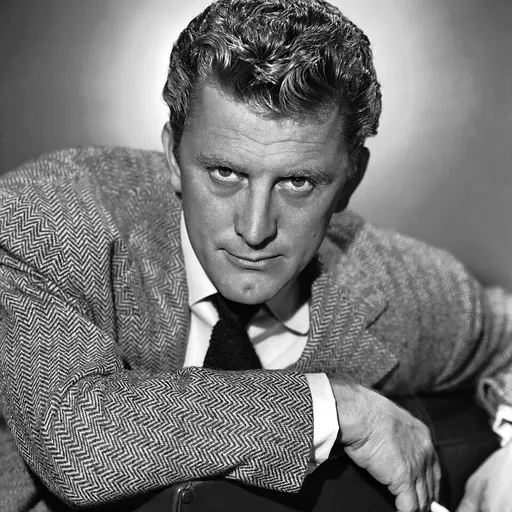
About Kirk Douglas
Lived 1916 – 2020 (aged 103). Kirk Douglas was an American film producer, television actor, film actor, film director, screenwriter and soldier.
Kirk Douglas (born Issur Danielovitch; December 9, 1916 – February 5, 2020) was an American actor and filmmaker. After an impoverished childhood, he made his film debut in The Strange Love of Martha Ivers with Barbara Stanwyck. Douglas soon developed into a leading box-office star throughout the 1950s, known for serious dramas, including westerns and war films. During his career, he appeared in more than 90 films and was known for his explosive acting style. He was named by the American Film Institute the 17th-greatest male star of Classic Hollywood cinema.
Douglas played an unscrupulous boxing hero in Champion (1949), which brought him his first nomination for the Academy Award for Best Actor. His other early films include Out of the Past (1947); Young Man with a Horn (1950), playing opposite Lauren Bacall and Doris Day; Ace in the Hole (1951); and Detective Story (1951), for which he received a Golden Globe nomination. He received his second Oscar nomination for his dramatic role in The Bad and the Beautiful (1952), opposite Lana Turner, and earned his third for portraying Vincent van Gogh in Lust for Life (1956), a role for which he won the Golden Globe for the Best Actor in a Drama. He also starred with James Mason in the adventure 20,000 Leagues Under the Sea (1954), a large box-office hit.
In September 1949 at the age of 32, he established Bryna Productions, which began producing films as varied as Paths of Glory (1957) and Spartacus (1960). In those two films, he collaborated with the then relatively unknown director Stanley Kubrick, taking lead roles in both films. Douglas arguably helped to break the Hollywood blacklist by having Dalton Trumbo write Spartacus with an official on-screen credit. His parents were Russian-Jewish immigrants from Chavusy, Mogilev Governorate, in the Russian Empire (present-day Belarus). The family spoke Yiddish at home. His six sisters included Freida "Fritzi" Demsky Becker and Ida Sahr. Douglas reconnected to the Jewish religion after a near-fatal helicopter crash at the age of 74.
Douglas's uncle used the surname Demsky , and Douglas's family adopted the same surname in the United States. Douglas grew up as Izzy Demsky and altered his name to Kirk Douglas before entering the United States Navy during World War II.
Douglas had an unhappy childhood, living with an alcoholic, physically abusive father. While his father drank up what little money they had, Douglas and his mother and sisters endured "crippling poverty".
Douglas first wanted to be an actor after he recited "The Red Robin of Spring", a poem by the English poet John Clare, while in kindergarten and received applause. Growing up, he sold snacks to mill workers to earn enough to buy milk and bread to help his family. He later delivered newspapers, and he had more than forty jobs during his youth before becoming an actor. He found living in a family with six sisters to be stifling: "I was dying to get out. In a sense, it lit a fire under me." After appearing in plays at Amsterdam High School, from which he graduated in 1934, he knew he wanted to become a professional actor. Unable to afford the tuition, Douglas talked his way into the dean's office at St. Lawrence University and showed him a list of his high school honors. He graduated with a bachelor's degree in 1939. He received a loan which he paid back by working part-time as a gardener and a janitor. He was a standout on the school's wrestling team and wrestled one summer in a carnival to make money.
Douglas's acting talents were noticed at the American Academy of Dramatic Arts in New York City, which gave him a special scholarship. One of his classmates, Betty Joan Perske, later known as Lauren Bacall, played an important role in launching his film career. Bacall wrote that she "had a wild crush on Kirk", and they dated casually. Another classmate, and a friend of Bacall's, was aspiring actress Diana Dill, who would later become Douglas's first wife.
During their time together, Bacall learned Douglas had no money and that he once spent the night in jail since he had no place to sleep. She once gave him her uncle's old coat to keep warm: "I thought he must be frozen in the winter ... He was thrilled and grateful." Sometimes, just to see him, she would drag a friend or her mother to the restaurant where he worked as a busboy and waiter. He told her his dream was to someday bring his family to New York to see him on stage. During that period she fantasized about someday sharing her personal and stage lives with Douglas, but would later be disappointed: "Kirk did not really pursue me. He was friendly and sweet—enjoyed my company—but I was clearly too young for him," the eight-years-younger Bacall later wrote. He was medically discharged in 1944 for injuries sustained from the premature explosion of a depth charge. He rose to the rank of Lieutenant (junior grade). Wallis's film The Strange Love of Martha Ivers (1946) with Barbara Stanwyck became Douglas' debut screen appearance. He played a young, insecure man stung by jealousy, whose life was dominated by his ruthless wife, and who hid his feelings with alcohol. It would be the last time that Douglas portrayed a weakling in a film role. Reviewers of the film noted that Douglas already projected qualities of a "natural film actor", with the similarity of this role with later ones explained by biographer Tony Thomas:
In 1947, Douglas appeared in Out of the Past (UK: Build My Gallows High), playing a large supporting role in this classic noir thriller starring Robert Mitchum and Jane Greer. Douglas made his Broadway debut in 1949 in Three Sisters, produced by Katharine Cornell. The month after Out of the Past was released, I Walk Alone, the first film teaming Douglas with Burt Lancaster, presented Douglas playing a supporting part quite similar to his role in Out of the Past in another classic fast-paced noir thriller.
Douglas' image as a tough guy was established in his eighth film, Champion (1949), after producer Stanley Kramer chose him to play a selfish boxer. However, in accepting the role, he took a gamble, since he had to turn down an offer to star in a big-budget MGM film, The Great Sinner, which would have earned him three times the income.
Douglas received his first Academy Award nomination, and the film earned six nominations in all. Variety called it "a stark, realistic study of the boxing rackets."
After Champion he decided that, to succeed as a star, he needed to ramp up his intensity, overcome his natural shyness, and choose stronger roles. He later stated, "I don't think I'd be much of an actor without vanity. And I'm not interested in being a 'modest actor'". Early in his Hollywood career, Douglas demonstrated his independent streak and broke his studio contracts to gain total control over his projects, forming his own movie company, Bryna Productions (named after his mother) in September 1949.
Peak years of success
Throughout the 1950s and 1960s, Douglas was a major box-office star, playing opposite some of the leading actresses of that era. He portrayed a frontier peace officer in his first western, Along the Great Divide (1951). He quickly became very comfortable with riding horses and playing gunslingers, and he appeared in many Westerns. He considered Lonely Are the Brave (1962), in which he plays a cowboy trying to live by his own code, his personal favorite. The film, written by Dalton Trumbo, was respected by critics but did not do well at the box office due to poor marketing and distribution.
In 1950, Douglas played Rick Martin in Young Man with a Horn, based on a novel of the same name by Dorothy Baker based on the life of jazz cornetist Bix Beiderbecke. Composer and pianist Hoagy Carmichael, a friend of the real Beiderbecke, played the sidekick, adding realism to the film and giving Douglas insight into the role. Doris Day starred as Jo, a young woman who was infatuated with the struggling jazz musician. This was strikingly opposite of the real-life account in Doris Day's autobiography, which described Douglas as "civil but self-centered" and the film as "utterly joyless". During filming, bit actress Jean Spangler disappeared, and her case remains unsolved. On October 9, 1949, Spangler's purse was found near the Fern Dell entrance to Griffith Park in Los Angeles. There was an unfinished note in the purse addressed to a "Kirk," which read: "Can't wait any longer, Going to see Dr. Scott. It will work best this way while mother is away". Douglas, married at the time, called the police and told them he was not the Kirk mentioned in the note. When interviewed via telephone by the head of the investigating team, Douglas stated that he had "talked and kidded with her a bit" on set, but that he had never been out with her. Spangler's girlfriends told police that she was three months pregnant when she disappeared, and scholars such as Jon Lewis of Oregon State University have speculated that she may have been considering an illegal abortion.
In 1951, Douglas starred as a newspaper reporter anxiously looking for a big story in Ace in the Hole, director Billy Wilder's first effort as both writer and producer. The subject and story were controversial at the time, and U.S. audiences stayed away. Some reviews saw it as "ruthless and cynical ... a distorted study of corruption, mob psychology and the free press." Possibly it "hit too close to home", said Douglas. It won a Best Foreign Film award at the Venice Film Festival. The film's stature has increased in recent years, with some surveys placing it in their Top 500 Films list. Woody Allen considers it one of his favorite films. As the film's star and protagonist, Douglas is credited for the intensity of his acting. Film critic Roger Ebert wrote, "his focus and energy ... is almost scary. There is nothing dated about Douglas' performance. It's as right-now as a sharpened knife." Biographer Gene Philips noted that Wilder's story was "galvanized" by Douglas's "astounding performance" and no doubt was a factor when George Stevens, who presented Douglas with the AFI Life Achievement Award in 1991, said of him: "No other leading actor was ever more ready to tap the dark, desperate side of the soul and thus to reveal the complexity of human nature."
Also in 1951, Douglas starred in Detective Story, nominated for four Academy Awards, including one for Lee Grant in her debut film. Grant said Douglas was "dazzling, both personally and in the part. ... He was a big, big star. Gorgeous. Intense. Amazing." To prepare for the role, Douglas spent days with the New York Police Department and sat in on interrogations. Reviewers recognized Douglas's acting qualities, with Bosley Crowther describing Douglas as "forceful and aggressive as the detective".
In The Bad and the Beautiful (1952), another of his three Oscar-nominated roles, Douglas played a hard-nosed film producer who manipulates and uses his actors, writers, and directors. In 1954 Douglas starred as the titular character in Ulysses, a film based on Homer's epic poem Odyssey, with Silvana Mangano as Penelope and Circe, and Anthony Quinn as Antinous.
In 20,000 Leagues Under the Sea (1954), Douglas showed that in addition to serious, driven characters, he was adept at roles requiring a lighter, comic touch. In this adaptation of the Jules Verne novel, he played a happy-go-lucky sailor who was the opposite in every way to the brooding Captain Nemo (James Mason). The film was one of Walt Disney's most successful live-action movies and a major box-office hit.
In 1955, Douglas was finally able to get his film production company, Bryna Productions, off the ground. Through Bryna, he produced and starred in the films Paths of Glory (1957), The Vikings (1958), Spartacus (1960), Lonely are the Brave (1962), and Seven Days in May (1964). In 1958, Douglas formed the music publishing company Peter Vincent Music Corporation, a Bryna Productions subsidiary. Peter Vincent Music was responsible for publishing the soundtracks of The Vikings and Spartacus.
While Paths of Glory did not do well at the box office, it has since become one of the great anti-war films, and it is one of director Stanley Kubrick's early films. Douglas, a fluent French speaker, portrayed a sympathetic French officer during World War I who tries to save three soldiers from facing a firing squad. Biographer Vincent LoBrutto describes Douglas's "seething but controlled portrayal exploding with the passion of his convictions at the injustice leveled at his men." The film was banned in France until 1976. Before production of the film began, however, Douglas and Kubrick had to work out some large problems, one of which was Kubrick's rewriting the screenplay without informing Douglas first. Kubrick and writer Jim Thompson had added a happy ending to the film to make the film more commercial to the general public, where the men's lives are saved from execution at the last minute by the general. However, these changes were reversed back more closely to the original novel at the demand of Kirk Douglas. It led to their first major argument: "I called Stanley to my room ... I hit the ceiling. I called him every four-letter word I could think of ... 'I got the money, based on that [original] script. Not this shit!' I threw the script across the room. 'We're going back to the original script, or we're not making the picture.' Stanley never blinked an eye. We shot the original script. I think the movie is a classic, one of the most important pictures—possibly the most important picture—Stanley Kubrick has ever made."
His role as Vincent van Gogh in Lust for Life (1956), directed by Vincente Minnelli and based on Irving Stone's bestseller, was filmed mostly on location in France. Douglas was noted not only for the veracity of van Gogh's appearance but for how he conveyed the painter's internal turmoil. Some reviewers consider it the most famous example of the "tortured artist" who seeks solace from life's pain through his work. Others see it as a portrayal not only of the "painter-as-hero", but a unique presentation of the "action painter", with Douglas expressing the physicality and emotion of painting, as he uses the canvas to capture a moment in time.
Douglas was nominated for an Academy Award for the role, with his co-star Anthony Quinn winning the Oscar for Best Supporting Actor as Paul Gauguin, van Gogh's friend. Douglas won a Golden Globe award, although Minnelli said Douglas should have won an Oscar: "He achieved a moving and memorable portrait of the artist—a man of massive creative power, triggered by severe emotional stress, the fear and horror of madness." Douglas himself called his acting role as Van Gogh a painful experience: "Not only did I look like Van Gogh, I was the same age he was when he committed suicide." His wife said he often remained in character in his personal life: "When he was doing Lust for Life, he came home in that red beard of Van Gogh's, wearing those big boots, stomping around the house—it was frightening."
In general, however, Douglas's acting style fit well with Minnelli's preference for "melodrama and neurotic-artist roles", writes film historian James Naremore. He adds that Minnelli had his "richest, most impressive collaborations" with Douglas, and for Minnelli, no other actor portrayed his level of "cool": "A robust, athletic, sometimes explosive player, Douglas loved stagy rhetoric, and he did everything passionately." Douglas had also starred in Minnelli's film The Bad and the Beautiful four years earlier, for which he received a Best Actor Oscar nomination.
Financial troubles For approximately 15 years and 27 films, Douglas's agent had been Sam Norton, who was compensated with 10% of Douglas's gross earnings. In addition, Norton was partners with Jerome "Jerry" B. Rosenthal in the law firm of Rosenthal & Norton which received an additional 10%. On the day of his wedding in 1958 his bride Anne had been quietly pulled aside by Norton and been presented by Norton (without Kirk Douglas's knowledge) with a pre-nuptial agreement. She signed the document, but Douglas, because he held Norton as both his best friend and a father figure, was unwilling to get involved in his wife's subsequent attempts to obtain a copy. as the Thracian gladiator slave rebel Spartacus with an all-star cast in Spartacus (1960). He was the executive producer as well, which increased the $12 million production cost and made Spartacus one of the most expensive films up to that time. Douglas initially selected Anthony Mann to direct, but replaced him early on with Stanley Kubrick, with whom he had previously collaborated in Paths of Glory.
Howard Fast, was originally hired to adapt his own 1951 novel Spartacus as a screenplay, but had difficulty working in the format. He was replaced by Dalton Trumbo, who had been blacklisted as one of the Hollywood 10 and since survived by writing screenplays under assumed names. Douglas insisted on giving Trumbo an official on-screen credit and thereby arguably helped to break the Hollywood blacklist.
Douglas bought the rights to stage a play of the novel One Flew Over the Cuckoo's Nest from its author, Ken Kesey. He mounted a play from the material in 1963 in which he starred and that ran on Broadway for five months. Reviews were mixed. Douglas retained the movie rights due to an innovative loophole of basing the rights on the play rather than the novel, despite Kesey's objections, but after a decade of being unable to find a producer he gave the rights to his son, Michael. In 1975, the film version was produced by Michael Douglas and Saul Zaentz, and starred Jack Nicholson, as Douglas was then considered too old to play the character as written. The film won all five major Academy Awards, only the second film to do so (after It Happened One Night in 1934).
Douglas made seven films over four decades with actor Burt Lancaster: I Walk Alone (1947), Gunfight at the O.K. Corral (1957), The Devil's Disciple (1959), The List of Adrian Messenger (1963), Seven Days in May (1964), Victory at Entebbe (1976), and Tough Guys (1986), which fixed the notion of the pair as something of a team in the public imagination. Douglas was always billed under Lancaster in these movies, but, with the exception of I Walk Alone and, even more so, The List of Adrian Messenger (where Lancaster's part is just a cameo appearance, while Douglas plays the film's villain), their roles were usually of a similar size. Both actors arrived in Hollywood at about the same time and first appeared together in the fourth film for each, albeit with Douglas in a supporting role. They both became actor-producers who sought out independent Hollywood careers.
In 1967 Douglas starred with John Wayne in the western film directed by Burt Kennedy titled The War Wagon.
In The Arrangement (1969), a drama directed by Elia Kazan and based upon his novel of the same title, Douglas starred as a tormented advertising executive, with Faye Dunaway as costar. The film did poorly at the box office, receiving mostly negative reviews. Dunaway believed many of the reviews were unfair, writing in her biography, "I can't understand it when people knock Kirk's performance, because I think he's terrific in the picture," adding that "he's as bright a person as I've met in the acting profession." She says that his "pragmatic approach to acting" would later be a "philosophy that ended up rubbing off on me."
Later work
In the 1970s, he starred in films such as There Was a Crooked Man... (1970), A Gunfight (1971), The Light at the Edge of the World (1971). and The Fury (1978). He made his directorial debut in Scalawag. (1973), and subsequently also directed Posse (1975), in which he starred alongside Bruce Dern.
In 1980, he starred in The Final Countdown, playing the commanding officer of the aircraft carrier USS Nimitz, which travels through time to the day before the 1941 attack on Pearl Harbor. It was produced by his son Peter Douglas. He also played in a dual role in The Man from Snowy River (1982), an Australian film which received critical acclaim and numerous awards.
In 1986, he reunited with his longtime co-star, Burt Lancaster, in a crime comedy, Tough Guys, with a cast including Charles Durning and Eli Wallach. It marked the final collaboration between Douglas and Lancaster, completing a partnership of more than 40 years. That same year, he co-hosted (with Angela Lansbury) the New York Philharmonic's tribute to the 100th anniversary of the Statue of Liberty. The symphony was conducted by Zubin Mehta.
In 1988, Douglas starred in a television adaptation of Inherit the Wind, opposite Jason Robards and Jean Simmons. The film won two Emmy Awards. In the 1990s, Douglas continued starring in various features. Among them was The Secret in 1992, a television movie about a grandfather and his grandson who both struggle with dyslexia. That same year, he played the uncle of Michael J. Fox in a comedy, Greedy. He appeared as the Devil in the video for the Don Henley song "The Garden of Allah". In 1996, after suffering a severe stroke at age 79 which impaired his ability to speak, Douglas still wanted to make movies. He underwent years of voice therapy and made Diamonds in 1999, in which he played an old professional boxer who was recovering from a stroke. It co-starred his longtime friend from his early acting years, Lauren Bacall.
In 2003, Michael and Joel Douglas produced It Runs in the Family, which along with Kirk starred various family members, including Michael, Michael's son Cameron, and his wife from 50 years earlier, Diana Dill, playing his wife. His final feature-film appearance was in the 2004 Michael Goorjian film Illusion, in which he depicts a dying film director forced to watch episodes from the life of a son he had refused to acknowledge. His last screen role was the TV movie Empire State Building Murders, which was released in 2008.
On December 9, 2016, he celebrated his 100th birthday at the Beverly Hills Hotel, joined by several of his friends, including Don Rickles, Jeffrey Katzenberg, and Steven Spielberg, along with Douglas's wife Anne, his son Michael and his daughter-in-law Catherine Zeta-Jones. Douglas was described by his guests as still being in good shape, able to walk with confidence into the Sunset Room for the celebration.
Douglas appeared at the 2018 Golden Globes with his daughter-in-law Catherine Zeta-Jones, a rare public appearance in the final decade of his life. He received a standing ovation and helped Zeta-Jones present the award for "Best Screenplay – Motion Picture".
Style and philosophy of acting
quote=Kirk is one of a kind. He has an overpowering physical presence, which is why on a large movie screen he looms over the audience like a tidal wave in full flood. Globally revered, he is now the last living screen legend of those who vaulted to stardom at the war's end, that special breed of movie idol instantly recognizable anywhere, whose luminous on-screen characters are forever memorable. — —Jack Valenti, president of the Motion Picture Association of America. Douglas had great vitality and explained that "it takes a lot out of you to work in this business. Many people fall by the wayside because they don't have the energy to sustain their talent."
Douglas's attitude toward acting became evident with Champion (1949). From that one role, writes biographer John Parker, he went from stardom and entered the "superleague", where his style was in "marked contrast to Hollywood's other leading men at the time".
Actress Lee Grant, who acted with him and later filmed a documentary about him and his family, noted that even after he achieved worldwide stardom, his father would not acknowledge his success.
Personal life Personality In The Ragman's Son, Douglas described himself as a "son of a bitch". He added, "I'm probably the most disliked actor in Hollywood. And I feel pretty good about it. Because that's me... . I was born aggressive, and I guess I'll die aggressive". Douglas's brash personality was attributed to his difficult and impoverished upbringing and to his neglectful, abusive, and alcoholic father. According to Douglas, "there was an awful lot of rage churning around inside me, rage that I was afraid to reveal because there was so much more of it, and so much stronger, in my father".
Douglas met producer Anne Buydens (born Hannelore Marx) while acting on location in Paris in Act of Love. Buydens originally fled from Germany to escape Nazism and survived by putting her multilingual skills to work at a film studio, creating translations for subtitles. In 2017, the couple released a book, Kirk and Anne: Letters of Love, Laughter and a Lifetime in Hollywood, that revealed intimate letters they shared through the years. Throughout their marriage, Douglas had affairs with other women, including several Hollywood starlets. He never hid his infidelities from his wife, who was accepting of them and explained, "as a European, I understood it was unrealistic to expect total fidelity in a marriage."
Mike Todd Douglas was good friends with producer Mike Todd who lived across the street from him in Palm Springs. On the morning of March 22, 1958, they were playing tennis when Todd asked him to come with him later that day on his private aircraft to New York, where he was due to receive an award. He suggested that Douglas could make the presentation to him and afterwards on the way back they could stop and visit former president Harry Truman in Independence, Missouri.
Upon hearing of the plan, Douglas's wife Anne had an uneasy feeling and urged him to take a commercial flight instead. After a heated argument about the matter, Douglas in a temper said that if he could not fly with Todd then he would not go at all. This near-death experience sparked a search for meaning by Douglas, which led him, after much study, to embrace the Judaism in which he had been raised. He documented this spiritual journey in his book, Climbing the Mountain: My Search for Meaning (1997).
He decided to visit Jerusalem again and wanted to see the Western Wall Tunnel during a trip where he would dedicate two playgrounds he donated to the state. His tour guide arranged to end the tour of the tunnel at the bedrock where, according to Jewish tradition, Abraham's binding of Isaac took place.
In his earlier autobiography, The Ragman's Son, he recalled, "years back, I tried to forget that I was a Jew," but later in his career he began "coming to grips with what it means to be a Jew," which became a theme in his life. In an interview in 2000, he explained this transition:
Douglas noted that an underlying theme of some of his films, including The Juggler (1953), Cast a Giant Shadow (1966), and Remembrance of Love (1982), was about "a Jew who doesn't think of himself as one, and eventually finds his Jewishness."
Although his children had non-Jewish mothers, Douglas stated that they were "aware culturally" of his "deep convictions" and he never tried to influence their own religious decisions. Among the donations have been those to his former high school and college. In September 2001, he helped fund his high school's musical, Amsterdam Oratorio, composed by Maria Riccio Bryce, who won the school Thespian Society's Kirk Douglas Award in 1968. In 2012 he donated $5 million to St. Lawrence University, his alma mater. The college used the donation for the scholarship fund he began in 1999. They supported the Anne Douglas Childhood Center at the Sinai Temple of Westwood. In March 2015, Douglas and his wife donated $2.3 million to the Children's Hospital Los Angeles.
Since the early 1990s, Kirk and Anne Douglas donated up to $40 million to Harry's Haven, an Alzheimer's treatment facility in Woodland Hills, to care for patients at the Motion Picture Home.
Douglas donated a number of playgrounds in Jerusalem and donated the Kirk Douglas Theater at the Aish Center across from the Western Wall.
Politics
Douglas and his wife traveled to more than 40 countries, at their own expense, to act as goodwill ambassadors for the U.S. Information Agency, speaking to audiences about why democracy works and what freedom means. In subsequent years, Douglas testified before Congress about elder abuse. Douglas was also friends with former Secretary of State Henry Kissinger.
Douglas was a long-time member of the Democratic Party. He wrote letters to politicians who were friends. He noted in his memoir, Let's Face It (2007), that he felt compelled to write to former president Jimmy Carter in 2006 to stress that "Israel is the only successful democracy in the Middle East ... [and] has had to endure many wars against overwhelming odds. If Israel loses one war, they lose Israel."
Role in breaking Hollywood blacklist
Kirk Douglas claimed that he broke the Hollywood blacklist when he insisted that Dalton Trumbo, who had been blacklisted as one of the Hollywood 10, be given screen credit for his screenplay for Spartacus. Trumbo had intended to use the pseudonym "Sam Jackson". In his autobiography, Douglas states that this decision was motivated by a meeting that Edward Lewis, Stanley Kubrick, and he had regarding whose names to list for the screenplay in the film credits, given Trumbo's shaky position with Hollywood executives. One idea was to credit Lewis as co-writer or sole writer, but Lewis vetoed both suggestions. The next day, Douglas called the gate at Universal saying, "I'd like to leave a pass for Dalton Trumbo." Douglas writes, "For the first time in 10 years, Trumbo walked on to a studio lot. He said, 'Thanks, Kirk, for giving me back my name.' During a 2012 interview Douglas said, "I've made over 85 pictures, but the thing I'm most proud of is breaking the blacklist." Douglas later successfully denied Trumbo a sought credit on the film Town Without Pity as he worried that his continued association with the screenwriter would hurt his career.
Blogging Douglas blogged from time to time. Originally hosted on Myspace, his posts were hosted by the Huffington Post beginning in 2012. As of 2008, he was believed to be the oldest celebrity blogger in the world.
Rape allegation Douglas is alleged to have raped actress Natalie Wood in the summer of 1955, when she was 16 and he 38.
The allegation received renewed attention in January 2018, after the 75th Golden Globe Awards ceremony paid tribute to Douglas, with several news outlets citing a 2012 anonymous blog post which accused Douglas. In July 2018, Wood's sister Lana said during a 12-part podcast about her sister's life that her sister was sexually assaulted as a teen and that the attack had occurred inside the Chateau Marmont during an audition and went on "for hours". In the 2021 memoir Little Sister: My Investigation Into the Mysterious Death of Natalie Wood, Lana Wood alleged Douglas was her sister's assailant.
Health problems and death
In August 1986, aged 69, Douglas suffered a severe heart attack and recovered in the hospital, and underwent surgery to insert a pacemaker into his heart, which remained for the rest of his life. On January 28, 1996, at age 79, Douglas suffered a severe stroke, which impaired his ability to speak. Doctors told his wife that unless there was rapid improvement, the loss of his ability to speak would probably be permanent. However, after a regimen of daily speech-language therapy that lasted several months, his ability to speak returned, although it was still limited. He was able to accept an honorary Academy Award two months later (in March) and to thank the audience. He wrote about this experience in his 2002 book My Stroke of Luck, which he hoped would be an "operating manual" for others on how to handle a stroke victim in their own family.
Douglas died at his home in Beverly Hills, California, surrounded by his family on February 5, 2020, at age 103. Douglas's funeral was held at the Westwood Village Memorial Park Cemetery on February 7, 2020, two days after his death. He was buried in the same plot as his son Eric. On April 29, 2021, his wife Anne died at age 102 and was buried next to him and their son.
Filmography
In a 2014 article, Douglas cited The Strange Love of Martha Ivers, Champion, Ace in the Hole, The Bad and the Beautiful, Act of Love, 20,000 Leagues Under the Sea, The Indian Fighter, Lust for Life, Paths of Glory, Spartacus, Lonely Are the Brave, and Seven Days in May as the films he was most proud of throughout his acting career.
Radio appearances Year !! Program !! Episode/source
In 1958, he was awarded the honorary degree of Doctor of Fine Arts from St. Lawrence University. In 1981, Douglas received the Presidential Medal of Freedom from Jimmy Carter. In 1984, he was inducted into the Western Performers Hall of Fame at the National Cowboy & Western Heritage Museum in Oklahoma City, Oklahoma. In 1990, he received the French Légion d'honneur for distinguished services to France in arts and letters. In 1991, he received the AFI Life Achievement Award. In 1994, Douglas's accomplishments in the performing arts were celebrated in Washington, D.C., where he was among the recipients of the annual Kennedy Center Honors. In 1998, he received the Screen Actors Guild Life Achievement Award. In 2002, he received the National Medal of Arts award from President Bush. For his contributions to the motion picture industry, Douglas has a star on the Hollywood Walk of Fame at 6263 Hollywood Blvd. He is one of the few personalities (along with James Stewart, Gregory Peck, and Gene Autry) whose star has been stolen and later replaced.
AFI Life Achievement Award 1991 Accepted AFI Life Achievement Award
Kennedy Center Honors 1994 Honoree
Academy Awards Douglas received three nominations for the Academy Award for Best Actor, for Champion (1949), The Bad and the Beautiful (1952), and Lust for Life (1956), but never won.
Golden Globes 1986 Amos nominated for Best Actor in a Mini-Series or Motion Picture Made for TV 1957 Lust for Life won for Best Actor-Drama 1992 Tales from the Crypt nominated for Outstanding Lead Actor in a Drama Series
BAFTA Awards 1963 Lonely Are the Brave nominated for Best Foreign Actor
Britannia Awards 2009 BAFTA/LA award for Worldwide Contribution To Filmed Entertainment
Berlin International Film Festival 2001 Honorary Golden Bear 1975 Posse nominated for Competing Film
Cesar Awards 1980 Honorary Cesar
Hollywood Film Festival 1997 Lifetime Achievement Award
National Board of Review 1988 Career Achievement Award 1951 Detective Story nominated for Best Actor
In 1996, Douglas received an Honorary Academy Award for "50 years as a moral and creative force in the motion picture community." The award was presented by producer/director Steven Spielberg. As a result of Douglas's stroke the previous summer, however, in which he lost most of his speaking ability, his close friends and family were concerned about whether he should try to speak, or what he should say. Both his son Michael, and his long-time friend Jack Valenti, urged him to only say "Thank you", and leave the stage. Douglas agreed, but had second thoughts when standing in front of the audience. He later reflected that: "I intended to just say 'thank you,' but I saw 1,000 people, and felt I had to say something more, and I did." Valenti remembers that after Douglas held up the Oscar, addressed his sons, and told his wife how much he loved her, everyone was astonished at his voice's improvement:
Since 2006, the Santa Barbara International Film Festival has awarded the Kirk Douglas Award for Excellence in film to acknowledge lifetime contributions to the film industry. Recipients of the award include Robert De Niro, Ed Harris, Harrison Ford, Michael Douglas, Hugh Jackman, and Judi Dench. The award is typically presented to actors, although directors Quentin Tarantino and Martin Scorsese have been presented with it. In 2015, a star was nicknamed after Douglas in the International Star Registry to commemorate his 99th birthday.
Books The Ragman's Son. Simon & Schuster, 1988. . Dance with the Devil. Random House, 1990. . The Gift. Grand Central Publishing, 1992. . Last Tango in Brooklyn. Century, 1994. . The Broken Mirror: A Novella. Simon & Schuster Books for Young Readers, 1997. . Young Heroes of the Bible. Simon & Schuster Books for Young Readers, 1999. . Climbing the Mountain: My Search for Meaning. Simon and Schuster, 2001. . My Stroke of Luck. HarperCollins, 2003. . Let's Face It: 90 Years of Living, Loving, and Learning. John Wiley & Sons, 2007. . I Am Spartacus!: Making a Film, Breaking the Blacklist. Open Road Media, 2012. . Life Could Be Verse: Reflections on Love, Loss, and What Really Matters. Health Communications, Inc., 2014. Kirk and Anne: Letters of Love, Laughter and a Lifetime in Hollywood. Running Press, 2017. . With Anne Douglas and Marcia Newberger.
Don’t just read it —
keep it.
Full-length biographies made to live with: read them, listen on the way to work, watch them tonight.
- E-book
- Audio
- Video
Instant download · yours to keep · every purchase keeps this site free
Important facts
Family & relationships
People in Kirk Douglas's life
Named in this biography and alive at the same time





Related people
Same field, nearest in time


Contemporaries
People whose lives overlapped Kirk Douglas's



Frequently asked questions
Who was Kirk Douglas?
American actor (1916–2020)
When was Kirk Douglas born?
Kirk Douglas was born on 9 December 1916 in Amsterdam.
When did Kirk Douglas die?
Kirk Douglas died on 5 February 2020 in Beverly Hills.
What was Kirk Douglas's occupation?
Kirk Douglas was a film producer, television actor, film actor, film director, screenwriter and soldier.
What nationality was Kirk Douglas?
Kirk Douglas was American.
Sources & further reading
Cite this page
APA: Biography.guide. (2026). Kirk Douglas. https://biography.guide/kirk-douglas/
MLA: "Kirk Douglas." Biography.guide, https://biography.guide/kirk-douglas/.
Chicago: "Kirk Douglas." Biography.guide. https://biography.guide/kirk-douglas/.
Data last updated: 2026-09-22 · Spot an error? Report a correction.
Portrait: Wikimedia Commons · author & licence
Page generated 2026-09-27 05:01 UTC