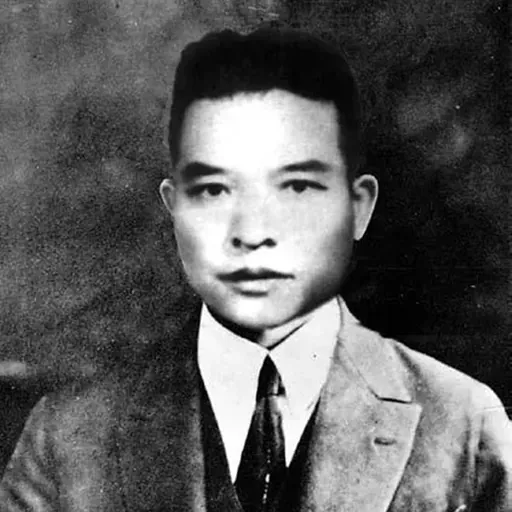
About Kim Won-bong
Lived 1898 – 1958 (aged 59–60). Kim Won-bong was a North Korean politician.
Kim Wŏnbong (; 1898 – ), also known by his art name Yaksan , was a Korean independence activist, anarchist militant and politician. In 1919, Kim established the Heroic Corps, an anarchist group which carried out a six-year campaign of attacks against Japanese officials. In 1935, he established the Korean National Revolutionary Party, which formed part of a united front with other Korean radical groups, and commanded its military detachment, the Korean Volunteer Corps. After the liberation of Korea, he initially moved to South Korea, but defected to North Korea after receiving death threats from members of the Syngman Rhee government. He then served in the 1st Cabinet of North Korea as head of the and . After the Korean War, the North Korean government accused him of subversive activities and purged him.
Biography Early life Kim Wŏnbong was born in 1898, in Miryang, in the South Gyeongsang Province of the Korean Empire. He was born to father Kim Chu-ik and mother Yi Kyŏng-nyŏm and into the Gimhae Kim clan. In his youth, he studied at a seodang, a traditional Korean school. In 1908, he enrolled in a modern-style school. In 1910, he attended the Donghwa Middle School . In 1913, he attended a school in Seoul. In 1916, he was in China, learning the German language. In 1918, he enrolled in the University of Nanking. In February 1919, he entered the Sinhŭng Military Academy and underwent military education for six months, after which he dropped out of the academy.
Militant activism Kim moved to Manchuria, where he established the Heroic Corps in December 1919. The group sought the destruction of the Empire of Japan and the independence of Korea. Inspired by the political philosophy of anarchism, Kim led six years of armed resistance against Japan. During this period, the group out a number of terrorist attacks, including assassinations of Japanese officials and attacks on military bases. In January 1923, Kim and fellow Heroic Corps member influenced Sin Ch'aeho's conversion to anarchism when they convinced him to write his "Declaration of the Korean Revolution".
By the 1930s, Kim's group was collaborating with the Chinese Nationalist government, which gave them military training and political education. Over the course of the 1930s, Kim's political outlook moved towards socialism. In 1935, Kim established the Korean National Revolutionary Party (KNRP), which largely distributed anti-Japanese propaganda. During this time, Kim's anarchist communist faction of the Korean independence movement began to clash with Kim Ku's right-wing nationalist faction.
On 12 November 1937, Kim met with Yu Ja-meyong and to discuss the formation of a united front with other radical organisations, including Yu's anarchist League of Korean Revolutionaries and Kim Seongsuk's Marxist Alliance for Korean National Liberation Movement. In December 1937, they established the League for the Korean National Front (LKNF). In 1938, Kim Wŏnbong was appointed as commander-in-chief of its military branch, the Korean Volunteer Corps (KVC), which later merged together with other pro-independence forces, forming the Korean Liberation Army.
Political career Following the liberation of Korea, Kim moved back to South Korea (then under United States occupation) and threw his support behind Syngman Rhee's government. He had initially decided against moving to the Soviet-occupied north, due to his opposition to orthodox Stalinism. But when right-wing and collaborationist elements in Rhee's government began to threaten Kim's life, in April 1948, he decided to defect to North Korea out of self-preservation. There he joined the Workers' Party of North Korea and became a close collaborator of Kim Il Sung, helping to establish the country's communist government.
Kim was elected to the 1st Supreme People's Assembly, and served as its first Vice Chairman. He also served in the cabinet as head of the and , and as a commanding officer in the Korean People's Army. In 1950, Kim collaborated in the invasion of South Korea, which began the Korean War; after the war, Kim Il Sung awarded him with the ". By this time, Kim had adjusted his anarchist political philosophy to fit in with the state's prevailing ideology of Marxism-Leninism. In a 1955 article for Kulloja, Kim wrote of the importance of persuasion and education in the establishment of a new society in North Korea. He emphasised that the wellbeing of the working class ought to be a central consideration for the ruling Workers' Party, which he believed should build its new society in accordance with the will of the masses.
During the mid-1950s, debates flared up within the party around de-Stalinization and Kim Il Sung's cult of personality, during which Kim Wŏnbong had allegedly expressed concern about the building of a one-party state in North Korea. He became a target for a subsequent purge of elements perceived as hostile to the leader's consolidation of power. In a report to the Soviet embassy on 17 November 1958, the party leadership announced that Kim Wŏnbong had been purged, claiming he was an agent of the United States and that he had attempted to support the UN offensive into North Korea.
In March 1959, an article allegedly written by Kim was published in Kulloja, in which he praised the Central Committee of the Workers' Party of Korea and its "Great Leader" for improving the country's transportation infrastructure. Following this article's publication, his name disappeared from the public record.
Legacy Historian Benjamin Young noted Kim Wŏnbong as an example of Korean anarchists, who did not fit neatly into the communist ideological box, who had fled political repression in South Korea. South Korean historians have conducted scant research into the defection of anarchists – including Kim Wŏnbong, Ri Kiyŏng and Hong Myong-hui – to North Korea. Kim remains a controversial figure in South Korea due to his defection to the North, although he has been celebrated by some South Koreans for his struggle against the Empire of Japan. During a speech for Memorial Day, on 6 June 2019, South Korean president Moon Jae-in paid tribute to Kim and other anarchist leaders of the Korean independence movement. This drew criticism from South Korean conservatives, who viewed Kim as a traitor.
Don’t just read it —
keep it.
Full-length biographies made to live with: read them, listen on the way to work, watch them tonight.
- E-book
- Audio
- Video
Instant download · yours to keep · every purchase keeps this site free
Important facts
People in Kim Won-bong's life
Named in this biography and alive at the same time



Related people
Same field, nearest in time




Contemporaries
People whose lives overlapped Kim Won-bong's



Frequently asked questions
Who was Kim Won-bong?
Korean anarchist (1898–c. 1958)
When was Kim Won-bong born?
Kim Won-bong was born on 13 August 1898 in Miryang.
When did Kim Won-bong die?
Kim Won-bong died in 1958 in Pyongyang.
What was Kim Won-bong's occupation?
Kim Won-bong was a politician.
What nationality was Kim Won-bong?
Kim Won-bong was North Korean.
Sources & further reading
Cite this page
APA: Biography.guide. (2026). Kim Won-bong. https://biography.guide/kim-won-bong/
MLA: "Kim Won-bong." Biography.guide, https://biography.guide/kim-won-bong/.
Chicago: "Kim Won-bong." Biography.guide. https://biography.guide/kim-won-bong/.
Data last updated: 2026-09-22 · Spot an error? Report a correction.
Portrait: Wikimedia Commons · author & licence
Page generated 2026-09-27 05:04 UTC