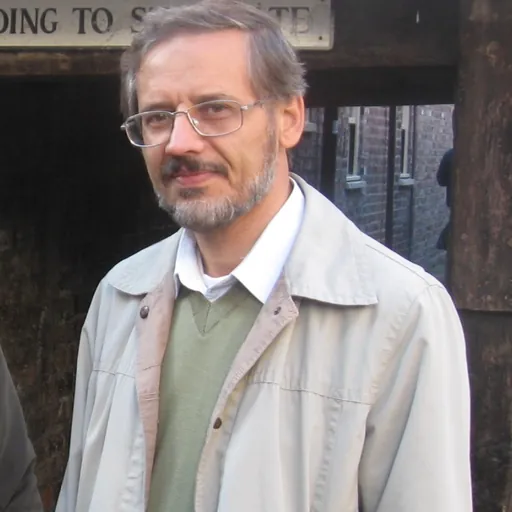
About Khosrow Bagheri
Born 1957. Khosrow Bagheri is an Iranian philosopher, translator, university teacher and pedagogue.
Khosrow Bagheri Noaparast (in Persian: خسرو باقری نوع پرست) is an Iranian philosopher, educational theorist and the president of Philosophy of Education Society of Iran (PESI).
Biography Bagheri was born in 1957 in Tehran. He took his Ph.D. degree from the University of New South Wales, Australia, in 1994. He is Professor of Philosophy of Education at the University of Tehran. He has made contributions to a wide range of topics in philosophy of education, Religion and personal construct psychology; topics from different viewpoints, such as constructive realism, neo-Pragmatism, action theory, deconstruction, Hermeneutics, and Islamic philosophy of education. In 2011 he was awarded First order Medal of Research (The Distinguished Researcher) by the University of Tehran.
Philosophical views Religious education In his book Islamic Education he places human agency as the main educational thesis of Islam. This is while before him scholars such as Mutahari believed in human nature as the center of Islamic education. He opposes nature as a central key to Islamic education claiming that human beings are not composed of non-living matter to be fabricated into a human being. Instead a human is a dynamic creature who should choose being religious. In this regard he has introduced abstinence by presence. While most scholars have insisted that religion is about preventing sinful situations Bagheri insists that real education leads to presence in a sinful situation and yet remain intact.
Personal construct theory He argues that in George Kelly's personal construct psychology a combination of correspondence theory of truth and a coherence theory of truth is necessary. Offering criteria for a reconciliation of correspondence and coherence theories he argues that constructivism should be based on a reality and the effort is to search for an optimal point where reality and constructs reach each other.
Religious science Most Classic Islamic Philosophers followed or concurred with Aristotle in understanding knowledge as grasping the form of a thing. This was possible in two ways, one by divine inspiration (which might be called intuition), or by sensory apprehension. They did not question, as many philosophers do today, whether sensory information was reliable. Either of these perspectives or a combination of them has led some to conclude that a science based on religion can lead to infallible knowledge. However, Bagheri argues that a religious science is only possible through interference of religious elements in the presupposition of a theory and hence will remain a science tout court, and its religious presuppositions will not guarantee infallible knowledge.
Publications A non-comprehensive list of Bagheri's published works include: In English
In Persian
Translations Bagheri has translated the following books into Persian:
Don’t just read it —
keep it.
Full-length biographies made to live with: read them, listen on the way to work, watch them tonight.
- E-book
- Audio
- Video
Instant download · yours to keep · every purchase keeps this site free
Important facts
People in Khosrow Bagheri's life
Named in this biography and alive at the same time


Related people
Same field, nearest in time


Contemporaries
People whose lives overlapped Khosrow Bagheri's
Frequently asked questions
Who is Khosrow Bagheri?
Iranian philosopher of education
When was Khosrow Bagheri born?
Khosrow Bagheri was born in 1957 in Tehran.
What is Khosrow Bagheri's occupation?
Khosrow Bagheri is a philosopher, translator, university teacher and pedagogue.
What nationality is Khosrow Bagheri?
Khosrow Bagheri is Iranian.
Sources & further reading
Cite this page
APA: Biography.guide. (2026). Khosrow Bagheri. https://biography.guide/khosrow-bagheri/
MLA: "Khosrow Bagheri." Biography.guide, https://biography.guide/khosrow-bagheri/.
Chicago: "Khosrow Bagheri." Biography.guide. https://biography.guide/khosrow-bagheri/.
Data last updated: 2026-09-23 · Spot an error? Report a correction.
Portrait: Wikimedia Commons · author & licence
Page generated 2026-09-27 05:06 UTC