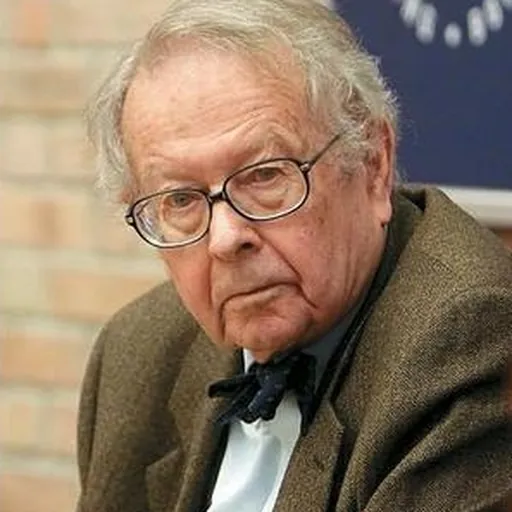
Kenneth Waltz
American political scientist and international relations theoretician
About Kenneth Waltz
Lived 1924 – 2013 (aged 88). Kenneth Waltz was an American university teacher, political scientist, philosopher and politician.
Kenneth Neal Waltz (; June 8, 1924 – May 12, 2013 ) was an American political scientist who was a member of the faculty at both the University of California, Berkeley, and Columbia University and one of the most prominent scholars in the field of international relations. He was a veteran of both World War II and the Korean War.
Waltz was one of the original founders of neorealism, or structural realism, in international relations theory and later became associated with the school of defensive neorealism. Waltz's theories have been extensively debated within the field of international relations. His 1979 book Theory of International Politics is the most assigned book in International Relations graduate training at U.S. universities.
Early life, education, and military service Waltz was born on June 8, 1924, in Ann Arbor, Michigan, Waltz served in the Pacific theater of the war, rising in rank from private to 1st lieutenant, and was stationed in Japan during the U.S. occupation.
He graduated from Oberlin with an A.B. degree in 1948, He received his M.A. degree from there in 1950.
Waltz retired from his position at Berkeley and returned to Columbia University in 1997.
Levels of analysis Waltz's initial contribution to the field of international relations was his influential 1959 book, Man, the State, and War. It classified theories of the causes of war into three categories, or levels of analysis. He referred to those levels of analysis as "images" and used the writings of one or more classic political philosophers to outline the major points of each image. Each image was given two chapters: the first used the classical philosopher's writings mainly to describe what that image says about the cause of war, and the second usually had Waltz analyze the strengths and weaknesses of that image. Waltz's wife was essential in contributing the research that became the basis for the book.
The first image argued that wars are often caused by the nature of particular statesmen and political leaders such as state leaders, like Napoleon, or by human nature more generally. That is basically consistent with classical realism, which then dominated the international relations discipline, but Waltz would contest it more fully in his next book, Theory of International Politics.
Theories of war that fall under the rubric of Waltz's second image contended that wars are caused by the domestic makeup of states. A prime example that Waltz referred to is Lenin's theory of imperialism, which posits that the main cause of war is rooted in the need for capitalist states to continue opening up new markets in order to perpetuate their economic system at home. Today, a more familiar example in the Western world is the notion that nondemocratic states, because of their internal composition, start wars.
Waltz next assessed the first two images as being less influential in general than the third image but as ultimately necessary in understanding the causes of war. The third image posits that the cause of war is found at the systemic level and the anarchic structure of the international system is the root cause of war. In that context, "anarchy" was defined not as a condition of chaos or disorder but one in which no sovereign body governs the interactions between autonomous nation-states. In other words, in domestic society, citizens can theoretically rely on law enforcement agencies to protect their persons and property, but if a state is invaded and calls "9-1-1," it cannot be sure that anyone will answer.
Similarly, when two citizens have a dispute, they can appeal to the courts to render a verdict and, more importantly, the law enforcement agencies to enforce the court's ruling. However, there is no body above nation-states that can establish rules or laws for all the states, decide how they apply in specific cases, and compel the states to honor the court's ruling. As a result, if an issue at stake is important enough to a state, it can achieve a satisfactory outcome only by using its power to impose its will on another state(s). The realization that any state can resort to armed force anytime forces each state to be always prepared for that contingency.
Those themes were fleshed out more fully in Theory of International Politics, which, as the title suggests, explained a theory for international politics as a whole, rather than the narrower focus on what causes war.
Neorealism
Waltz's key contribution to the realm of political science is in the creation of neorealism (or structural realism, as he calls it), a theory of international relations that posits that the interaction of sovereign states can be explained by the pressures exerted on them by the anarchic structure of the international system, which limits and constrains their choices. Neorealism thus aims to explain recurring patterns in international relations, such as why relations between Sparta and Athens resembled those between the United States and the Soviet Union in some important ways.
Waltz emphasizes repeatedly in the book and elsewhere that he is not creating a theory of foreign policy, which aims to explain the behavior or actions of a particular state at a specific time or throughout a period. For Waltz, neorealism is divided into two branches: defensive and offensive neorealism. Although both branches agree that the structure of the system is what causes states to compete for power, defensive realism posits that most states seek a status quo and limit themselves to concentrate on maintaining the balance of power. Revisionist states are said to be the only states that seek to alter the balance. Offensive neorealism, in contrast to Waltz, asserts that nations seek local hegemony over neighboring states to assert authority in local relations with rival states.
Waltz argues that contemporary geopolitics exists in a state of international affairs comparable to that of perpetual international anarchy. He distinguishes the anarchy of the international environment from the order of the domestic one. In the domestic realm, all actors may appeal to and be compelled by a central authority, "the state" or "the government," but in the international realm, no such source of order exists. The anarchy of international politics, with its lack of a central enforcer, means that states must act in a way that ensures their security above all, or they otherwise risk falling behind. He wrote that this international anarchy is a fundamental fact of political life faced by democracies and dictatorships alike. Except in rare cases, they cannot count on the good will of others to help them and so they must always be ready to fend for themselves. Waltz's usage of the term "anarchy" led to a fundamental discursive transformation in international relations, as scholars wrestled with Waltz's ideas. A 2015 study by Jack Donnelly found that the term "anarchy" occurred on average 6.9 times in international relations books prior to 1979 but 35.5 times in those afterward.
Like most other neorealists, Waltz accepted that globalization poses new challenges to states, but he did not believe that states are being replaced because no other non-state actor can equal the capabilities of the state. Waltz suggested that globalization is a fad of the 1990s, and if anything, the role of the state has expanded its functions in response to global transformations.
Neorealism was Waltz's response to what he saw as the deficiencies of classical realism. Although both terms are sometimes used interchangeably, neorealism and realism have a number of fundamental differences. The main distinction between the two theories is that classical realism puts human nature, or the urge to dominate, at the center of its explanation for war, but neorealism stakes a reduced claim on human nature and argues instead that the pressures of anarchy tend to shape outcomes more directly than the human nature of statesmen and diplomats or domestic governmental preferences.
Waltz's theory, as he explicitly states in Theory of International Politics, is not a theory of foreign policy and does not attempt to predict specific state actions, such as the collapse of the Soviet Union. The theory explains only general principles of behavior that govern relations between states in an anarchic international system, rather than specific actions. The recurring principles of behavior include balancing of power (the theory was refined by Stephen Walt, who modified the "balance of power" concept to "balance of threat"), entering individually-competitive arms races, and exercising restraint in proportion to relative power. In Theory of International Politics (1979:6) Waltz suggested that explanation, rather than prediction, is expected from a good social science theory since social scientists cannot run the controlled experiments that give the natural sciences so much predictive power.
As a teacher, Waltz trained numerous prominent international relations scholars, including Stephen Walt, Barry Posen, Stephen Van Evera, Bob Powell, Avery Goldstein, Christopher Layne, Benny Miller, Karen Adams, Shibley Telhami, James Fearon, William Rose, Robert Gallucci, and Andrew Hanami. He influenced Robert Jervis and Robert Art.
Columbia University colleague Robert Jervis has said of Waltz, "Almost everything he has written challenges the consensus that prevailed at the time" He argued that nuclear proliferation was desirable. He received the James Madison Award for "distinguished scholarly contributions to political science" from the American Political Science Association in 1999.
Don’t just read it —
keep it.
Full-length biographies made to live with: read them, listen on the way to work, watch them tonight.
- E-book
- Audio
- Video
Instant download · yours to keep · every purchase keeps this site free
Important facts
People in Kenneth Waltz's life
Named in this biography and alive at the same time






Related people
Same field, nearest in time



Contemporaries
People whose lives overlapped Kenneth Waltz's

Frequently asked questions
Who was Kenneth Waltz?
American political scientist and international relations theoretician (1924-2013)
When was Kenneth Waltz born?
Kenneth Waltz was born on 8 June 1924 in Ann Arbor.
When did Kenneth Waltz die?
Kenneth Waltz died on 12 May 2013 in Washington, D.C..
What was Kenneth Waltz's occupation?
Kenneth Waltz was a university teacher, political scientist, philosopher and politician.
What nationality was Kenneth Waltz?
Kenneth Waltz was American.
Sources & further reading
Cite this page
APA: Biography.guide. (2026). Kenneth Waltz. https://biography.guide/kenneth-waltz/
MLA: "Kenneth Waltz." Biography.guide, https://biography.guide/kenneth-waltz/.
Chicago: "Kenneth Waltz." Biography.guide. https://biography.guide/kenneth-waltz/.
Data last updated: 2026-09-21 · Spot an error? Report a correction.
Portrait: Wikimedia Commons · author & licence
Page generated 2026-09-27 04:59 UTC