
About Ken Strong
Lived 1906 – 1979 (aged 73). Ken Strong was an American baseball player and american football player.
Elmer Kenneth Strong (April 21, 1906 – October 5, 1979) was an American professional football player who was a halfback and fullback. He also played minor league baseball. Considered one of the greatest all-around players in the early decades of the game, he was inducted into the College Football Hall of Fame in 1957 and the Pro Football Hall of Fame in 1967 and was named to the NFL 1930s All-Decade Team.
A native of West Haven, Connecticut, Strong played college baseball and football for the NYU Violets. In football, he led the country in scoring with 162 points in 1928, gained over 3,000 yards from scrimmage, and was a consensus first-team selection on the 1928 College Football All-America Team.
Strong played professional football in the National Football League (NFL) for the Staten Island Stapletons (1929–1932) and New York Giants (1933–1935, 1939, 1944–1947), and in the second American Football League (AFL) for the New York Yankees (1936–1937). He led the NFL in scoring in 1934 and was selected as a first-team All-Pro in 1930, 1931, 1933, and 1934. He also played minor league baseball from 1929 to 1931, but his baseball career was cut short by a wrist injury.
Early life Strong was born in the Savin Rock section of West Haven, Connecticut, in 1906. His father Elmer F. Strong was a Connecticut native who worked as an egg and dairy inspector. Strong attended West Haven High School where he was a star baseball and football player. that powered the Hyannis lineup.
As a halfback for the 1928 NYU Violets football team, he led the country in scoring with 162 points, and was a consensus pick on the 1928 College Football All-America Team.
Strong gained widespread fame when he led NYU to a 27–13 upset victory over undefeated Carnegie Tech. He threw two long touchdown passes, rushed for two touchdowns, and kicked three extra points, leading Grantland Rice to write:
This attack was led by a runaway buffalo, using the speed of a deer, and his name was Ken Strong. He ran all over a big, powerful team, smashed its line, ran its ends, kicked 50 and 55 yards, threw passes and tackled all over the lot. Today he was George Gipp, Red Grange and Chris Cagle rolled into one human form and there was nothing Carnegie Tech had that could stop his march.
Carnegie Tech coach Walter Steffen said of Strong's performance: "This is the first time in my career that one man was good enough to run over and completely wreck an exceptionally good team. I can tell you he is better than Heston or Thorpe." He also had a 70-yard run in a scoreless tie with the Orange Tornadoes on November 3, 1929. Two days later, Strong had a 50-yard touchdown run against the Providence Steam Roller. At the end of the 1929 season, Strong was selected by Collyer's Eye and the Green Bay Press-Gazette as a second-team All-Pro. In December 1930, he led the Stapletons to a 16–7 victory over the New York Giants for the pro football championship of New York City; Strong accounted for all 16 Stapleton points, running 98 yards for a touchdown, passing for a second touchdown, and kicking a field goal and an extra point. He was selected as a first-team player on the 1930 All-Pro Team by Collyer's Eye and the Green Bay Press-Gazette. At the end of the 1931 season, Strong was selected as an All-Pro for the second year in a row, receiving first-team honors from the United Press (UP) and Collyer's Eye. Strong received first-team All-Pro honors in 1934 from the NFL and others. Slowed by injury in 1935, he was described as "a celebrated invalid" who "hobbled" from the bench to kick a field goal for the Giants in a 3–0 victory over the Bears on November 17. In the 1935 NFL Championship Game, a 26–7 loss to the Detroit Lions, Strong scored all of the Giants' points on a long touchdown catch and run and the extra point.
New York Yankees In August 1936, Strong signed with the New York Yankees of the newly formed second American Football League. Strong's departure from the NFL was the new league's first raid on the NFL. Strong later recalled that Giants owner Jack Mara wanted Strong to accept a pay cut from $6,000 to $3,200; the Yankees agreed to pay him $5,000.
During the 1936 season, Strong earned a reputation as "the best blocker in the game." He also: kicked a field goal and two extra points in a 17–6 victory over Brooklyn on October 14; scored a touchdown and kicked the extra point in a 7–6 victory over Pittsburgh on October 21; and kicked three field goals in a 15–7 win over Cleveland on November 23.
Strong returned to the Yankees in 1937. However, he left the team after three games to assist Mal Stevens in coaching the NYU Violets football team.
Jersey City Giants In 1938, Strong was a player and head coach for the Jersey City Giants, the New York Giants' farm team in the American Association. He was barred from playing in the NFL because of his decision to jump to the American Football League in 1936. Tim Mara, owner of the Giants, reportedly negotiated a deal with Strong to play for Jersey City in exchange for which Mara would seek Strong's reinstatement in 1939. He kicked 13 field goals, scored 51 points, and was named to the all-league team.
Return to the New York Giants Strong returned to the New York Giants in 1939. He appeared in nine games and scored 19 points on four field goals and seven extra points.
In the summer of 1940, Strong became ill with stomach ulcers, underwent emergency surgery, and was hospitalized for four weeks. He said that he intended to return to playing when his health permitted.
He came out of retirement in 1942 to play for the Long Island Clippers, scoring 12 points in four games. He helped lead the team to the 1944 NFL Championship Game, scoring 41 points on six field goals and 23 extra points.
Overview and honors
In 12 seasons in the NFL, Strong received first-team All-Pro honors four times (1930, 1931, 1933, and 1934) and scored 520 career points (including 36 points in the post-season) on 38 touchdowns, 39 field goals, and 175 extra points.
Walter Steffen, also a member of the College Football Hall of Fame, said: "I'll tell you he is easily the greatest football player I ever saw – and I've been around over twenty-five years ... I can tell you honestly that since 1905 I've never seen a football player in his class for all-around stuff."
Harry Grayson wrote: "An amazing runner, blocker, passer, kicker, and defensive man, Strong was, in the opinion of many who saw him, the greatest football player of them all." Grayson later called Strong "a runaway buffalo with the speed of an antelope."
Strong received numerous honors for his football career, including the following: In 1950, he was one of the 25 charter inductees into the Helms Athletic Foundation's Professional Football Hall of Fame. In 1957, he was inducted into the College Football Hall of Fame. In 1967, he was inducted into the Pro Football Hall of Fame. Prior to 1968, Strong's jersey number (No. 50) was retired by the New York Giants. He was among the first four Giants (along with Mel Hein, Y. A. Tittle and Al Blozis) to be so honored. In 1969, he was named to the NFL 1930s All-Decade Team. In 1971, he was inducted into the NYU Athletics Hall of Fame. In 2010, he was one of the 22 players included in the New York Giants Ring of Honor at MetLife Stadium.
Baseball Strong also played professional baseball for several years. He was signed by the New York Yankees before graduating from NYU and spent the summer of 1929 with the New Haven Profs of the Eastern League. He was an outfielder for New Haven, appearing in 104 games and compiling a .283 batting average with 21 home runs and 43 extra-base hits.
Strong began the 1930 season with New Haven. In mid-May, he joined the Hazleton Mountaineers of the New York–Pennsylvania League, appearing in 117 games and compiling a .373 batting average with 41 home runs (a league record), and 88 extra-base hits.
In 1931, Strong moved up to AA ball with the Toronto Maple Leafs of the International League. He appeared in 118 games with Toronto and compiled a .340 batting average with 53 extra-base hits. In July 1933, Strong won a $75,000 jury verdict in a lawsuit against the surgeon who removed the wrong bone. The verdict was later reversed on appeal. The marriage was "stormy", short-lived, and ended in divorce. Strong and his second wife remained married for nearly 48 years and had a son, Kenneth Robert Strong, born in approximately 1932.
Strong had a history of heart problems and died of a heart attack in 1979 at age 73.
Television On February 19, 1957, Strong made an appearance on the game show To Tell the Truth. He was contestant number 3 claiming to be Tommy Loughran, a former boxer.
Don’t just read it —
keep it.
Full-length biographies made to live with: read them, listen on the way to work, watch them tonight.
- E-book
- Audio
- Video
Instant download · yours to keep · every purchase keeps this site free
Important facts
People in Ken Strong's life
Named in this biography and alive at the same time


Related people
Same field, nearest in time

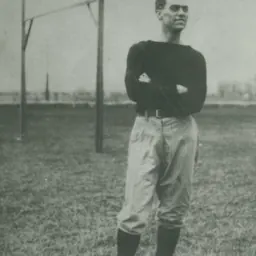
Contemporaries
People whose lives overlapped Ken Strong's


Frequently asked questions
Who was Ken Strong?
American football player (1906-1979)
When was Ken Strong born?
Ken Strong was born on 21 April 1906 in West Haven.
When did Ken Strong die?
Ken Strong died on 5 October 1979 in New York City.
What was Ken Strong's occupation?
Ken Strong was a baseball player and american football player.
What nationality was Ken Strong?
Ken Strong was American.
Sources & further reading
Cite this page
APA: Biography.guide. (2026). Ken Strong. https://biography.guide/ken-strong-baseball-player/
MLA: "Ken Strong." Biography.guide, https://biography.guide/ken-strong-baseball-player/.
Chicago: "Ken Strong." Biography.guide. https://biography.guide/ken-strong-baseball-player/.
Data last updated: 2026-09-20 · Spot an error? Report a correction.
Page generated 2026-09-27 05:19 UTC