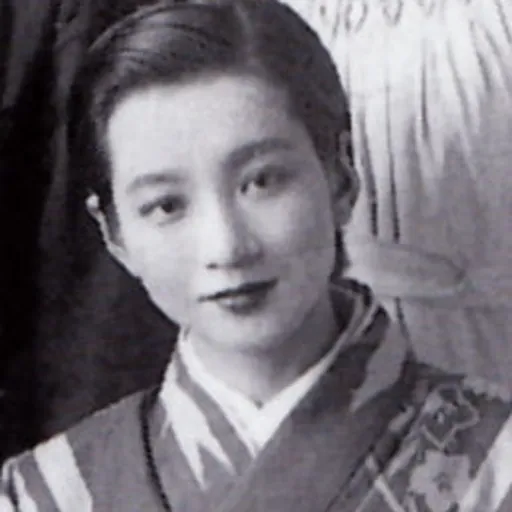
About Keiko Sonoi
Lived 1913 – 1945 (aged 32). Keiko Sonoi was a Japanese actor.
Takarazuka Revue
In 1930, she became second-year student (yoka-sei ) and was now a performing member of the . making the stage debut in Haru no odori in April. She changed her stage name later that year to Keiko Sonoko.
Typecasting Sonoi is touted for her fine supporting role acting (waki-yaku) in this karuta card mock-up. , December 1937.
She became recognized as a skilled and versatile supporting actress, especially in comedic roles. Her close colleagues Hisako Sakura and recalled that she excelled in her role as Frédéri's mother in , which was the Takarazuka adaptation of L'Arlésienne.Refn|. Including Ashihara interview.
Playing outside repertoires Stage scene from Wagaya no kōfuku (1942). Left to right: , Sonoi, Roppa Furukawa.
In January 1941, Sonoi and Toho Studio movie star Hideko Takamine made guest appearances in theatrical productions by comedian Roppa Furukawa's company in Tokyo.Refn|group="lower-alpha"|At the theater, According to some sources, Sonoi was specially picked out by playwright who wrote for Roppa's troupe; Kikuta had already regarded Sonoi as a promising talent and insisted she be cast in his Sekijūji-ki wa sususmu at Takarazuka in 1940.
The Takarazuka Revue tried to retain her by offering her terms that would allow her some leeway to perform in film or shingeki theater, but the compensation and performing restrictions they offered were unsatisfactory, according to her correspondence to Shizu Nakai.
Film role in Matsu Sonoi in a still shot from Muhōmatsu no isshō (1943). With Tsumasaburo Bando as Matsu. The child was played by Hiroyuki Nagato.
In 1943, Sonoi was cast opposite top leading actor Tsumasaburō Bandō in , where she played Mrs. Yoshioka, whom Muhōmatsu (or Matsu the Untamed, played by Bandō) becomes romantically but unrequitedly attached to. The film became a box office hit.
The child actor billed as Akio Sawamura (actor Hiroyuki Nagato of later years) said he earnestly wished he could marry a woman like Sonoi.
Sakura-tai unit (Formally still Kuraku-za's mobile unit). At Fuji Film's Ashikaga Plant where they performed January 1945. Front row, left to right: Tsuyako Shimaki , Keiko Sonoi, Yasushi Nagata, X, , X. Middle row: Midori Naka, (stage director), Jun Tatara, 、, Junko[?] Emori . Left row: , X, Ichiro Tetsu (acting coach), Yoshio Endo (lighting), Miezō Mizutani (prop manager), Kohei Hijikata (stage effects), X.
The mobile troupe was only able to do a grand tour briefly, from January to March 1945, travelling to parts of the Kanto area and then Hiroshima. In Kanto they mainly visited manufacturing plant workers, but in Hiroshima they "comfort-visited" wounded soldiers as well. The Nihon Ido Engeki Renmei ( Japan Touring Theatre League) then instructed all troupes to cease touring city by city, and perform in the confines of an evacuation (sokai) area. It was decided Kuraku-za would be assigned to stay in Hiroshima or its vicinity.
Hiroshima
The choice of Hiroshima as their evacuation zone was a source of consternation for members, because the city remained relatively unscathed despite its military strategic importance, and a major strike was thought imminent. Sonoi wrote in April stating that she tried to refuse going to Hiroshima and remain in Tokyo (which had been incinerated in the March bombing), but was pressured to change her mind. Also while she was still at Tokyo, she went to the Toho Studio office asking if there were any film roles for her, which she wanted to take to extricate herself from touring under heavy bombardment. In fact director Kajirō Yamamoto was hoping to cast her in his new film (Kaidanji) but the office replied no, and she had left.
Matsuo village In 1989 her birthplace Matsuo, Iwate commemorated the centennial of the founding of the village by holding an exhibit of Sonoi's belongings and related printed paraphernalia, publishing a scrapbook compilation entitled Shiryōshū .
Don’t just read it —
keep it.
Full-length biographies made to live with: read them, listen on the way to work, watch them tonight.
- E-book
- Audio
- Video
Instant download · yours to keep · every purchase keeps this site free
Important facts
People in Keiko Sonoi's life
Named in this biography and alive at the same time





Related people
Same field, nearest in time



Contemporaries
People whose lives overlapped Keiko Sonoi's




Frequently asked questions
Who was Keiko Sonoi?
Japanese actress
When was Keiko Sonoi born?
Keiko Sonoi was born on 6 August 1913 in Matsuo.
When did Keiko Sonoi die?
Keiko Sonoi died on 21 August 1945 in Ashiya.
What was Keiko Sonoi's occupation?
Keiko Sonoi was an actor.
What nationality was Keiko Sonoi?
Keiko Sonoi was Japanese.
Sources & further reading
Cite this page
APA: Biography.guide. (2026). Keiko Sonoi. https://biography.guide/keiko-sonoi/
MLA: "Keiko Sonoi." Biography.guide, https://biography.guide/keiko-sonoi/.
Chicago: "Keiko Sonoi." Biography.guide. https://biography.guide/keiko-sonoi/.
Data last updated: 2026-09-22 · Spot an error? Report a correction.
Portrait: Wikimedia Commons · author & licence
Page generated 2026-09-27 05:02 UTC