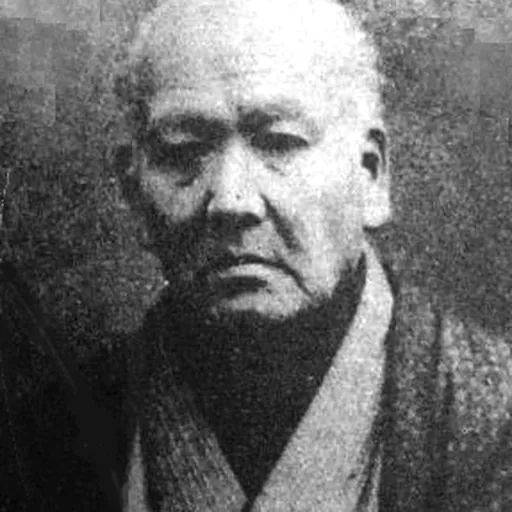
About Kawatake Mokuami
Lived 1816 – 1893 (aged 76). Kawatake Mokuami was a Japanese writer, screenwriter, playwright, actor and kabuki.
, born was a Japanese dramatist of Kabuki. It has been said that "as a writer of plays of Kabuki origin, he was one of the greatest, if not the greatest, Japan has ever known". He wrote 150 or so plays over the course of his 58-year career, covering a wide variety of themes, styles, and forms, including short dance pieces, period plays (jidaimono), contemporary genre pieces (sewamono), tragedies and comedies, as well as adaptations of foreign (Western) stories, though he is perhaps most famous for his shiranamimono, plays featuring sympathetic or tragic rogues and thieves. For the greater part of his career he wrote under the professional name Kawatake Shinshichi, only taking the name Mokuami on his retirement from the stage in 1881.
Life and career Mokuami was born in the Nihonbashi district of Edo (modern-day Tokyo). He was disinherited by his father at age fourteen, and obtained work at a lending library, introducing him to the world of theatre. In 1835, he entered into an apprenticeship with Tsuruya Nanboku IV, and in 1843 became the lead playwright (tate-sakusha) for the Kawarazaki-za theatre, succeeding to the name Kawatake Shinshichi II. He began working with kabuki star Ichikawa Kodanji IV in 1854, producing kizewamono pieces. ). Mokuami formally retired in 1881, but continued to present new works, and was spoken highly of by novelist and literary critic Tsubouchi Shōyō. Mokuami died in 1893 and is buried at Gentsū-ji in Nakano, Tokyo.
Selected works
Izayoi Seishin (1859) Sannin Kichisa Kuruwa no Hatsugai (1860) Murai Chōan (1862) Benten Kozō aka Shiranami Gonin Otoko (1862) Marubashi Chūya aka Keian Taiheiki (1870) Renjishi (Two Lions) (1872) Sakai no Taiko (Sakai's Drum) (1873) Kamiyui Shinza (Shinza the Barber) (1873) Ningen Banji Kane Yono Naka (Everything in the World is Run by Money) (1878), an adaptation of Money (play) by Edward_Bulwer-Lytton Kumo ni Magō Ueno no Hatsuhana (1881) Tsuchigumo (1881) Ibaraki (The Demon Ibaraki) (1883) Funa Benkei (1885) Momijigari (1887)
Don’t just read it —
keep it.
Full-length biographies made to live with: read them, listen on the way to work, watch them tonight.
- E-book
- Audio
- Video
Instant download · yours to keep · every purchase keeps this site free
Important facts
People in Kawatake Mokuami's life
Named in this biography and alive at the same time

Related people
Same field, nearest in time

Contemporaries
People whose lives overlapped Kawatake Mokuami's





Frequently asked questions
Who was Kawatake Mokuami?
Japanese dramatist of Kabuki (1816–1893)
When was Kawatake Mokuami born?
Kawatake Mokuami was born on 1 March 1816 in Tokyo.
When did Kawatake Mokuami die?
Kawatake Mokuami died on 22 January 1893 in Tokyo.
What was Kawatake Mokuami's occupation?
Kawatake Mokuami was a writer, screenwriter, playwright, actor and kabuki.
What nationality was Kawatake Mokuami?
Kawatake Mokuami was Japanese.
Sources & further reading
Cite this page
APA: Biography.guide. (2026). Kawatake Mokuami. https://biography.guide/kawatake-mokuami/
MLA: "Kawatake Mokuami." Biography.guide, https://biography.guide/kawatake-mokuami/.
Chicago: "Kawatake Mokuami." Biography.guide. https://biography.guide/kawatake-mokuami/.
Data last updated: 2026-09-20 · Spot an error? Report a correction.
Page generated 2026-09-27 05:10 UTC