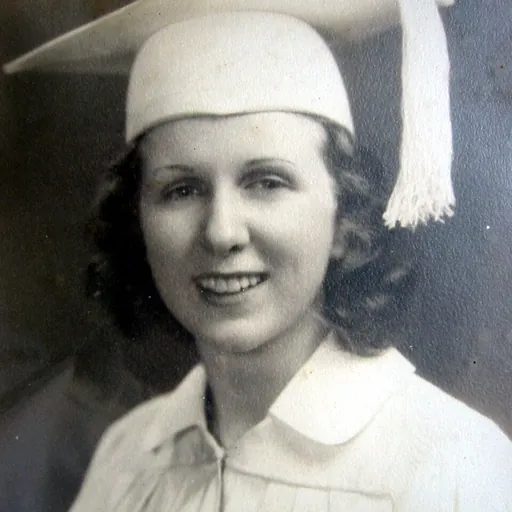
About Kathleen Antonelli
Lived 1921 – 2006 (aged 85). Kathleen Antonelli was an American and Irish programmer, mathematician and computer scientist, known for ENIAC.
Kathleen Rita Antonelli ( McNulty; formerly Mauchly; 12 February 1921 – 20 April 2006), known as Kay McNulty, was an Irish computer programmer and one of the six original programmers of the ENIAC, one of the first general-purpose electronic digital computers. The other five ENIAC programmers were Betty Holberton, Ruth Teitelbaum, Frances Spence, Marlyn Meltzer, and Jean Bartik.
Early life and education
She was born Kathleen Rita McNulty in Feymore, part of the small village of Creeslough in what was then a Gaeltacht area (Irish-speaking region) of County Donegal in Ulster, the northern province in Ireland, on February 12, 1921, during the Irish War of Independence. She was the third of six children of James and Anne (née Nelis) McNulty. On the night of her birth, her father, an Irish Republican Army training officer, was arrested and imprisoned in Derry Gaol for two years as he was a suspected member of the IRA. On his release, the family emigrated to the United States in October 1924 and settled in the Chestnut Hill section of Philadelphia, Pennsylvania, where he found work as a stonemason. At the time, Kathleen McNulty was unable to speak any English, only Irish; she would remember prayers in Irish for the rest of her life.
She attended parochial grade school in Chestnut Hill (1927–1933) and J. W. Hallahan Catholic Girls High School (1933–1938) in Philadelphia. In high school, she had taken a year of algebra, a year of plane geometry, a second year of algebra, and a year of trigonometry and solid geometry. After graduating high school, she enrolled in Chestnut Hill College for Women. During her studies, she took every mathematics course offered, including spherical trigonometry, differential calculus, projective geometry, partial differential equations, and statistics.
Career Computer programmer Kay McNulty, Alyse Snyder, and Sis Stump operate the differential analyser in the basement of the Moore School of Electrical Engineering, University of Pennsylvania, Philadelphia, Pennsylvania, c. 1942–1945.
A week or two after graduating, she saw a US Civil Service ad in The Philadelphia Inquirer looking for women with degrees in mathematics. They were notified to report to work at the Moore School of Engineering. Their job was to compute ballistics trajectories used for artillery firing tables, mostly using mechanical desk calculators and extremely large sheets of columned paper. The pay was low, but both Antonelli and Bilas were satisfied to have attained employment that used their educations and that served the war effort. She and Bilas began work with about 10 other "girls" (as the female computers were called ) and 4 men—a group recently brought to the Moore School from Aberdeen Proving Ground. Antonelli and Bilas conducted their work in a large, former classroom in the Moore School; the same room would later be the one where the ENIAC was built and operated until December 1946. A total of about 75 female computers were employed at the Moore School in this period, many of them taking courses from Adele Goldstine, Mary Mauchly, and Mildred Kramer. Each gun required its own firing table, which had about 1,800 trajectories. Computing just one trajectory required approximately 30–40 hours of handwork with a calculator.
After two or three months, Antonelli and Bilas were moved to work on the differential analyser in the basement of the Moore School, the largest and most sophisticated analogue mechanical calculator of the time, of which there were only three in the United States and five or six in the world (all of the others were in Great Britain). The analyser had been lent to the University of Pennsylvania for the duration of the war. Antonelli was further promoted to supervising calculations on the analyser.
Working with ENIAC Kay McNulty hands a print-out of ENIAC results to its inventors Pres Eckert (left) and John Mauchly (right) in a newsreel dating from 1946.
The Electronic Numerical Integrator And Computer was developed for the purpose of performing these same ballistics calculations between 1943 and 1946. In June 1945, Antonelli was selected to be one of its first programmers, along with several other women from the computer corps: Betty Snyder, Marlyn Wescoff, and Ruth Lichterman, and a fifth computer named Helen Greenman. When Greenman declined to go to Aberdeen for training and a 1st alternate refused as well, Betty Jean Jennings, the 2nd alternate, got the job, and between June and August 1945 they received training at Aberdeen Proving Ground in the IBM punched card equipment that was to be used as the I/O for the ENIAC. Later, Antonelli's college schoolmate and fellow computer, Bilas, would join the team of ENIAC programmers at the Moore School, though she did not attend the initial training at Aberdeen. During her work programming the ENIAC, Antonelli is credited with the invention of the subroutine. Her colleague, Jean Jennings, recalled when Antonelli proposed the idea to solve the problem where the logical circuits did not have enough capacity to compute some trajectories. The team collaborated on the implementation.
Much of the programming time of the ENIAC consisted of setting up and running test programs that assured its operators of the whole system's integrity: every vacuum tube, every electrical connection needed to be verified before running a problem.
Personal life
ENIAC co-inventor John Mauchly, who had since departed his post as a professor at the Moore School to found his own computer company along with Presper Eckert, made frequent trips to Washington, D.C., during this period, and stopped in to check up on the ENIAC in Aberdeen. Mauchly had already hired Jean Bartik (née Betty Jean Jennings) and Betty Holberton (née Snyder); and had hoped to attract McNulty as well.
Instead, Mauchly married McNulty in 1948 against the wishes of her parents and she resigned her post at Aberdeen. The couple, along with his two children from his first marriage, lived initially in his row house on St. Mark's Street near the University of Pennsylvania. They later moved to a large farmhouse called Little Linden in Ambler, Pennsylvania. With Mauchly, McNulty had five children, Sally (born 1949), Kathy (born 1951), Bill (born 1953), Gini (born 1954) and Eva (born 1958).
During the heyday of ENIAC, proper recognition escaped Antonelli and her fellow programmers. The invisibility of the ENIAC programmers (both from being women and the secrecy of their work, especially during the war) kept them from the public eye. In 2010, a documentary called, "Top Secret Rosies: The Female "Computers" of WWII" was released. The film centered around in-depth interviews of three of the six women programmers, focusing on the commendable patriotic contributions they made during World War II.
The ENIAC team is also the inspiration behind the award-winning 2013 documentary The Computers. This documentary, created by Kathy Kleiman and the ENIAC Programmers Project, combines actual footage of the ENIAC team from the 1940s with interviews with the female team members as they reflect on their time working together on the ENIAC. It is the first documentary of a series of three, and parts two and three will be entitled The Coders and The Future-Maker, respectively.
In July 2017, Dublin City University (DCU) honoured Antonelli by naming their computing building after Kathleen (Kay) McNulty.
In 2019, the Irish Centre for High-End Computing (ICHEC) at the National University of Ireland, Galway, named its new Waterford-based primary supercomputer, which is to serve as Ireland's national supercomputer for academic researchers, Kay, following a public poll, wherein Antonelli beat out candidates including botanist Ellen Hutchins, scientist and inventor Nicholas Callan, geologist Richard Kirwan, chemist Eva Philbin, and hydrographer Sir Francis Beaufort.
On 3 April 2023 a plaque was unveiled in her honour in Creeslough, County Donegal in the presence of her granddaughter Naomi Most, organised by the community council and the National Committee for Commemorative Plaques in Science and Technology and Women in Technology and Science (WITS).
Don’t just read it —
keep it.
Full-length biographies made to live with: read them, listen on the way to work, watch them tonight.
- E-book
- Audio
- Video
Instant download · yours to keep · every purchase keeps this site free
Important facts
People in Kathleen Antonelli's life
Named in this biography and alive at the same time




Related people
Same field, nearest in time





Contemporaries
People whose lives overlapped Kathleen Antonelli's


Frequently asked questions
Who was Kathleen Antonelli?
Irish computer programmer (1921-2006)
When was Kathleen Antonelli born?
Kathleen Antonelli was born on 12 February 1921 in Creeslough.
When did Kathleen Antonelli die?
Kathleen Antonelli died on 20 April 2006 in Wyndmoor.
What was Kathleen Antonelli's occupation?
Kathleen Antonelli was a programmer, mathematician and computer scientist.
What was Kathleen Antonelli known for?
Kathleen Antonelli was known for ENIAC.
What nationality was Kathleen Antonelli?
Kathleen Antonelli was American and Irish.
Sources & further reading
· Wikipedia: Kathleen Antonelli
Cite this page
APA: Biography.guide. (2026). Kathleen Antonelli. https://biography.guide/kathleen-antonelli/
MLA: "Kathleen Antonelli." Biography.guide, https://biography.guide/kathleen-antonelli/.
Chicago: "Kathleen Antonelli." Biography.guide. https://biography.guide/kathleen-antonelli/.
Data last updated: 2026-09-20 · Spot an error? Report a correction.
Portrait: Wikimedia Commons · author & licence
Page generated 2026-09-27 05:08 UTC