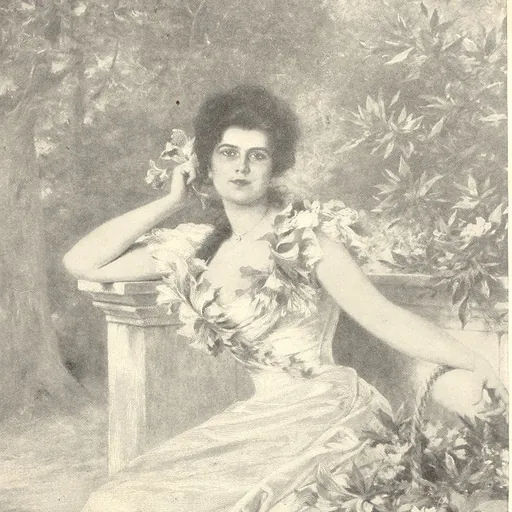
About Katherine Duer Mackay
Lived 1878 – 1930 (aged 51–52). Katherine Duer Mackay was an American suffragist and writer, known for Roslyn Union Free School District.
Katherine Alexander Duer Mackay (18781930) was an American suffragist, socialite and writer from New York city. She was the founder of the Equal Franchise Society. Her involvement with the women's suffrage movement "encouraged other wealthy women to follow her lead and become involved." She was also the first female member of the Roslyn Union Free School District's school board in Roslyn, New York.
Biography Katherine Duer was born in New York City in 1878. She was a direct descendant of Lady Kitty Duer, daughter of Lord Stirling. She married Clarence H. Mackay in 1898. Mackay was well known in connection with Harbor Hill where she was involved with philanthropy and education. Once, the Trinity Episcopal Sunday School members were invited to Harbor Hill for a picnic where the children inducted her as an "honorary knight". Mackay served on the Roslyn School board from 1905 to 1910, and was the first woman on the board. During her term on the board, she was able to successfully remove corporal punishment from the public schools in Roslyn. She also enrolled her own children in the public schools in Roslyn because she felt that "it is necessary for the rich as well as the poor to patronize them."
Mackay became a suffragist after reading books used for a suffrage debate at the Colony Club. She was also related to another suffragist, Alice Duer Miller. Mackay argued for suffrage from the standpoint of maternalism: she said that giving mothers the vote would let them protect their families, and mothers would make politics more moral, because they would vote selflessly for their children. Mackay, unlike many other wealthy suffragists, did not emphasize suffrage as a means of giving women political independence or equality. Her maternalist arguments had more in common with the earlier views of Josephine Lowell.
Mackay became the president of the Equal Franchise Society (EFS), which she founded, in 1908. She leased offices for the group's meetings in the Madison Square Building. Mackay's involvement in the suffrage movement helped combat the stereotype of suffragists as "frumpy" or "unwomanly". She also drew other wealthy women into the suffrage movement, working with Harriot Stanton Blatch to recruit the society women of New York. She recruited new EFS members from her home, convincing Florence Harriman, Anne Harriman Vanderbilt, and Alva Belmont. Mackay encouraged people to become educated about suffrage and organized a series of lectures at the Garden Theater. She did not want to participate in Blatch's 1910 suffrage parade but allowed the EFS to help fund it. Mackay did volunteer for other events by fundraising, speaking, writing letters to newspapers, and answering the EFS's mail. Speculation that Mackay left EFS for reasons other than demands on her time included her apparent "dissatisfaction over the management of the campaign to get suffrage bills passed by the Legislature."
Dr. Joseph A. Blake became the personal physician for Clarence Mackay and operated on him twice. Gossip about a possible illicit relationship between the physician of Clarence Mackay, Dr. Blake, and Katherine Mackay had started in the summer of 1911. Hints that Katherine and Clarence Mackay were separating came in July 1913. Mackay was sued by Catherine Ketcham Blake for the alienation of affections of her husband in 1913 for the sum of $1,000,000. Answering the claims of Catherine Blake, Mackay said that Joseph Blake had stopped loving his wife many years ago because of her temper and "death threats". Catherine Blake dropped the suit later that year. Mackay and her husband, Clarence, were divorced in February 1914. She also gave up her American citizenship. Full custody of their three children, Katherine Duer, Ellin Duer and John William, was given to Clarence Mackay.
In Paris, Mackay continued to fight for women's suffrage, contributing to the Woman Suffrage Party from overseas. The couple was involved in aiding the war effort during World War I.
Works Mackay wrote a novel, The Stone of Destiny, published in 1904, and a drama, Gabrielle. A Dream from the Treasures Contained in the Letters of Abélard and Héloïse, published in The North American Review in 1903.
Don’t just read it —
keep it.
Full-length biographies made to live with: read them, listen on the way to work, watch them tonight.
- E-book
- Audio
- Video
Instant download · yours to keep · every purchase keeps this site free
Important facts
Family & relationships
People in Katherine Duer Mackay's life
Named in this biography and alive at the same time

Related people
Same field, nearest in time

Contemporaries
People whose lives overlapped Katherine Duer Mackay's





Frequently asked questions
Who was Katherine Duer Mackay?
American suffragist and socialite (1878–1930)
When was Katherine Duer Mackay born?
Katherine Duer Mackay was born on 9 May 1878 in New York City.
When did Katherine Duer Mackay die?
Katherine Duer Mackay died in 1930.
What was Katherine Duer Mackay's occupation?
Katherine Duer Mackay was a suffragist and writer.
What was Katherine Duer Mackay known for?
Katherine Duer Mackay was known for Roslyn Union Free School District.
What nationality was Katherine Duer Mackay?
Katherine Duer Mackay was American.
Sources & further reading
· Wikipedia: Katherine Duer Mackay
· DBpedia: Katherine Duer Mackay
Cite this page
APA: Biography.guide. (2026). Katherine Duer Mackay. https://biography.guide/katherine-duer-mackay/
MLA: "Katherine Duer Mackay." Biography.guide, https://biography.guide/katherine-duer-mackay/.
Chicago: "Katherine Duer Mackay." Biography.guide. https://biography.guide/katherine-duer-mackay/.
Data last updated: 2026-09-22 · Spot an error? Report a correction.
Portrait: Wikimedia Commons · author & licence
Page generated 2026-09-27 05:02 UTC