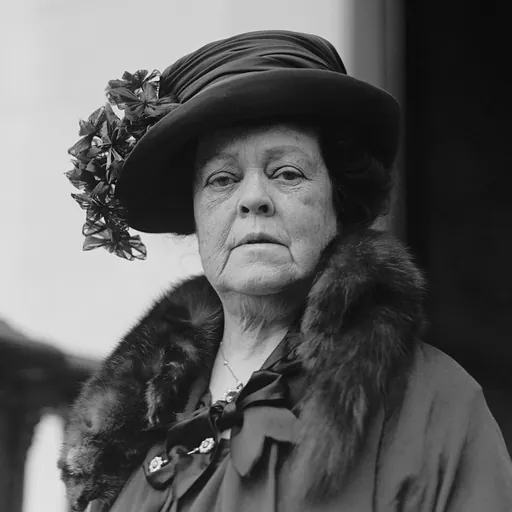
About Alva Belmont
Lived 1853 – 1933 (aged 80). Alva Belmont was an American socialite, suffragist, patron of the arts and political activist.
Alva Erskine Belmont (née Smith; January 17, 1853 – January 26, 1933), known as Alva Vanderbilt from 1875 to 1896, was an American multi-millionaire socialite and women's suffrage activist. She was noted for her energy, intelligence, strong opinions, and willingness to challenge convention.
In 1909, she founded the Political Equality Association to get votes for suffrage-supporting New York State politicians, wrote articles for newspapers, and joined the National American Woman Suffrage Association (NAWSA). She later formed her own Political Equality Association to seek broad support for suffrage in neighborhoods throughout New York City, and, as its president, led its division of New York City's 1912 Women's Votes Parade. In 1916, she was one of the founders of the National Woman's Party (NWP) and organized the first picketing ever to take place before the White House, in January 1917. She was elected president of the NWP, an office she held until her death.
She was married twice, to socially prominent New York City millionaires William Kissam Vanderbilt, with whom she had three children, and Oliver Hazard Perry Belmont. Alva was known for her many building projects, including the Petit Chateau in New York; the Marble House in Newport, Rhode Island; the Belmont House in New York; Brookholt in Long Island; and Beacon Towers in Sands Point, New York.
On "Equal Pay Day," April 12, 2016, Belmont was honored when President Barack Obama established the Belmont-Paul Women's Equality National Monument in Washington, D.C., named for Alva Belmont and Alice Paul.
Early life
Alva Erskine Smith was born on January 17, 1853, at 201 Government Street in Mobile, Alabama, to Murray Forbes Smith, a commission merchant, and Phoebe Ann Desha. Smith was the son of George Smith and Delia Forbes of Dumfries, Virginia. Phoebe Desha was the daughter of US Representative Robert Desha and Eleanor Shelby, both originally from Sumner County, Tennessee. The Smith family were wealthy slaveholders.
Alva was one of seven children. Her sister Alice died as a child before she was born. Her brother, Murray Forbes Smith Jr. died in 1857 and was buried in Magnolia Cemetery in Mobile. Four other siblings, Desha Smith, Armide Vogel Smith, Julia Florence Smith, and Mary Virginia "Jennie" Smith, survived into adulthood. Jennie first married Fernando Yznaga, the brother of Alva's childhood best friend, Consuelo Yznaga, Duchess of Manchester. Following a divorce from Fernando in 1886, Jennie remarried, to William George Tiffany.
As a child, Alva summered with her parents in Newport, Rhode Island, and accompanied them on European vacations. In 1859, the Smiths left Mobile and relocated to New York City, where they briefly settled in Madison Square. When Murray went to Liverpool, England, to conduct his business, Alva's mother, Phoebe Smith, moved to Paris, where Alva attended a private boarding school in Neuilly-sur-Seine. Following the Civil War, the Smith family returned to New York, where Phoebe died in 1871. The family had financial trouble at this point, accentuated by the expectation that the four daughters needed to marry. introduced her to William Kissam Vanderbilt, grandson of Cornelius Vanderbilt. On April 20, 1875, William and Alva were married at Calvary Church in New York City. Alva married William for money: she described it as her attempt to help her family avoid bankruptcy, but others gossiped that she did it for her own wealth and status.
Consuelo Vanderbilt (March 2, 1877 – December 6, 1964) William Kissam Vanderbilt II (October 26, 1878 – January 8, 1944) Harold Stirling Vanderbilt (July 6, 1884 – July 4, 1970)
Alva maneuvered Consuelo into marrying Charles Spencer-Churchill, 9th Duke of Marlborough, on November 6, 1895. The marriage was annulled much later, at the Duke's request and with Consuelo's assent, in May 1921. The annulment was fully supported by Alva, who testified that she had forced Consuelo into the marriage. By this time, Consuelo and her mother enjoyed a closer, easier relationship. Consuelo then married Jacques Balsan, a French aeronautics pioneer. William Kissam II became president of the New York Central Railroad Company on his father's death in 1920. Harold Stirling graduated from Harvard Law School in 1910, then joined his father at the New York Central Railroad Company. He remained the only active representative of the Vanderbilt family in the New York Central Railroad after his brother's death, serving as a director and member of the executive committee until 1954.
Rise in society Balls and dances, the Fifth Avenue chateau
Determined to bring the Vanderbilt family the social status that she felt it deserved, Vanderbilt christened the Fifth Avenue chateau–situated at the intersection of 5th Avenue and 57th through 58th Street, occupying an entire city block—in March 1883 with a costume ball for 1000 guests. "The New York World speculated that Alva's party cost [at least] more than a quarter of a million dollars, more than $5 million in today's dollars," wrote Roark et al. in 2020.
Astor did, in fact, pay a social call on Vanderbilt, and she and her daughter were guests at the ball, effectively bestowing on the Vanderbilt family society's official acceptance. Vanderbilt and Astor were observed at the ball in animated conversation. "We have no right to exclude those whom this great country has brought forward," Astor conceded, "The time has come for the Vanderbilts."
In 1886, after her husband inherited $65 million from his father's estate, Alva set her sights on owning a yacht. William commissioned Harlan and Hollingsworth of Wilmington, Delaware to build the Alva at a cost of $500,000. While J.P. Morgan's yacht Corsair was 165 feet long, Mrs. Astor's Nourmahal (named after a Punjabi chateau famous at the time) measured 233 feet, and Alva's departed father-in-law's North Star was 270 feet, Alva and William's new yacht was the largest private yacht in the world at 285 feet long. The Vanderbilts subsequently toured the Caribbean and Europe on the Alva in the highest fashion.
This being done, Alva then wanted a "summer cottage" in fashionable Newport, Rhode Island. William commissioned Richard Morris Hunt again, and the elaborate Marble House was built next door to Mrs. Astor's Beechwood. In 1917 Alva commissioned Beacon Towers, which apparently was a source of inspiration to F. Scott Fitzgerald for his book The Great Gatsby. Alva's ostentatious displays of wealth helped to fuel American public interest in the lives of the rich and powerful, and, coupled with the opulent and decadent lifestyles by America's rich and their apparent disregard for the wellbeing of the working class, helped to also fuel fears that America had become a plutocracy. Either way, Alva was unhappy in the marriage, angered by William's cheating, and now acutely aware of how precarious women's positions in marriages and workplaces were since the men with power over them did not really protect them. Oliver had been a friend of the Vanderbilts since the late 1880s and, like William, was a great fan of yachting and horse racing. He had accompanied them on at least two long voyages aboard their yacht, the Alva. Scholars have written that it seems to have been obvious to many that he and Alva were attracted to one another upon their return from one such voyage in 1889. He was the son of August Belmont, a successful Jewish investment banker for the Rothschild family, and Caroline Perry, the daughter of Commodore Matthew Calbraith Perry. Alva and Oliver were apparently happy in their relationship.
Women's suffrage
National American Woman Suffrage Association
After Belmont returned to the U.S. in 1909, she took on the new cause of the women's suffrage movement. Her close friend Katherine Duer Mackay had become heavily involved in the movement the year before, and Mackay invited Belmont to suffragist events. In Belmont's first meeting, she met many of the leaders of the National American Woman Suffrage Association (NAWSA), including Carrie Chapman Catt, Harriot Stanton Blatch, and Fanny Villard. Belmont attended lectures by suffragist Ida Husted Harper in 1909, and Belmont followed Harper to NAWSA meetings. Belmont later complained in her memoir that the NAWSA organizers were an old and rigid crowd who could not take action to secure rights for women. At the time, NAWSA headquarters were in Warren, Ohio, and NAWSA's longstanding strategy of winning suffrage at the state level had only resulted in victory in four states: Wyoming, Idaho, Utah, and Colorado. thumb National Woman's Party members picket the White House in 1917.
Drawn further into the suffrage movement by NAWSA president Anna Shaw, Belmont soon shaped the organization through the use of her own celebrity and funds. Belmont joined NAWSA after dining with Shaw in March 1909, and Shaw sent her as an alternate delegate from New York to the International Women's Suffrage Association meeting in London in April. There Belmont observed the commitment of Emmeline Pankhurst and her followers, who adopted a militant, confrontational and protest-driven strategy of eliciting publicity for the suffragist movement. Pankhurst's organization, the Women's Social and Political Union (WSPU), had moved from working-class roots in Manchester to become a large and well-funded organization in London. By 1909, it started to be fashionable and profitable to support the suffragist cause there. Belmont felt more aligned with this style of activism than the respectable approach taken by other organizations, because she thought they attracted important publicity and inspired followers. Belmont paid for NAWSA to relocate to New York, covering moving fees and two years' rent for office space. She hired Ida Husted Haper and other writers to run NAWSA's new National Press Bureau from the same building. In her writing, she linked labor protections to suffrage as two necessary tools of women's independence. During the New York shirtwaist strike from 1909 to 1910, Belmont raised strike funds with Anne Morgan, helped organize marches and a Hippodrome rally, and attended court cases for picketers who had been arrested. Belmont received mixed reviews for her actions, and the strike's labor leaders, often socialists, were concerned about Belmont's motives, while some NAWSA members worried about the connection to working-class women. Working with leading clubwomen in the African American community, like Sarah J. S. Garnet, Frances Reynolds Keyser, Marie C. Lawton and Irene Moorman, she funded them in forming a Black branch of her PEA. Belmont attended two mass meetings with Black suffragists, speaking about racial equality and suffrage. She established the PEA's first "suffrage settlement house" in Harlem, and she included African American women and immigrants in weekend retreats at Beacon Towers, her estate in Sands Point. As president of the PEA, Belmont led its division of New York City's 1912 Women's Votes Parade. She described the 50-block march as a physically "terrible ordeal," but reporter Marie Manning credited Belmont's presence at the parade as a turning point for political interest in the suffrage movement. That same year, Katherine McCormick began donating to NAWSA and diminishing Belmont's financial leverage over the organization. Belmont then merged the PEA into the CU. Now committed to securing the passage of the 19th Amendment, she convened a "Conference of Great Women" at Marble House in the summer of 1914. Belmont's daughter Consuelo, who promoted suffrage and prison reform in England, addressed the gathering, which was followed by the CU's first national meeting. Belmont served on the executive committee of the CU from 1914 to 1916.
Later life and death From the early 1920s onward, she lived in France most of the time to be near her daughter Consuelo. She restored the 16th century Chateau d'Augerville and used it as a residence. With Paul, she formed the International Advisory Council of the National Woman's Party and the Auxiliary of American Women abroad. She suffered a stroke in the spring of 1932 that left her partially paralyzed, and she died in Paris of bronchial and heart ailments on January 26, 1933. Her funeral at Saint Thomas Episcopal Church in New York City featured all female pallbearers and a large contingent of suffragists. She is interred with Oliver Belmont in the Belmont Mausoleum at Woodlawn Cemetery in The Bronx, New York, for which artist Helen Maitland Armstrong designed a set of Renaissance-inspired painted glass windows.
Building programs
During Alva Belmont's lifetime she built, helped design, and owned many mansions. At one point she owned nine. She was a friend and frequent patron of Richard Morris Hunt and was one of the first female members of the American Institute of Architects. Following the death of Hunt, she frequently utilized the services of the architectural firm of Hunt & Hunt, formed by the partnership of Richard Morris Hunt's sons, Richard and Joseph.
Petit Chateau
As a young newlywed, Alva Vanderbilt worked from 1878 to 1882 with Richard Morris Hunt to design a French Renaissance style chateau, known as the Petit Chateau, for her family at 660 Fifth Avenue in Manhattan. A contemporary of Vanderbilt's was quoted as saying that "she loved nothing better than to be knee deep in mortar."
Marble House
In 1878, Hunt began work on their Queen Anne style retreat on Long Island, Idle Hour. It would be added to almost continuously until 1889 and burned down in 1899. William K. Vanderbilt had a new fireproof mansion rebuilt on the estate and it later became the home of now closed Dowling College.
Hunt was again hired to design the neoclassical style Marble House in Newport, Rhode Island, as William K. Vanderbilt's 39th birthday present and summer "cottage" retreat for Alva. Marble House was staffed with 36 servants, including butlers, maids, coachmen, and footmen. Eager to reshape and redesign Belcourt, Alva made changes that transformed the interiors of the mansion into a blend of French and English Gothic and Renaissance styles.
477 Madison Avenue
Mrs. O. H. P. Belmont House at 477 Madison Avenue and 51st Street in Manhattan
In 1899 she and Oliver bought the corner of 477 Madison Avenue and 51st Street in Manhattan. The mansion became known as the Mrs. O. H. P. Belmont House. The neoclassical three-story townhouse, designed by Hunt & Hunt, had a limestone facade and interior rooms in an eclectic mix of styles. Construction was still underway when Oliver Belmont died, when Alva announced that she would build an addition that was an exact reproduction of the Gothic Room in Belcourt, to house her late husband's collection of medieval and early Renaissance armor. The room, dubbed The Armory, measured and was the largest room in the house. She and her youngest son, Harold, moved into the house in 1909. The Armory would later be used as a lecture hall for women suffragists. She sold the townhouse in 1923.
Brookholt
Prior to the construction of their new Manhattan mansion, the Belmonts had another neoclassical mansion, Brookholt, built in 1897 in East Meadow on Long Island. It was designed by Hunt & Hunt. Oliver Belmont died there in 1908. For a short period, she operated the estate as Brookholt School of Agriculture for Women, a training school for female farmers. She sold Brookholt in 1915. The house was later destroyed by fire in 1934.
Mausoleum Following Oliver Belmont's death, Belmont commissioned a family mausoleum to be built in Woodlawn Cemetery. Again designed by Hunt & Hunt, it was an exacting replica of the original Chapel of Saint Hubert on the grounds of the Château d'Amboise. It took several years, but construction was completed in 1913.
Beacon Towers
Belmont's last new mansion in the United States was built on Long Island's North Shore. This one, Beacon Towers, has been described by scholars as a pure Gothic fantasy. It was also designed by Hunt & Hunt and was built from 1917 to 1918 in Sands Point. In 1925 Belmont closed the castle permanently; it was sold to William Randolph Hearst in 1927. He partially remodeled it and then sold it in 1942. It was demolished in 1945. It is thought by some literary scholars to have been part of the inspiration for the home of Jay Gatsby in F. Scott Fitzgerald's The Great Gatsby.
Château d'Augerville
Belmont retired to France in 1923. She had a townhouse in Paris and a villa on the Riviera. She also purchased the 15th-century Château d'Augerville in Augerville-la-Rivière, Loiret, in the summer of 1926 and restored it as her primary residence. It had been one of the inspirations for her châteauesque-style 660 Fifth Avenue house and legend had it that the chateau had once belonged to Jacques Cœur, who had left it to his daughter. Her daughter, Consuelo, wrote that she thought these two things had inspired her mother to buy the estate.
Belmont did a great deal of restoration and renovation during her ownership. She had the river flowing through the estate widened because she said, as Consuelo later wrote, "This river is not wide enough." She brought in paving stones from Versailles to cover the previously sand-paved great forecourt between the house and the village. She also built a massive neo-Gothic portal gate on the northern entrance road, separating the château and village from the surrounding farmland. Other changes included replacement of the wrought iron staircases and moving the kitchens to the basement. She also added a bowling alley in one of the houses on the estate. After her death in 1933, the chateau was left to Consuelo, who sold it to a Swiss company in the winter of 1937.
Don’t just read it —
keep it.
Full-length biographies made to live with: read them, listen on the way to work, watch them tonight.
- E-book
- Audio
- Video
Instant download · yours to keep · every purchase keeps this site free
Important facts
more
Alva Erskine BelmontFamily & relationships
People in Alva Belmont's life
Named in this biography and alive at the same time



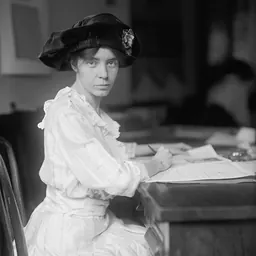
Related people
Same field, nearest in time

Contemporaries
People whose lives overlapped Alva Belmont's



Frequently asked questions
Who was Alva Belmont?
American suffragette and socialite (1853–1933)
When was Alva Belmont born?
Alva Belmont was born on 17 January 1853 in Mobile.
When did Alva Belmont die?
Alva Belmont died on 26 January 1933 in Augerville-la-Rivière, Paris.
What was Alva Belmont's occupation?
Alva Belmont was a socialite, suffragist, patron of the arts and political activist.
What nationality was Alva Belmont?
Alva Belmont was American.
Sources & further reading
Cite this page
APA: Biography.guide. (2026). Alva Belmont. https://biography.guide/alva-belmont/
MLA: "Alva Belmont." Biography.guide, https://biography.guide/alva-belmont/.
Chicago: "Alva Belmont." Biography.guide. https://biography.guide/alva-belmont/.
Data last updated: 2026-09-20 · Spot an error? Report a correction.
Page generated 2026-09-27 05:09 UTC