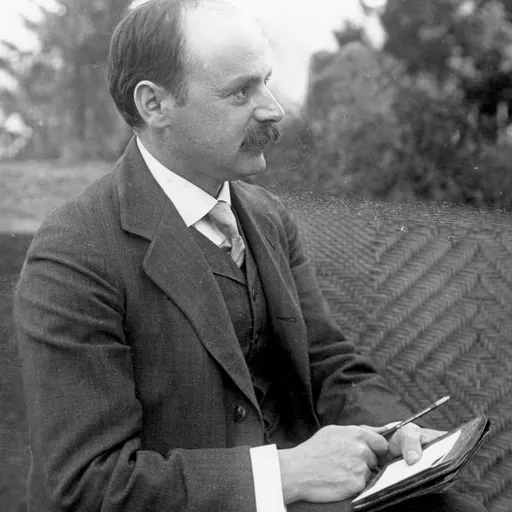
Karl Schwarzschild
German physicist, astronomer and mathematician
About Karl Schwarzschild
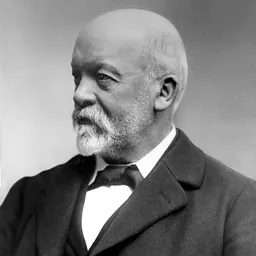
Lived 1873 – 1916 (aged 42). Karl Schwarzschild was a German physicist, astronomer, astrophysicist, university teacher and mathematician.
Karl Schwarzschild (; 9 October 1873 – 11 May 1916) was a German physicist and astronomer.
Schwarzschild provided the first exact solution to the Einstein field equations of general relativity, for the limited case of a single spherical non-rotating mass, which he accomplished in 1915, the same year that Einstein first introduced general relativity. The Schwarzschild solution, which makes use of Schwarzschild coordinates and the Schwarzschild metric, leads to a derivation of the Schwarzschild radius, which is the size of the event horizon of a non-rotating black hole.
Schwarzschild accomplished this while serving in the German army during World War I. He died the following year, possibly from the autoimmune disease pemphigus, which he developed while at the Russian front.
Life Karl Schwarzschild was born on 9 October 1873 in Frankfurt am Main, the eldest of six boys and one girl, to Jewish parents. His father was active in the business community of the city, and the family had ancestors in Frankfurt from the sixteenth century onwards. The family owned two fabric stores in Frankfurt. His brother Alfred became a painter. The young Schwarzschild attended a Jewish primary school until 11 years of age and then the Lessing-Gymnasium (secondary school). He received an all-encompassing education, including subjects like Latin, Ancient Greek, music and art, but developed a special interest in astronomy early on. He proved to be a child prodigy, having two papers on binary orbits (celestial mechanics) published before the age of sixteen.
After graduation in 1890, he attended the University of Strasbourg to study astronomy. After two years he transferred to the Ludwig-Maximilians-Universität München, where he obtained his doctorate in 1896 for a work on Henri Poincaré's theories.
From 1897, he worked as assistant at the Kuffner Observatory in Vienna. His work here concentrated on the photometry of star clusters and laid the foundations for a formula linking the intensity of the starlight, exposure time, and the resulting contrast on a photographic plate. An integral part of that theory is the Schwarzschild exponent (astrophotography). In 1899, he returned to Munich to complete his Habilitation.
From 1901 until 1909, he was a professor at the prestigious Göttingen Observatory within the University of Göttingen, where he had the opportunity to work with some significant figures, including David Hilbert and Hermann Minkowski. Schwarzschild became the director of the observatory. He married Else Rosenbach, a great-granddaughter of Friedrich Wöhler and daughter of a professor of surgery at Göttingen, in 1909. Later that year they moved to Potsdam, where he took up the post of director of the Astrophysical Observatory of Potsdam. This was then the most prestigious post available for an astronomer in Germany.
From 1912, Schwarzschild was a member of the Prussian Academy of Sciences.
Work on general relativity and death At the outbreak of World War I in 1914, Schwarzschild volunteered for service in the German army despite being over 40 years old. He served on both the western and eastern fronts, specifically helping with ballistic calculations and rising to the rank of second lieutenant in the artillery.
Nevertheless, he managed to write three important papers, two on the theory of relativity and one on quantum theory. His papers on relativity produced the first exact solutions to the Einstein field equations, and a minor modification of these results gives the well-known solution that now bears his name — the Schwarzschild metric. He also identified the Schwarzschild radius, at which a star will form what is now known as a black hole, though he wrongly believed this finding to be a mathematical curiosity that had no practical relevance. Twenty-three years after Schwarzschild's death, J. Robert Oppenheimer and Hartland Snyder correctly predicted the existence of black holes in their Oppenheimer–Snyder model, though they did not draw directly on Schwarzschild's work.
Karl Schwarzschild's grave at Stadtfriedhof (Göttingen) Schwarzschild died of immune complications related to his illness on 11 May 1916, at the age of 42. Martin Schwarzschild (1912–1997) became a professor of astronomy at Princeton University, and was the first astronomer to lift a telescope into the stratosphere by balloon. Alfred Schwarzschild (1914–1944) remained in Nazi Germany and was murdered during the Holocaust.
Work Schwarzschild's solutions to the Einstein field equations are fundamental to the study of gravitation, as fundamental as Coulomb's law is for electricity. In addition, his research interests were extremely broad, including work in celestial mechanics, observational stellar photometry, quantum mechanics, instrumental astronomy, stellar structure, radiative transfer, stellar statistics, Halley's Comet, and spectroscopy.
Some of his particular achievements include measurements of variable stars, using photography, and the improvement of optical systems, through the perturbative investigation of geometrical aberrations.
Physics of photography While at Vienna in 1897, Schwarzschild developed a formula, now known as the Schwarzschild law, to calculate the optical density of photographic material. It involved an exponent now known as the Schwarzschild exponent, which is the in the formula:
(where is optical density of exposed photographic emulsion, a function of , the intensity of the source being observed, and , the exposure time, with a constant). This formula was important for enabling more accurate photographic measurements of the intensities of faint astronomical sources.
Electrodynamics
According to Wolfgang Pauli, Schwarzschild is the first to introduce the correct Lagrangian formalism of the electromagnetic field as
where are the electric and applied magnetic fields, is the vector potential and is the electric potential.
He also introduced a field free variational formulation of electrodynamics (also known as "action at distance" or "direct interparticle action") based only on the world line of particles as
where are the world lines of the particle, the (vectorial) arc element along the world line. Two points on two world lines contribute to the Lagrangian (are coupled) only if they are a zero Minkowskian distance (connected by a light ray), hence the term . The idea was further developed by Hugo Tetrode and Adriaan Fokker in the 1920s and John Archibald Wheeler and Richard Feynman in the 1940s and constitutes an alternative but equivalent formulation of electrodynamics.
Thermal radiation
In 1906, Schwarzschild developed the concept of radiative equilibrium between convection inside the Sun and thermal radiation at the surface. He developed an equation for radiative transfer and proved that, in accordance to data, the Sun’s photosphere is in radiative equilibrium.
Relativity
Einstein himself was pleasantly surprised to learn that the field equations admitted exact solutions, because of their prima facie complexity, and because he himself had produced only an approximate solution. In 1916, Einstein wrote to Schwarzschild on this result:
I have read your paper with the utmost interest. I had not expected that one could formulate the exact solution of the problem in such a simple way. I liked very much your mathematical treatment of the subject. Next Thursday I shall present the work to the Academy with a few words of explanation.|Albert Einstein| In cases where the radius of the central body is less than the Schwarzschild radius, represents the radius within which all massive bodies, and even photons, must inevitably fall into the central body (ignoring quantum tunnelling effects near the boundary). When the mass density of this central body exceeds a particular limit, it triggers a gravitational collapse which, if it occurs with spherical symmetry, produces what is known as a Schwarzschild black hole. This occurs, for example, when the mass of a neutron star exceeds the Tolman–Oppenheimer–Volkoff limit (about three solar masses).
The modern interpretation of the Schwarzschild solution as describing a black hole developed only gradually after Schwarzschild's death. In his original 1916 paper, Schwarzschild used a radial coordinate that differs from the standard Schwarzschild radial coordinate used in modern presentations, and he did not identify the surface now associated with the Schwarzschild radius as an event horizon. The apparent singularity at this radius subsequently became the subject of considerable debate among relativists, including Albert Einstein and David Hilbert. It was only later, through developments in the understanding of coordinate singularities and the extension of the Schwarzschild spacetime, that the surface was recognised as a horizon rather than a physical singularity. This historical development helped establish the Schwarzschild solution as the simplest exact model of a black hole in general relativity.
Honours Asteroid 837 Schwarzschilda is named in his honour, as is the large crater Schwarzschild, on the far side of the Moon.
Cultural references Schwarzschild appears as a character in the science fiction short story "Schwarzschild Radius" (1987) by Connie Willis. He also appears as a fictionalized character in the story “Schwarzschild’s Singularity” in the collection When We Cease to Understand the World (2020) by Benjamín Labatut.
Works The entire scientific estate of Karl Schwarzschild is stored in a special collection of the Lower Saxony National and University Library of Göttingen.
Relativity Über das Gravitationsfeld eines Massenpunktes nach der Einstein’schen Theorie. Reimer, Berlin 1916, S. 189 ff. (Sitzungsberichte der Königlich-Preussischen Akademie der Wissenschaften; 1916) Über das Gravitationsfeld einer Kugel aus inkompressibler Flüssigkeit. Reimer, Berlin 1916, S. 424-434 (Sitzungsberichte der Königlich-Preussischen Akademie der Wissenschaften; 1916)
Other papers Untersuchungen zur geometrischen Optik I. Einleitung in die Fehlertheorie optischer Instrumente auf Grund des Eikonalbegriffs, 1906, Abhandlungen der Gesellschaft der Wissenschaften in Göttingen, Band 4, Nummero 1, S. 1-31 Untersuchungen zur geometrischen Optik II. Theorie der Spiegelteleskope, 1906, Abhandlungen der Gesellschaft der Wissenschaften in Göttingen, Band 4, Nummero 2, S. 1-28 Untersuchungen zur geometrischen Optik III. Über die astrophotographischen Objektive, 1906, Abhandlungen der Gesellschaft der Wissenschaften in Göttingen, Band 4, Nummero 3, S. 1-54 Über Differenzformeln zur Durchrechnung optischer Systeme, 1907, Nachrichten von der Gesellschaft der Wissenschaften zu Göttingen, S. 551-570 Aktinometrie der Sterne der B. D. bis zur Größe 7.5 in der Zone 0° bis +20° Deklination. Teil A. Unter Mitwirkung von Br. Meyermann, A. Kohlschütter und O. Birck, 1910, Abhandlungen der Gesellschaft der Wissenschaften in Göttingen, Band 6, Numero 6, S. 1-117 Über das Gleichgewicht der Sonnenatmosphäre, 1906, Nachrichten von der Gesellschaft der Wissenschaften zu Göttingen, S. 41-53 Die Beugung und Polarisation des Lichts durch einen Spalt. I., 1902, Mathematische Annalen, Band 55, S. 177-247 Zur Elektrodynamik. I. Zwei Formen des Princips der Action in der Elektronentheorie, 1903, Nachrichten von der Gesellschaft der Wissenschaften zu Göttingen, S. 126-131 Zur Elektrodynamik. II. Die elementare elektrodynamische Kraft, 1903, Nachrichten von der Gesellschaft der Wissenschaften zu Göttingen, S. 132-141 Zur Elektrodynamik. III. Ueber die Bewegung des Elektrons, 1903, Nachrichten von der Gesellschaft der Wissenschaften zu Göttingen, S. 245-278 Ueber die Eigenbewegungen der Fixsterne, 1907, Nachrichten von der Gesellschaft der Wissenschaften zu Göttingen, S. 614-632 Ueber die Bestimmung von Vertex und Apex nach der Ellipsoidhypothese aus einer geringeren Anzahl beobachteter Eigenbewegungen, 1908, Nachrichten von der Gesellschaft der Wissenschaften zu Göttingen, S. 191-200 K. Schwarzschild, E. Kron: Ueber die Helligkeitsverteilung im Schweif des Halley´schen Kometen, 1911, Nachrichten von der Gesellschaft der Wissenschaften zu Göttingen, S. 197-208 Die naturwissenschaftlichen Ergebnisse und Ziele der neueren Mechanik., 1904, Jahresbericht der Deutschen Mathematiker-Vereinigung, Band 13, S. 145-156 Über die astronomische Ausbildung der Lehramtskandidaten., 1907, Jahresbericht der Deutschen Mathematiker-Vereinigung, Band 16, S. 519-522
Don’t just read it —
keep it.
Full-length biographies made to live with: read them, listen on the way to work, watch them tonight.
- E-book
- Audio
- Video
Instant download · yours to keep · every purchase keeps this site free
Important facts
People in Karl Schwarzschild's life
Named in this biography and alive at the same time





Related people
Same field, nearest in time


Contemporaries
People whose lives overlapped Karl Schwarzschild's


Frequently asked questions
Who was Karl Schwarzschild?
German physicist, astronomer and mathematician (1873–1916)
When was Karl Schwarzschild born?
Karl Schwarzschild was born on 9 October 1873 in Frankfurt.
When did Karl Schwarzschild die?
Karl Schwarzschild died on 11 May 1916 in Potsdam.
What was Karl Schwarzschild's occupation?
Karl Schwarzschild was a physicist, astronomer, astrophysicist, university teacher and mathematician.
What nationality was Karl Schwarzschild?
Karl Schwarzschild was German.
Sources & further reading
· Wikipedia: Karl Schwarzschild
Cite this page
APA: Biography.guide. (2026). Karl Schwarzschild. https://biography.guide/karl-schwarzschild/
MLA: "Karl Schwarzschild." Biography.guide, https://biography.guide/karl-schwarzschild/.
Chicago: "Karl Schwarzschild." Biography.guide. https://biography.guide/karl-schwarzschild/.
Data last updated: 2026-09-23 · Spot an error? Report a correction.
Portrait: Wikimedia Commons · author & licence
Page generated 2026-09-27 05:06 UTC