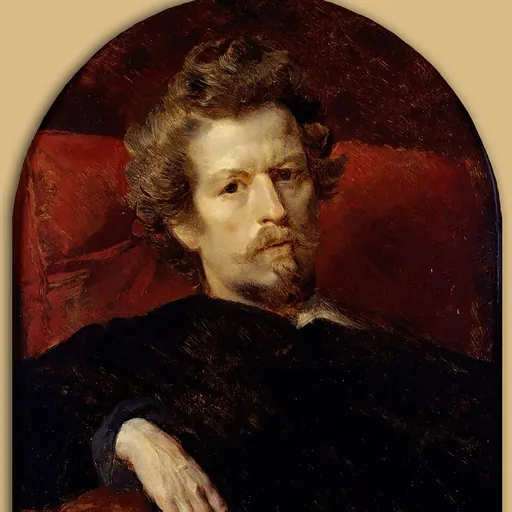
About Karl Bryullov
Lived 1799 – 1852 (aged 52). Karl Bryullov was a Russian painter, architect and graphic artist.
Karl Pavlovich Bryullov ( Brüllo ; ; – ) was a Russian painter and draughtsman during the Romantic period, remembered among the greatest visual artists in the history of Russian art.
Biography Karl Bryullov was born on 12 (23) December 1799 in St. Petersburg, in the family of the academician, woodcarver, and engraver Pavel Ivanovich Briullo (Brulleau, 1760—1833) who was of Huguenot descent. He felt drawn to Italy from his early years. Despite his education at the Imperial Academy of Arts (1809–1821), Bryullov never fully embraced the classical style taught by his mentors and promoted by his brother, Alexander Bryullov. After distinguishing himself as a promising and imaginative student and finishing his education, he left Russia for Rome where he worked until 1835 as a portraitist and genre painter, though his fame as an artist came when he began doing historical painting.
His best-known work, The Last Day of Pompeii (1830–1833), is a vast composition compared by Pushkin and Gogol to the best works of Rubens and Van Dyck. It created a sensation in Italy and established Bryullov as one of the finest European painters of his day. After completing this work, he triumphantly returned to the Russian capital, where he made many friends among the aristocracy and intellectual elite and obtained a high post in the Imperial Academy of Arts.
An anecdote concerning Bryullov appeared in Leo Tolstoy's essay "Why Do Men Stupefy Themselves?" and later in the same author's book What Is Art?.
While teaching at the academy (1836–1848) he developed a portrait style which combined a neoclassical simplicity with a romantic tendency that fused well, and his penchant for realism was satisfied with an intriguing level of psychological penetration. While he was working on the plafond of St Isaac's Cathedral, his health suddenly deteriorated. Following advice of his doctors, Bryullov left Russia for Madeira in 1849 and spent the last three years of his life in Italy. He died in the village of Manziana near Rome and is buried at the Cimitero Acattolico there.
Characteristics of art Bryullov's work is the pinnacle of late Russian Romanticism when the sense of harmonic wholeness and beauty of the world is replaced by a feeling of tragedy and conflict of life. In the forefront of the historical picture, but its main theme - not the struggle of heroes, as in classicism, and the fate of the huge human masses. In his central work "The Last Day of Pompeii" Bryullov combined the drama of action, romantic lighting effects and sculptural plasticity of figures. The painting brought the artist great fame both in Russia and in Europe.
An outstanding master of both ceremonial and chamber portraits, Bryullov evolved in his art from the joyful embrace of life in his early works to the intricate psychologism of his later ones, thus anticipating the achievements of such artists like Ilya Repin in the second half of the 19th century. Bryullov had an enormous influence on Russian artists, among whom he had many followers and imitators.
Selected artwork
Don’t just read it —
keep it.
Full-length biographies made to live with: read them, listen on the way to work, watch them tonight.
- E-book
- Audio
- Video
Instant download · yours to keep · every purchase keeps this site free
Important facts
more
Karl Brulloff, Karl Pavlovich Brulloff, Karl Brullo, K. P. Bryullov, Karl Bruloff, Karl Bryulov, Karl Briulov, Karl Pavlovich Bryullov, Karl Bruelloff, Karl Pavlovitch Bryulov, Karl Pavlovich Briulov, Karl Brullov, Karl Pavlovich Bri︠u︡llov, Karl Pavlovich Briullov, Charles Bruleau, Karl Pavlovič Briullov, Karl Pawloitsch Brüloff, Karl Pawlowitsch Brülow, Karl Pawlowitsch Brüloff, Karl Pavlovic Briullov, Carl PPeople in Karl Bryullov's life
Named in this biography and alive at the same time
Related people
Same field, nearest in time


Contemporaries
People whose lives overlapped Karl Bryullov's






Frequently asked questions
Who was Karl Bryullov?
Russian painter (1799-1852)
When was Karl Bryullov born?
Karl Bryullov was born on 12 December 1799 in Saint Petersburg.
When did Karl Bryullov die?
Karl Bryullov died on 11 June 1852 in Manziana.
What was Karl Bryullov's occupation?
Karl Bryullov was a painter, architect and graphic artist.
What nationality was Karl Bryullov?
Karl Bryullov was Russian.
Sources & further reading
Cite this page
APA: Biography.guide. (2026). Karl Bryullov. https://biography.guide/karl-bryullov/
MLA: "Karl Bryullov." Biography.guide, https://biography.guide/karl-bryullov/.
Chicago: "Karl Bryullov." Biography.guide. https://biography.guide/karl-bryullov/.
Data last updated: 2026-09-23 · Spot an error? Report a correction.
Portrait: Wikimedia Commons · author & licence
Page generated 2026-09-27 05:05 UTC