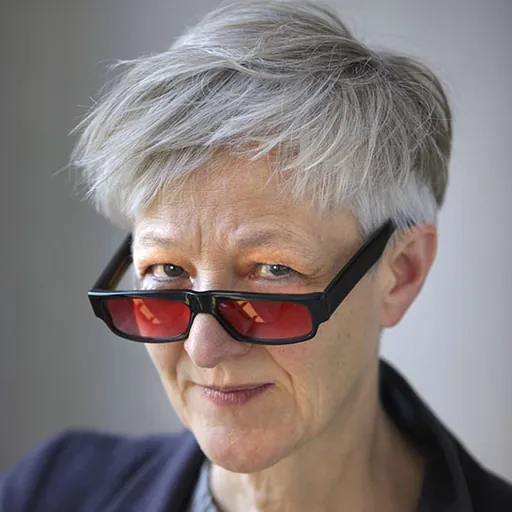
About Karin Sander
Born 1957. Karin Sander is a German artist, painter, sculptor, draftsperson, conceptual artist and visual artist.
Karin Sander (born 1957 in Bensberg, North Rhine-Westphalia) is a German conceptual artist. She lives and works in Berlin and Zurich. Karin Sander works across media, including sculpture, performance, photography, video, and architecture. At the core of her conceptual practice is an engagement with existing situations, spaces, and institutional contexts. Her works intervene in given structures, transform them, and render them newly legible.
Life Education Sander studied art and art history at the Freie Kunstschule Stuttgart and at the Staatliche Akademie der Bildenden Künste Stuttgart, among others with professor Jürgen Brodwolf. From 1989 to1990 she received a scholarship from the German Academic Exchange Service (DAAD-scholarship) for New York, where she attended the Independent Study Program (ISP) of the Whitney Museum of American Art.
Teaching Sander has been invited to visiting professorships at the Iceland University of Arts, Reykjavík (Listaháskóli Íslands, 1993), CalArts (California Institute of the Arts, Los Angeles) (1995), Akademie der Bildenden Künste in Karlsruhe (1995–1996), Staatliche Akademie der Bildenden Künste Stuttgart (1997–1998) and Elam School of Fine Arts, Auckland (2003). From 1999 to 2007, she had a professorship at the Kunsthochschule Berlin-Weissensee. From 2007 to 2023, she held the chair for architecture and art at the ETH Zurich Swiss Federal Institute of Technology. She understood her teaching as a continuation of her artistic practice.
Other activities Sander is a member of Deutscher Künstlerbund (Association of German Artists) and the Internationalen Künstlergremium (International Artists’ Committee). In 2007, Sander was elected to the Akademie der Künste (Academy of Arts) Berlin. Since November 2021, she has been director of the fine arts section there. In this capacity, she was a member of the juries that selected Katharina Sieverding (2017) and Candida Höfer (2024) as recipients of the Käthe Kollwitz Prize. In 2024, she was also part of the jury that selected Simone Fattal as a recipient of the Academy's Berlin Art Prize.
In 2023, Sander and art and architecture historian Philip Ursprung represented Switzerland in the Swiss pavilion at the 18th Venice Biennale of Architecture.
Karin Sander is represented by the galleries Esther Schipper, Berlin (since 2012), I8 Gallery, Reykjavik (since 2000), Galeria Helga de Alvear, Madrid (since 1995) und Galerie Nächst St. Stephan – Rosemarie Schwarzwälder, Vienna (since1994).
She is also engaged in cultural and urban policy in Berlin, advocating for the preservation of artists’ studio spaces, including in the development of the Uferhallen site. In 2000, Sander was part of a group of 15 artists and architects who bought a complex of buildings called Werkhof L57, where the Prussian army had once manufactured its uniforms, in Berlin's Moabit. Sander’s share is two levels of a three-story building, one on the ground floor and the other on the third floor, with a combined space of about 5,800 square feet.
Work (selection) In her exhibitions, Sander refers to existing situations and addresses their institutional, political and historical contexts. Her work is often sculptural, site-specific and participatory. The seemingly familiar is rethought, it becomes the starting point of an exploratory process. She uses various media, including painting, sculpture, drawing, electronic media, film and photography. Recurring aspects in her practice include the relationship between art and architecture and the translation of modes of representation into digitally generated three-dimensional visualizations. Her works combine analytical rigor with sensory experience and reflect fundamental questions of space, perception, materiality, and social context. Particularly influential is her early and consistent use of digital technologies since the 1990s. In 1997 she began working with 3D scanning and printing processes, developing forms of three-dimensional photography.
Wallpieces (since 1986) Wall Pieces is a long-standing series of works in which sanding and polishing of specific areas of the wall create reflective surfaces that mirror their surroundings. The image is produced not by adding material but by removing it. Sander references the illusion of an opening in traditional panel painting and transforms it: the image is created by the viewer’s perspective. The relationship between real space and its representation on a two-dimensional surface is thus expanded. These works have been shown at Museum Abteiberg, Mönchengladbach (permanent, since 1992), the Museum of Modern Art, New York (1994), and the Solomon R. Guggenheim Museum, New York (2004), among many others.
Egg, polished, raw, size 0 (1994) Egg, polished, raw, size 0 (1994) is one of Sander’s early sculptural works. By sanding and polishing the originally matte eggshell, a high-glossy, almost transparent surface is created. The reflective surface mirrors its surroundings, while a subtle yellow shimmer hints at the interior. The transformation of a fragile everyday object into a minimalist sculpture addresses feminism and oppositions such as visibility and concealment, or natural form and artistic artifact. The work was developed for the traveling exhibition "Leiblicher Logos, 14 women artists" (1995–2002) of the Institut für Auslandsbeziehungen.
Gebrauchsbilder (since 1990) The Gebrauchsbilder are among Sander’s central conceptual work groups. The idea of the image as a representation of reality is realized almost literally—as the direct imprint of a process. Instructions to collectors or institutions to install the work without protection in a place determined by the collector him/herself, create a form of shared authorship. The works are in the process of permanent change and open action. This work series illustrates how Sander deliberately intervenes in private and institutional processes in order to reveal their underlying conditions and bring about lasting change through minimal interventions.
Mailed Paintings (since 2004) Mailed Paintings are standard-sized white-primed canvases of various shapes that are sent to exhibitions without any kind of protection and exhibited as they arrive. The collected traces become part of the surface and continuously transform the image as it travels.
Kitchen Pieces (since 2012) For her group of work Kitchen Pieces, Sander uses fresh fruits and vegetables, which she nails individually directly onto the wall. While formally recalling the tradition of still life paintings, the works subvert it through the real presence and processes of decay. The organic decomposition becomes an integral part of the work, continuously altering its appearance. The works address transience and everyday life. By relocating of an ordinary object into the context of art, a tension arises between aesthetic expectation and material reality.
3D Body Scans (since 1997) With her 3D body scans, Karin Sander is among the artists who integrated digital scanning and printing technologies into art at a very early stage. People are captured using 3D scanners and reproduced as true-to-scale, colored sculptures. The digitally generated three-dimensional visualizations constitute an important body of work in Sander’s oeuvre. They combine technological precision with social interaction and question representation, scale, and individuality. In projects such as Museum Visitors 1:8, visitors themselves become the artwork. By actively allowing the participants themselves to decide how they are scanned and how they wish to be seen as sculptures, Sander expands the artwork to include social processes. The genre of portraiture becomes an integral part of the work.
More selected works Astro Turf Floorpiece, The Museum of Modern Art, New York, 1994 Persons 1:10, 3-D-Bodyscans, Galería Helga de Alvear, Madrid, 2000 Museum Visitors 1:9, 3-D-Bodyscans, Staatsgalerie Stuttgart, 2002 Wordsearch, a translinguistic sculpture, 4. Oktober 2002, New York Times, in collaboration with Deutsche Bank, 2002 XML-SVG Code, Source Code of the Exhibition Space, Galerie nächst St. Stephan, Vienna, 2009 Zeigen. Eine Audiotour durch Berlin, Temporäre Kunsthalle Berlin, 2009–2010
Works in Public Space (selection) The sculpture Maximilian Joseph Graf von Montgelas (2003–2005, Munich) is based on digitally scanned and evaluated historical portraits. Out of various sources Sander created a computer-generated new composite sculpture of the historically transmitted figure. Sander combines analog and digital methods and deliberately avoids a heroic representation: the figure stands without a pedestal in the public space of Munich’s Promenadeplatz, at the same size as its neighbors. The work critically reflects contemporary approaches to history, memory, and monument traditions.
Further works in public space
Point of Interest, Mobimo-Tower Zurich, 2025 Lehrkamin / Salomonische Säule, Städtisches Berufsschulzentrum für das Bau- und Kunsthandwerk, Munich, 2024 Transzendenzaufzug, Universität für künstlerische und industrielle Gestaltung, Linz, 2017 XML-SVG Code, Universität Bayreuth, 2008 Willy-Brandt-Platz, Messestadt Riem, Munich, 2003 Delegationsgeschenke, Paul-Löbe-Haus, Deutscher Bundestag, Berlin, 2001 Center of Gravity / Center of the City of Münster, Skulptur.Projekte in Münster, 1997 Sechs Litfaßsäulen im Stadtraum, Langenhagen, 1993 White Passageways, Konstrukcja w Procesie, Łódź, Polen, 1990
Exhibitions (selected) Sander's work has been exhibited worldwide, particularly in Europe and the United States, notably in solo exhibitions at Museion, Bozen (2020), Kunst Museum Winterthur (2018), the Neuer Berliner Kunstverein (2011), Kunstmuseum St. Gallen (2010), K20 Kunstsammlung North Rhine-Westphalia, Düsseldorf (2010), Temporäre Kunsthalle, Berlin (2009), Kunstverein Arnsberg (2008).
Exhibition list (selection)
1988 and 1989: Karin Sander, Vera Engelhorn Gallery, New York 1989: Karin Sander, Galerie Ute Parduhn, Düsseldorf 1991: Out of Site. P.S.1 Museum and Institute of Contemporary Art, New York 1992: Karin Sander, Städtisches Museum Abteiberg, Mönchengladbach 1993: Karin Sander, Kunstraum Neue Kunst, Hannover 1994: Projects 46: Karin Sander, Museum of Modern Art, New York 1994: Karin Sander, Second Floor Exhibition Space, Reykjavík 1995: Leiblicher Logos. 14 Künstlerinnen aus Deutschland, Wanderausstellung des Instituts für Auslandsbeziehungen, Stuttgart 1996 Karin Sander, Kunstmuseum St. Gallen, St. Gallen 1996: Karin Sander, Galerie nächst St. Stephan, Vienna 1997: Skulptur. Projekte in Münster 1997, Münster 1998: Karin Sander, Stiftung für konkrete Kunst, Reutlingen 1999: Minimal maximal, Staatliche Kunsthalle Baden-Baden, Baden-Baden 2001: Art Unlimited, Art 32 Basel, Galerie nächst St. Stephan, Basel 2001: Open Ends: White Spectrum, The Museum of Modern Art, New York 2001: 010101. Art in Technological Times, San Francisco Museum of Modern Art, San Francisco 2001: Karin Sander, i8 Gallery, Reykjavik 2002: Karin Sander, Staatsgalerie Stuttgart 2002: wordsearch. A translinguistic sculpture. New York Times / Deutsche Bank 2003: Karin Sander. 1:9, Centro Galego de Arte Contemporánea, (CGAC) Santiago de Compostela 2004: Singular Forms, Solomon R. Guggenheim Museum, New York 2005: Karin Sander. Zeigen. Eine Audiotour von Karin Sander, Galerie Mueller-Roth 2006: Nichts, Schirn Kunsthalle, Frankfurt am Main 2008: SCAPE 2008 Christchurch Biennial of Art in Public Space, Christchurch 2009: Karin Sander. Zeigen. Eine Audiotour durch Berlin, Temporäre Kunsthalle Berlin 2010: Contemplating the Void, Solomon R. Guggenheim Museum, New York 2010: Karin Sander. Museumsbesucher 1:8, K20 Kunstsammlung Nordrhein-Westfalen, Düsseldorf 2011: Karin Sander, n.b.k., Neuer Berliner Kunstverein, Berlin 2012: Karin Sander. h = 400 cm, Esther Schipper, Berlin 2012: Karin Sander. Zeigen. Eine Audiotour durch Baden-Württemberg, Staatliche Kunsthalle Karlsruhe 2013: Karin Sander / Holzer Kobler Architekturen Identities on Display, Humboldt Lab Dahlem, Berlin 2013: Karin Sander. Visitors on Display, Lehmbruck-Museum, Duisburg 2014: Lens-Based Sculpture, Akademie der Künste, Berlin / Kunstmuseum Liechtenstein 2014 Ceal Floyer and Karin Sander, Paper Work, Galerie Esther Schipper 2014: Solides Fragiles, Musée d’Art Moderne Grand-Duc Jean, Luxemburg 2015: Künstlerräume, Staatsgalerie Stuttgart 2016 The Distance of a Day: Connections and Disconnections in Contemporary Art, Israel Museum, Jerusalem 2016: Karin Sander. Announcement, Esther Schipper / Johnen Galerie, Berlin 2017: Karin Sander. Zeigen. Eine Audiotour durch die Sammlung der GfZK Leipzig, Galerie für Zeitgenössische Kunst, Leipzig 2017: Open Codes. Leben in digitalen Welten, ZKM, Karlsruhe 2018: Karin Sander, Kunst Museum Winterthur 2018: Ausstellen des Ausstellens, Staatliche Kunsthalle Baden-Baden 2019: Karin Sander A bis Z, Haus am Waldsee, Berlin 2020: Karin Sander. Skulptur / Sculpture / Scultura, Museion, Bolzano 2021: NOTHINGTOSEENESS Void/White/Silence, Akademie der Künste, Berlin 2021: The point of sculpture, Fundació Joan Miró, Barcelona 2021: Hummings, KØS Museum of Art in Public Spaces, Køge 2021: Karin Sander, Kunsthalle Tübingen 2022: Fun Feminisim, Kunstmuseum Basel 2023: THE KING IS DEAD, LONG LIVE THE QUEEN, Museum Frieder Burda, Baden Baden 2023 Scale: Sculpture (1945–2000), Fundación Juan March, Madrid 2023: Neighbours, Schweizer Pavillon, 18. Internationale Architekturausstellung, La Biennale di Venezia, Venice 2023: Ideoscapes, i8 Gallery, Reykjavík 2024: Keep See, Keep Seeing, G Museum Nanjing, China 2025: Karin Sander, 494h 29m 53s, Akademie der Künste (ADK), Neuer Berliner Kunstverein, (nbk), Berlin 2025: GRAFFITI, Museion, Bolzano 2025: Habitate. Über_Lebensräume, The 16th Triennial for Small Sculpture Fellbach 2025: NO BOUNDARIES, National Museum of Art, NMAO, Osaka 2026 Karin Sander 1957-2057, Reykjavik Art Museum, Hafnarhús
Biennals / Triennals
Habitate. Über_Lebensräume, 16. Triennale Kleinplastik in Fellbach (2025) Karin Sander/Philip Ursprung, Neighbours, Swiss Pavillon, 18th International Architecture Exhibition, Venice Biennial (2023) KölnSkulptur #7, Skulpturenpark Köln (2013-2015) Provisions for the Future and Past of the Coming Days, 9.Sharjah Biennial (2009) Scape, Christchurch Biennial of Art in Public Space (2008) Europa - Afrika, 7. Kleinplastik Triennale, Stuttgart (1998) Skulptur.Projekte Münster (1997) ORIENT/ATION – The Vision of Art in a Paradoxical World, Istanbul Biennale (1995) Construction in Process III: Back in Lodz (1990)
Collections (selected) Sander's work is in the collection of the Museum of Modern Art, the Metropolitan Museum of Art, the San Francisco Museum of Modern Art, and the National Gallery of Canada.
Public collections list
Israel-Museum, Jerusalem Hirshhorn Museum, Washington, D.C. Kunstmuseum Bonn Kunstmuseum St. Gallen Kunstmuseum Stuttgart Kunst Museum Winterthur Lenbachhaus, Munich Lehmbruck-Museum, Duisburg Kunstsammlung Nordrhein-Westfalen, Düsseldorf Museion, Bolzano San Francisco Museum of Modern Art Staatsgalerie Stuttgart Sprengel Museum, Hannover The Metropolitan Museum, New York Museum of Modern Art, New York National Museum of Art, Osaka
Don’t just read it —
keep it.
Full-length biographies made to live with: read them, listen on the way to work, watch them tonight.
- E-book
- Audio
- Video
Instant download · yours to keep · every purchase keeps this site free
Important facts
People in Karin Sander's life
Named in this biography and alive at the same time




Related people
Same field, nearest in time




Contemporaries
People whose lives overlapped Karin Sander's



Frequently asked questions
Who is Karin Sander?
German artist (born 1957)
When was Karin Sander born?
Karin Sander was born in 1957 in Bensberg.
What is Karin Sander's occupation?
Karin Sander is an artist, painter, sculptor, draftsperson, conceptual artist and visual artist.
What nationality is Karin Sander?
Karin Sander is German.
Sources & further reading
Cite this page
APA: Biography.guide. (2026). Karin Sander. https://biography.guide/karin-sander/
MLA: "Karin Sander." Biography.guide, https://biography.guide/karin-sander/.
Chicago: "Karin Sander." Biography.guide. https://biography.guide/karin-sander/.
Data last updated: 2026-09-20 · Spot an error? Report a correction.
Portrait: Wikimedia Commons · author & licence
Page generated 2026-09-27 04:58 UTC