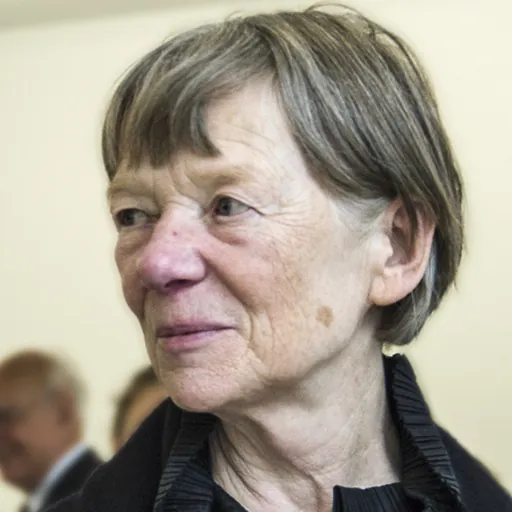
Candida Höfer
German photographer (born 1944)
About Candida Höfer
Born 1944. Candida Höfer is a German photographer, university teacher, architectural photographer, illustrator and photojournalist.
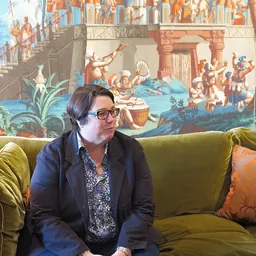
Candida Höfer (born 4 February 1944) is a German photographer known for her exploration of public spaces and architecture. In her career she transitioned from portraiture to focusing on spaces like libraries and museums. She is a former student of Bernd and Hilla Becher. Höfer's work is known for technical perfection and a strictly conceptual approach. Her work explores the ways in which institutional architecture shapes and directs human experience.
From 1997 to 2000, she taught as professor at the Karlsruhe University of Arts and Design. Höfer is the recipient of the 2018 Outstanding Contribution to Photography award, as part of the Sony World Photography Awards. She is based in Cologne.
Early life and education Candida Höfer was born in 1944 in Eberswalde, Province of Brandenburg. Höfer is a daughter of the German journalist Werner Höfer. From 1964 to 1968 Höfer studied at the Kölner Werkschulen (Cologne Academy of Fine and Applied Arts). After graduation, she began working for newspapers as a portrait photographer, producing a series on Liverpudlian poets. Along with Thomas Ruff, she was one of the first of Becher's students to use color, showing her work as slide projections. While at school, she conceived a film she shot jointly with Tony Morgan in the Düsseldorf ice cream parlour Da Forno in 1975.
Work Höfer initially worked with black-and-white photography, such as with Flipper (1973), a large photo-collage consisting of 47 gelatin silver prints. The images all depict pinball machines in arcades and pubs, sometimes seen with players and sometimes by themselves. Shortly afterwards, she began working on her 'Türken in Deutschland' (Turks in Germany) series (1973–1979), which follows Turkish migrant families in their new German homes. It was during this period that Höfer became interested in color, as she felt it suited her works better, and in interior spaces and their impact on the people who inhabit them and vice versa.
Höfer began taking color photographs of interiors of public buildings, such as offices, banks, and waiting rooms, in 1979. She tends to shoot each actionless room from an elevated vantage point near one wall so that the far wall is centered within the resulting image. From her earliest creations, she has been interested in representing public spaces such as museums, libraries, national archives or opera houses devoid of all human presence. Höfer's imagery has consistently focused on these depopulated interiors since the 1980s. Höfer groups her photographs into series that have institutional themes as well as geographical ones, but the formal similarity among her images is their dominant organizing principle.
In her Zoologische Gärten series (1991), Höfer shifted her focus away from interiors to zoos in Germany, Spain, England, France and the Netherlands. Implementing her typically descriptive style, Höfer's images again seek to deconstruct the role institutions play in defining the viewer's gaze by documenting animals in their caged environments.
In 2001, for Douze-Twelve, commissioned by the Musée des Beaux-Arts et de la Dentelle in Calais and later shown at Documenta 11, Höfer photographed all 12 casts of Auguste Rodin's The Burghers of Calais in their installations in various museums and sculpture gardens. From 2004 to 2007, she traveled the world to photograph conceptual artist On Kawara's iconic Date Paintings in the homes of private collectors. In 2005, Höfer embarked upon a project at the Musée du Louvre, documenting its various galleries, examining not only the sacred art they exhibit but also their individual design, arches, tiles and embellishments, with spectators and tourists entirely absent.
Interpretation in Institutional Photography Candida Höfer's photography, particularly her Libraries series, extends beyond architectural documentation to provide a detailed examination of institutional culture. The works parallel Sharon Macdonald's ethnographic study of the Science Museum in London. Höfer's images, marked by the absence of human presence, enable viewers to focus on the undisturbed tranquility and vibrant colors of spaces such as the British Library and the Whitney Museum. This "architecture of absence" draws attention to the unseen labor and institutional decisions that shape visitor experiences. Her large-scale photographs capture the essence of library spaces, emphasizing architectural beauty, intricate interior details, and the interplay of light and shadow. Höfer's precise use of symmetry and composition enhances the visual impact and documents the cultural and historical significance of these spaces. By highlighting architectural elements and institutional structures, her work reveals the complex interplay between architecture, institutional directives, and cultural representation. Höfer's focus on textures and materials adds a tactile dimension, intending to encourage viewers to imagine the physical sensations of these grand spaces. Some readings of her work adopt a ethnographic and thematic organization enhancing an understanding of how institutional spaces are designed and experienced, exploring the social architecture and cultural narratives inherent within these environments.
Exhibitions Höfer's first solo exhibition was in 1975 at the Konrad Fischer Galerie in Düsseldorf. Since then, Höfer has had solo exhibitions in museums throughout Europe and the United States, including the Centro de Fotografía at the Universidad de Salamanca, the Galerie de l’École des Beaux-Arts in Valenciennes, the Kunsthalle Bremen, the Louvre, the Kunsthalle Nürnberg, the Kunsthaus Hamburg, the Museum of Contemporary Photography (MoCP)), the Museum Folkwang, and the Rheinisches Landesmuseum Bonn She was a part of the "German Photography: Documentation and Introspection" at Aldrich Museum of Contemporary Art in 1990 as one of nine artists highlighted. In 2001 she was part of "Minimalismos: Un Signo de los Tiempos" at Museo Nacional Centro de Arte Reina Sofía. She was included by Okwui Enwezor in Documenta 11 in Kassel in 2002. The first comprehensive North American survey of her work was shown under the title Architecture of Absence at Norton Museum of Art in 2006. That same year, she had a solo exhibition at the Irish Museum of Modern Art, Dublin. She is currently represented by Sean Kelly Gallery and Kotaro Nukaga in Japan.
Art market The highest price reached by one of her photographs was when Biblioteca Geral da Universidade de Coimbra IV (2006) sold by £80,500 ($121,233) at Christie's London, on 12 February 2015.
Personal life Höfer lives and works in Cologne. 2018: Outstanding Contribution to Photography award, Sony World Photography Awards 2022: Achievement in Architecture, Lucie Awards 2024: Käthe Kollwitz Prize
Collections Höfer's work is held in the following permanent public collections: Jewish Museum, New York Solomon R. Guggenheim Museum, New York Museum of Modern Art, New York International Center for Photography, New York San Francisco Museum of Modern Art, San Francisco, CA Tate, London
Don’t just read it —
keep it.
Full-length biographies made to live with: read them, listen on the way to work, watch them tonight.
- E-book
- Audio
- Video
Instant download · yours to keep · every purchase keeps this site free
Important facts
People in Candida Höfer's life
Named in this biography and alive at the same time






Related people
Same field, nearest in time



Contemporaries
People whose lives overlapped Candida Höfer's




Frequently asked questions
Who is Candida Höfer?
German photographer (born 1944)
When was Candida Höfer born?
Candida Höfer was born on 4 February 1944 in Eberswalde.
What is Candida Höfer's occupation?
Candida Höfer is a photographer, university teacher, architectural photographer, illustrator and photojournalist.
What nationality is Candida Höfer?
Candida Höfer is German.
Sources & further reading
Cite this page
APA: Biography.guide. (2026). Candida Höfer. https://biography.guide/candida-hofer/
MLA: "Candida Höfer." Biography.guide, https://biography.guide/candida-hofer/.
Chicago: "Candida Höfer." Biography.guide. https://biography.guide/candida-hofer/.
Data last updated: 2026-09-22 · Spot an error? Report a correction.
Portrait: Wikimedia Commons · author & licence
Page generated 2026-09-27 05:04 UTC