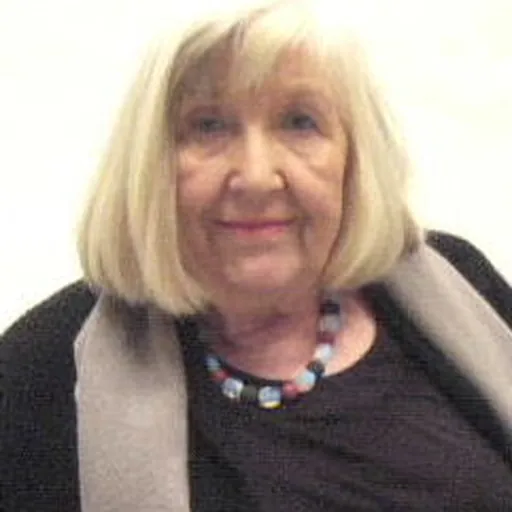
Hilla Becher
German photographer
About Hilla Becher
Lived 1934 – 2015 (aged 81). Hilla Becher was a German photographer, architectural photographer and conceptual artist.
Hilla Becher (; 2 September 1934 – 10 October 2015) was a German conceptual photographer. Becher was well known for her industrial photographs, or typologies, with longtime collaborator and husband, Bernd Becher. Her career spanned more than 50 years and included photographs from the United States, France, Germany, the Netherlands, Great Britain, Belgium, Switzerland, Luxembourg, and Italy.
Becher, alongside her husband, received the Erasmus Prize and the Hasselblad Award. The Bechers founded the Düsseldorf School of Photography in the mid-1970s.
In 2015, she died from a stroke at age 81, in Düsseldorf.
Childhood Becher was born in Potsdam, East Germany. Her mother attended Lette-Haus, a photography school for women, and occasionally worked in a studio, retouching photographs. Her father was a high school language teacher, later drafted to World War II.
Hilla Becher was exposed to photography early in life. Becher began photographing at thirteen years old with a 9×12 cm plate-camera. Becher photographed her teachers in high school. She printed and sold photographs at postcard size for the teachers. She was expelled from high school and became an intern for Walter Eichgrun, a working studio and commissioned photographer, in 1951, while studying photography at a vocational school and finishing her high school degree in Berlin. She spent three years working on commission with Eichgrun and did various solo assignments. In 1954, she and her mother moved to West Germany, where she worked as a freelance photographer in Hamburg. In 1957, she was offered a job in Düsseldorf, Germany as an advertising photographer and around 1958, she enrolled into the Kunstakademie Düsseldorf under Walter Breker studying graphic design and printing techniques. The Bechers traveled in a Volkswagen photographing industrial sites all over Germany, Belgium, Luxembourg, and France, then eventually, Britain and the US.
In an interview with Süddeutsche Zeitung Magazin, Hilla Becher claimed that her husband disliked photography at the beginning of the career. Originally a sketch artist, Bernd believed that photography was more a "means to an end" to further detail in his sketches rather than its own artistic medium. In the same interview, Hilla maintained that though the couple worked as a team, Bernd was the driving force because he was more of a perfectionist than she was.
Bernd died at 75 years old on 22 June 2007 from complications during heart surgery. By that time, their work had achieved worldwide acknowledgements, fascinating other photographers such as Stephen Shore. Their wide influence was also due to their roles as professors at Kunstakademie Düsseldorf, where some of their students included Candida Höfer, Andreas Gursky, and Thomas Ruff.
The couple, after Hilla's death in 2015, is survived by their only son, Max Becher, and his two children.
Work The beginning of their on-going project was part of the “...polemical return to the “straight” aesthetics and social themes of the 1920s and 1930s in response to the postpolitical and postindustrial subjectivist photographic aesthetics that arose in the early postwar period.” (Heckert, Virginia) Most subjects of the works of “...industrial structures-water towers, blast furnaces, gas tanks, mine heads, grain elevators, and the like-in the late 1950s.” (Heckert, Virginia) Bernd and Hilla Becher's once said about the works, “The idea is to make families of objects,” or, on another occasion, “to create families of motifs [that] become humanized and destroy one another, as in Nature where the older is devoured by the newer.” (Heckert, Virginia) Bernd and Hilla Becher's works are shown as a group to establish a “...movement itself from image to image to image aimed to be the story more than did the sum of the collected parts, regardless of whether it is the movement of the photographer himself or herself, or the camera, or the movement of our own eye as it skips from one photograph to the next.” (Heckert, Virginia).
The Becher's wanted to focus on what the images provide to the viewer when viewed together, e.g. an anatomy of the relations between constituent parts. Bernd and Hilla Becher's background with Germany and the inspirations from works of August Sander and company. Concepts such as ‘New Objectivity.’ Carrying forward Bernd and Hilla Becher's work is the machine age photographers, albeit complexly. Some describe it as “industrial archaeology” or “a contribution to the social history of industrial work.” Some criticisms of the concept, that those assumptions are misleading. The photographs were captured during overcast skies early in the morning, to remove shadows and convey as many details as possible. When displayed, the images are often grouped in a grid pattern by subject or as diptychs.
Art Framework Houses, 1959–1973 Water Towers, 1963–1993 Fforchaman Colliery, Rhondda Valley, South Wales, United Kingdom, 1966 Winding Towers, 1966–1997 Knutange, Lorraine, France, 1971 Hanover Mine 1/2/5, Bochum-Hordel, Ruhr Region..., 1973 Coal Mine, Bear Valley, Schuylkill County... 1974 Consolidation Mine, Gelsenkirchen, Ruhr Region Coal Tipple, Goodspring, Pennsylvania, 1975 Water Towers, 1988.
1963
Galerie Ruth Nohl, Siegen, Germany
1965
Galerie Pro, Bad Godesburg, Germany
1966
Staatliche Kunstakademie, Düsseldorf
1967
Staatliches Museum, Munich Technische Hochschule, Karlsruhe Bergbau-Museum, Bochum, Germany Kunstakademi, Copenhagen
1968
Stedelijk Van Abbemuseum, Eindhoven, Netherlands Wachsman Institute, University of Southern California Goethe Center, San Francisco Galerie Ruth Nohl, Siegen, Germany Städtisches Museum, Mönchengladbach, Germany
1969
Städtisches Kunsthalle, Düsseldorf
1970
Moderna Museet, Stockholm Galerie Konrad Fischer, Düsseldorf Städtisches Museum, Ulm, Germany
1971
Kabinett für Aktuelle Kunst, Bremerhaven, Germany Gegenverkehr, Aachen, Germany
1972
Sonnabend Gallery, New York Bennington College, Vermont
1973
Galleria Forma, Genoa Nigel Greenwood Inc., London Sonnabend Gallery, New York
1974
Institute of Contemporary Art, London (traveled) San Diego Museum of Contemporary Art, California Sonnabend Gallery, New York
1975
Rheinisches Landesmuseum, Bonn Museum of Modern Art, New York Sonnabend Gallery, New York Galleria Casteli, Milan
Legacy In response to a post-war Germanic period, Becher's "subjective photography" tries to humanize, naturalize, and synthesize Germany's history and idealization within the industrialized comportment. The Machine Age brought a visual pace that was "ever-accelerating, ever expanding" and highly juxtaposed to the past, more subdued, Germanic lifestyle. Becher sought to capture the underlying function and organization of this new ideal by ultimately picturing these differences in industrialization. Becher's work is often said to be continuous in that each photograph cannot stand on its own; Becher's work is a body of work and a thematic response in framing the political, enlightening, and responsive post-war Germany.
Becher's work was innovative in that, by capturing the post-war, she has ultimately defined Germany before mass industry and by the idealized past. Stimson, from Tate Paper, writes "by shooting the grand icons of the Machine Age 'straight-on' so they do not, they have claimed 'hide or exaggerate or depict anything in an untrue fashion', by committing themselves to an ethic of representation free of bogus political elevation or degradation, they realize one leg of their generation's postmodern affect". 2014: , sponsored by the Sparkassen-Kulturstiftung Rheinland, awarded to Hilla Becher.
Don’t just read it —
keep it.
Full-length biographies made to live with: read them, listen on the way to work, watch them tonight.
- E-book
- Audio
- Video
Instant download · yours to keep · every purchase keeps this site free
Important facts
Family & relationships
People in Hilla Becher's life
Named in this biography and alive at the same time





Related people
Same field, nearest in time





Contemporaries
People whose lives overlapped Hilla Becher's





Frequently asked questions
Who was Hilla Becher?
German photographer (1934–2015)
When was Hilla Becher born?
Hilla Becher was born on 2 September 1934 in Potsdam.
When did Hilla Becher die?
Hilla Becher died on 10 October 2015 in Düsseldorf.
What was Hilla Becher's occupation?
Hilla Becher was a photographer, architectural photographer and conceptual artist.
What nationality was Hilla Becher?
Hilla Becher was German.
Sources & further reading
Cite this page
APA: Biography.guide. (2026). Hilla Becher. https://biography.guide/hilla-becher/
MLA: "Hilla Becher." Biography.guide, https://biography.guide/hilla-becher/.
Chicago: "Hilla Becher." Biography.guide. https://biography.guide/hilla-becher/.
Data last updated: 2026-09-21 · Spot an error? Report a correction.
Portrait: Wikimedia Commons · author & licence
Page generated 2026-09-27 05:00 UTC