
About Kanō Eitoku
Lived 1543 – 1590 (aged 47). Kanō Eitoku was a Japanese painter.
was a Japanese painter who lived during the Azuchi–Momoyama period of Japanese history and one of the most prominent patriarchs of the Kanō school of Japanese painting.
Life and works Born in Kyoto, Eitoku was the grandson of Kanō Motonobu (1476–1559), an official painter for the Ashikaga shogunate. He showed his talent for painting at an early age, and at the age of 10 he had an audience with the shōgun Ashikaga Yoshiteru alongside Motonobu.
While there are various theories regarding the exact years of creation, in his early twenties, he created two works that are now considered National Treasures: and the paintings entitled at Jukō-in, a subtemple of the Daitoku-ji Temple. At a young age, he had acquired skills equivalent to those of Kano Motonobu. He painted the in 1565 at the request of Ashikaga Yoshiteru. Subsequently, Oda Nobunaga acquired the artwork to demonstrate his control over Kyoto and the shogunate, and presented it to Uesugi Kenshin. The is a depicting the scenery and customs of Kyoto, and among the designated National Treasures, there are only two: the version known as the Uesugi edition by Kano Eitoku and the Funaki edition by Iwasa Matabei.
Eitoku's patrons included Oda Nobunaga and Toyotomi Hideyoshi. He was hired by Nobunaga at the age of 34. His standing screen, sliding door, wall, and ceiling paintings decorated Nobunaga's Azuchi castle and Hideyoshi's residence in Kyoto and Osaka Castle. Contemporary accounts indicate that Eitoku was one of the most highly sought-after artists of his time, and received many wealthy and powerful patrons. Maintaining the preeminence of the Kanō School was not merely an artistic feat, but an organizational and political one also. Eitoku was able to secure a steady stream of commissions and an efficient workshop of students and assistants, and at one point successfully intercepted a warlord's commission of the rival Hasegawa Tōhaku studio.
Style His signal contribution to the Kanō repertoire was the so-called "monumental style" (taiga), characterized by bold, rapid brushwork, an emphasis on foreground, and motifs that are large relative to the pictorial space. The traditional account for this style, codified by Eitoku's great-grandson Einō (1631–97) in his History of Japanese Painting (Honcho gashi), is that it resulted partly from the exigencies of Eitoku's busy schedule, and that it embodied the martial and political bravura of the warlords, Nobunaga and Hideyoshi.
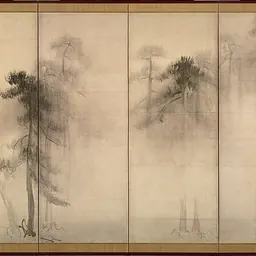
Most of his works were destroyed in the turmoil of the Sengoku period. Symbolic representations, like pheasants, phoenixes and trees are often depicted in the works. The pheasant, for example is the national symbol of Japan, are mythological messengers of the sun goddess Amaterasu.
Works
Don’t just read it —
keep it.
Full-length biographies made to live with: read them, listen on the way to work, watch them tonight.
- E-book
- Audio
- Video
Instant download · yours to keep · every purchase keeps this site free
Important facts
People in Kanō Eitoku's life
Named in this biography and alive at the same time

Related people
Same field, nearest in time

Contemporaries
People whose lives overlapped Kanō Eitoku's




Frequently asked questions
Who was Kanō Eitoku?
Japanese artist (1543-1590)
When was Kanō Eitoku born?
Kanō Eitoku was born on 16 February 1543 in Heian-kyō.
When did Kanō Eitoku die?
Kanō Eitoku died on 12 October 1590 in Heian-kyō.
What was Kanō Eitoku's occupation?
Kanō Eitoku was a painter.
What nationality was Kanō Eitoku?
Kanō Eitoku was Japanese.
Sources & further reading
Cite this page
APA: Biography.guide. (2026). Kanō Eitoku. https://biography.guide/kano-eitoku/
MLA: "Kanō Eitoku." Biography.guide, https://biography.guide/kano-eitoku/.
Chicago: "Kanō Eitoku." Biography.guide. https://biography.guide/kano-eitoku/.
Data last updated: 2026-09-25 · Spot an error? Report a correction.
Page generated 2026-09-27 05:12 UTC