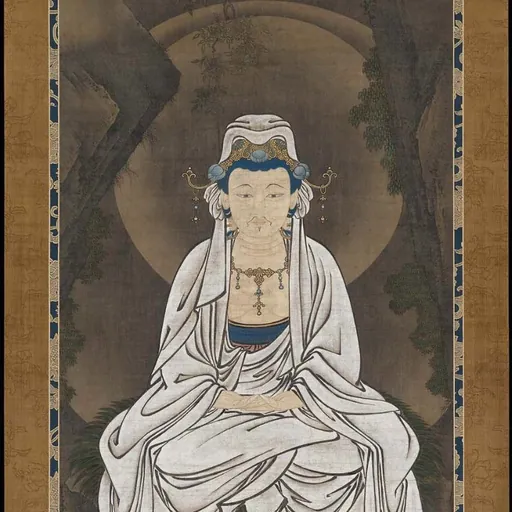
About Kanō Motonobu
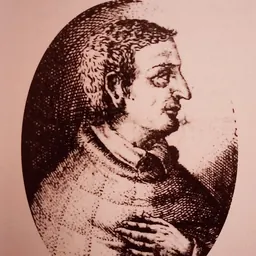
Lived 1476 – 1559 (aged 83). Kanō Motonobu was a Japanese painter.
was a Japanese painter and calligrapher. He was a member of the Kanō school of painting. Through his political connections, patronage, organization, and influence he was able to make the Kanō school into what it is today. The system was responsible for the training of a great majority of painters throughout the Edo period (1603–1868). After his death, he was referred to as Kohōgen (古法眼).
Family background The Kanō family are presumed to be the descendants from a line of warriors from the Kanō district. The Kanō district is now called Shizuoka Prefecture. The forebear of this family was Kanō Kagenobu. He seems to have been a retainer of the Imagawa family. It has been reported that he painted a picture of Mount Fuji for a visit to the shōgun Ashikaga Yoshinori in 1432. The Kanō family dominated the painting world from the end of the Muromachi period (1336–1573) to the end of the Edo period (1603–1868).
Kanō Masanobu, Motonobu's father, was the founder of the Kanō school. Kanō Masanobu was the official court painter to the Ashikaga shogunate in 1481. Masanobu was a professional artist whose style derived from the Kanga style (Chinese-style ink painting). Masanobu’s descendants were the people that made up the Kanō school. The Kanō school had secular ink painters.
Career At the age of 10 years old, he become an attendant of general Yoshihisa Ashikaga, and it is said that he served Yoshizumi Ashikaga.
Since Kanō Motonobu was a son and heir of the founder of the Kanō School, Kanō Masanobu, he was likely trained in Kanga (Chinese-style ink painting) by his father. Right away Motonobu showed great promise as an artist and procured several commissions from major patrons as early as nine years old. Such patrons include the Ashikaga shogunate, members of the imperial aristocracy, Kyoto merchant class, and major Kyoto shrines and temples.
Portrait of Hosokawa Takakuni by Kanō Motonobu, Tōrin-in, 1543One of his earliest documented contracts was for a set of votive plaques (e-ma) depicting for the Thirty-six Poetry Immortals for the Shinto shrine of Itsukushima. It was commissioned by a group of Sakai merchants in 1515 and the pieces are now located in Hiroshima Prefecture.
By the 1530s Motonobu had married the daughter of the head of the Tosa School of painting, Tosa Mitsunobu, had three sons (Shōei [1519–1592], Yusetsu [1514–1562], and Joshin), and lead a small Kanō sect in northern Kyoto. The workshop contains roughly ten people containing Motonobu, his three sons, Motonobu’s younger brother Yukinobu (1513–1575), and some assistants that might have not been blood related.
Works Kurama-dera engi (‘Origins of Kurama temple’; Zen Patriarchs), 1513. Separated and distributed into hanging scrolls, ink and color on paper, 175.1 x 88.4 cm. Tokyo National Museum, Tokyo, Japan. https://mdid3.uwsp.edu/data/record/10512/2015_00571jpg/ Em-a Thirty Six Immortal Poets, 1515. Hanging Scroll ink on paper. Shinto shrine of Itsukushima. The Four Accomplishments, mid-16th century. Pair of six-panel folding screens; ink and color on paper. https://www.metmuseum.org/art/collection/search/44673 Bo Ya Plays the Qin as Zhong Ziqi Listens, 1530s. Hanging scroll, ink on paper, Image: 65 1/16 × 34 1/4 in. (165.2 × 87 cm) Overall with mounting: 8 ft. 10 7/8 in. × 40 13/16 in. (271.5 × 103.7 cm) Overall with knobs: 8 ft. 10 7/8 in. × 43 3/16 in. (271.5 × 109.7 cm). https://www.metmuseum.org/art/collection/search/53233 Bamboo Stalks, Rocks and Cranes, 15th century. Ink on paper. https://www.japantimes.co.jp/culture/2017/10/24/arts/motonobu-father-kano-styles/#.Woc1ZZM-cWo White-robed Bodhisattva of Compassion, Early 16th century. Hanging scroll, ink and color on paper, Image: 157.2 x 76.4 cm (61 7/8 x 30 1/16 in.) Mount (with jiku): 256.5 x 104.1 cm (101 x 41 in.). Museum of Fine Arts Boston, Fenollosa-Weld Collection. http://www.mfa.org/collections/object/white-robed-bodhisattva-of-compassion-24752 49 Landscapes with Flowers and Birds, Early 16th century. Hanging Scroll, mounted ink and color on paper, Kyoto Shinto Shrine. Hosokawa Sumimoto on Horseback, 1507. Hanging Scroll, ink and color on paper. Eisei Bunko Museum. Portrait of Hosokawa Takakuni, 1543. Hanging Scroll, ink and color on paper. Tōrin-in. Mountain and Water, Hanging Scroll, ink and color on paper. Tokyo National Museum. Shuten Dōji emaki (Picture Scrolls of Shuten Dōji), Early 16th century. Set of three hand scrolls, colour on paper, Vol. 1: H. 33.0, W. 1751.7/ Vol. 2: H. 33.0, W. 2100.0/ Vol. 3: H. 33.0, W. 2788.9. Suntory Art Museum, Tokyo, Japan. https://www.suntory.com/sma/collection/gallery/detail?lang=en&id=626
Don’t just read it —
keep it.
Full-length biographies made to live with: read them, listen on the way to work, watch them tonight.
- E-book
- Audio
- Video
Instant download · yours to keep · every purchase keeps this site free
Important facts
more
Motonobu (1476), Kanou MotonobuPeople in Kanō Motonobu's life
Named in this biography and alive at the same time

Related people
Same field, nearest in time



Contemporaries
People whose lives overlapped Kanō Motonobu's




Frequently asked questions
Who was Kanō Motonobu?
Japanese painter (1476-1559)
When was Kanō Motonobu born?
Kanō Motonobu was born on 28 August 1476 in Kyoto.
When did Kanō Motonobu die?
Kanō Motonobu died on 5 November 1559 in Kyoto.
What was Kanō Motonobu's occupation?
Kanō Motonobu was a painter.
What nationality was Kanō Motonobu?
Kanō Motonobu was Japanese.
Sources & further reading
Cite this page
APA: Biography.guide. (2026). Kanō Motonobu. https://biography.guide/kano-motonobu/
MLA: "Kanō Motonobu." Biography.guide, https://biography.guide/kano-motonobu/.
Chicago: "Kanō Motonobu." Biography.guide. https://biography.guide/kano-motonobu/.
Data last updated: 2026-09-22 · Spot an error? Report a correction.
Portrait: Wikimedia Commons · author & licence
Page generated 2026-09-27 05:01 UTC