
Juris Hartmanis
Latvian computer scientist
About Juris Hartmanis
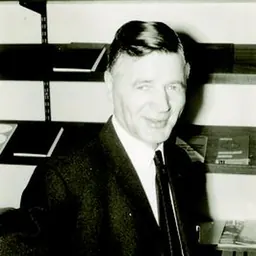
Lived 1928 – 2022 (aged 94). Juris Hartmanis was a Latvian and American mathematician, computer scientist, university teacher and editor.
Juris Hartmanis (July 5, 1928 – July 29, 2022) was a Latvian-born American computer scientist and computational theorist who, with Richard E. Stearns, received the 1993 ACM Turing Award "in recognition of their seminal paper which established the foundations for the field of computational complexity theory".
Life and career Hartmanis was born in Latvia on July 5, 1928. He was a son of , a general in the Latvian Army, and Irma Marija Hartmane. He was the younger brother of the poet Astrid Ivask. After the Soviet Union occupied Latvia in 1940, Mārtiņš Hartmanis was arrested by the Soviets and died in prison. Later in World War II, the wife and children of Mārtiņš Hartmanis left Latvia in 1944 as refugees, fearing for their safety if the Soviet Union took over Latvia again. In two of the interviews
They first moved to Germany, where Juris Hartmanis received the equivalent of a master's degree in physics from the University of Marburg. He then moved to the United States, where in 1951 he received a master's degree in applied mathematics at the University of Kansas City (now known as the University of Missouri–Kansas City) and in 1955 a Ph.D. in mathematics from Caltech under the supervision of Robert P. Dilworth. The University of Missouri–Kansas City honored him with an Honorary Doctor of Humane Letters in May 1999. which made recommendations based on its priorities to sustain the core effort in CS&E, to broaden the field, and to improve undergrad education in CS&E. He was assistant director of the National Science Foundation (NSF) Directorate of Computer and Information Science and Engineering (CISE) from 1996 to 1998.
In 1989, Hartmanis was elected as a member into the National Academy of Engineering for fundamental contributions to computational complexity theory and to research and education in computing. He was a Fellow of the Association for Computing Machinery and of the American Mathematical Society, also a member of the National Academy of Sciences. He was also a foreign member of the Latvian Academy of Sciences,
Computational complexity: foundational contributions In 1993, Hartmanis and R.E. Stearns received the highest prize in computer science, the Turing Award. The citation reads, "In recognition of their seminal paper which established the foundations for the field of computational complexity theory." He and his coauthors also defined the Boolean hierarchy.
Hartmanis's 1981 article gives a personal account of developments in this area and in automata theory and discusses the underlying beliefs and philosophy that guided his research. The book written in honor of his 60th birthday, in particular, the chapter by Stearns, is a valuable resource on computational complexity.
In the late 1980s, Hartmanis's exposition 1981 Member, National Academy of Engineering, 1989 Member (foreign): Latvian Academy of Sciences, 1990 Member, American Academy of Arts and Sciences, 1992 ACM Turing Award 1993 Humboldt Foundation Research Award, 1993 Charter Fellow, ACM, 1994 Honorary Doctor of Humane Letters, 2000 of the Latvian Academy of Sciences, 2001 ACM Distinguished Service Award, 2013 Inaugural Fellow, American Mathematical Society, 2013
Selected publications Books
Algebraic Structure Theory of Sequential Machines 1966 (with R.E. Stearns) Feasible Computations and Provable Complexity Properties 1978 Computational Complexity Theory (ed.) 1989 Computing the Future: A broader agenda for computer science and engineering (ed.) 1992 (with Herbert Lin)
Selected articles
"Computational complexity of recursive sequences" 2010 Len Shustek interviews Hartmanis in an article in Communications of the ACM, 2015 David Gries interviews Hartmanis as ACM Turing Award recipient,
Don’t just read it —
keep it.
Full-length biographies made to live with: read them, listen on the way to work, watch them tonight.
- E-book
- Audio
- Video
Instant download · yours to keep · every purchase keeps this site free
Important facts
People in Juris Hartmanis's life
Named in this biography and alive at the same time


Related people
Same field, nearest in time

Contemporaries
People whose lives overlapped Juris Hartmanis's




Frequently asked questions
Who was Juris Hartmanis?
Latvian computer scientist (1928–2022)
When was Juris Hartmanis born?
Juris Hartmanis was born on 5 July 1928 in Riga.
When did Juris Hartmanis die?
Juris Hartmanis died on 29 July 2022.
What was Juris Hartmanis's occupation?
Juris Hartmanis was a mathematician, computer scientist, university teacher and editor.
What nationality was Juris Hartmanis?
Juris Hartmanis was Latvian and American.
Sources & further reading
Cite this page
APA: Biography.guide. (2026). Juris Hartmanis. https://biography.guide/juris-hartmanis/
MLA: "Juris Hartmanis." Biography.guide, https://biography.guide/juris-hartmanis/.
Chicago: "Juris Hartmanis." Biography.guide. https://biography.guide/juris-hartmanis/.
Data last updated: 2026-09-20 · Spot an error? Report a correction.
Page generated 2026-09-27 05:20 UTC