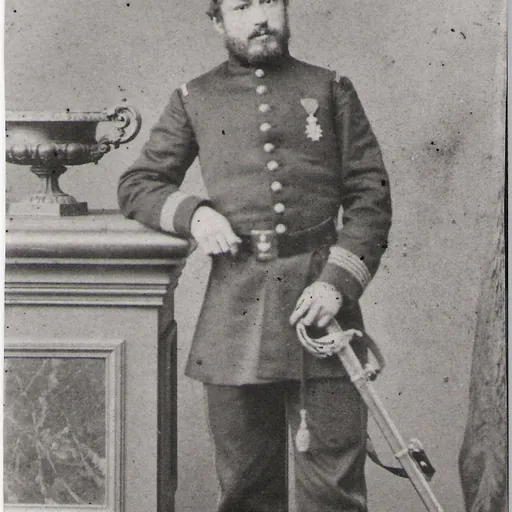
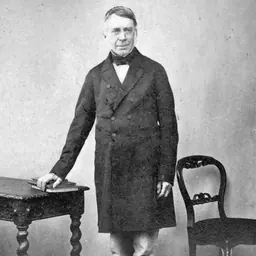
Jules Garnier
French mining engineer (1839-1904) and discoverer of New Caledonian nickel
About Jules Garnier
Lived 1839 – 1904 (aged 64). Jules Garnier was a French engineer, military personnel, writer, traveler and geologist.
Jacque Jules Garnier (25 November 1839 in Saint-Étienne – 8 March 1904 in Gorbio) was a French engineer and industrialist.
Biography
Garnier studied at the Saint-Étienne School of Mines (1860). Upon leaving the School of Mines of Saint-Étienne, he worked for two years at the Steelworks of the Navy and the Railways, then carried out a geological study in Sardinia in 1862. He was sent to Nouméa as head of the mines department of New Caledonia in 1863. Until 1866 he traveled the island and discovered a new green nickel ore, having a large weight percent of nickel oxide, which was named garnierite in his honor by his peers. This discovery was formalized at the Paris Academy of Sciences in 1876. He also undertook missions in Canada. He received the Legion of Honor at the age of 28.
Engineer-inventor, Jules Garnier is also known for the importance and diversity of his writings. Beyond the "simple" publication of research results and/or various projects, Jules Garnier was also a writer. He published many articles in the fields of science and technology, but also in journals of geography. His bibliography consists of more than 30 references, including his travelogues, his reference book "Le Fer" (i.e. "Iron"), and several inventions in various fields. After 1870, he even became secretary of the Geographical Society of Paris.
Jules Garnier died in Gorbio on 8 March 1904. He is buried in the cemetery of Crêt de Roch in Saint-Étienne. Jules Garnier still remains for New Caledonia, a key character in the origin of its industrial development. A school there, and a street in Nouméa bear his name. A species of New Caledonian lizard, Phoboscincus garnieri, is named in his honor.
Publications and works
Voyage à la Nouvelle-Calédonie, 1867-1868, reéd. 1978, éd. du Cagou, Excursion autour de l'île de Tahiti, ed. E. Martinet 1869 Notes géologiques sur l'Océanie, les îles Tahiti et Rapa Paris, ed. Dunod 1870 Les Migrations Polynésiennes en Océanie d'après les faits naturels Paris, ed. E. Martinet 1870 Voyage autour du Monde : OCÉANIE les îles des pins, Loyalty et Tahiti Paris, ed. Plon 1871 La Lithologie du fond des mers by M. Delesse, Report and Excerpts by M. Jules Garnier, 1872 Dianémomètre with M. Deprez ed. Imprimerie de J. Desoer, 1872 Machines à percer, couper et abattre les roches, Emploi de la Nitroglycérine with Ernest Javal St Étienne, ed. Imprimerie de V° Théolier et Co 1891 L'Or et le Diamant au Transvaal et au Cap, ed. Librairie Polytechnique Baudry et Cie, 1896
Don’t just read it —
keep it.
Full-length biographies made to live with: read them, listen on the way to work, watch them tonight.
- E-book
- Audio
- Video
Instant download · yours to keep · every purchase keeps this site free
Important facts
Related people
Same field, nearest in time

Contemporaries
People whose lives overlapped Jules Garnier's


Frequently asked questions
Who was Jules Garnier?
French mining engineer (1839-1904) and discoverer of New Caledonian nickel
When was Jules Garnier born?
Jules Garnier was born on 25 November 1839 in Saint-Étienne.
When did Jules Garnier die?
Jules Garnier died on 8 March 1904 in Gorbio.
What was Jules Garnier's occupation?
Jules Garnier was an engineer, military personnel, writer, traveler and geologist.
What nationality was Jules Garnier?
Jules Garnier was French.
Sources & further reading
Cite this page
APA: Biography.guide. (2026). Jules Garnier. https://biography.guide/jules-garnier/
MLA: "Jules Garnier." Biography.guide, https://biography.guide/jules-garnier/.
Chicago: "Jules Garnier." Biography.guide. https://biography.guide/jules-garnier/.
Data last updated: 2026-09-22 · Spot an error? Report a correction.
Portrait: Wikimedia Commons · author & licence
Page generated 2026-09-27 05:03 UTC