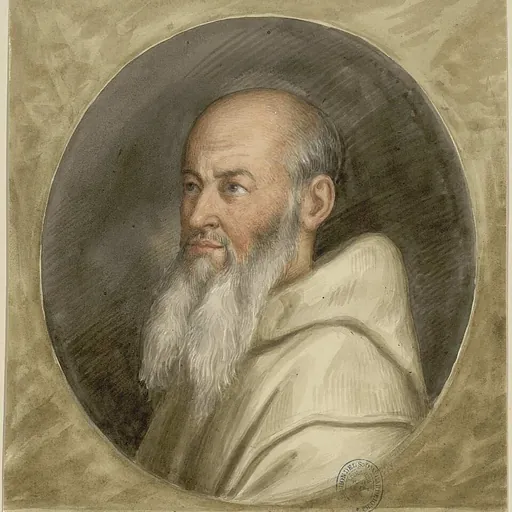
About Juan Sánchez Cotán
Lived 1560 – 1627 (aged 67). Juan Sánchez Cotán was a Spanish painter.
Juan Sánchez Cotán (June 25, 1560 – September 8, 1627) was a Spanish Baroque painter, a pioneer of realism in Spain. His still lifes and bodegones were painted in an austere style, especially when compared to similar works in the Netherlands and Italy.
Life Brígida del Río, the Bearded Lady of Peñaranda; 1590, 102 × 61 cm, Prado Museum. Sánchez Cotán was born in the town of Orgaz, near Toledo, Spain. He was a friend and perhaps pupil of Blas de Prado, an artist famous for his still lifes whose mannerist style with touches of realism the disciple developed further. Cotán began by painting altarpieces and religious works. For approximately twenty years, patronized by the city's aristocracy, he pursued a successful career as an artist in Toledo painting religious scenes, portraits and still lifes. These paintings found a receptive audience among the educated intellectuals of Toledo society. Sánchez Cotán executed his notable still lifes around the beginning of the seventeenth century, before the end of his secular life.
Sánchez Cotán painted several Catholic works for the Carthusians, like The Carthusians Building the First Monastery of Santa Maria de las Cuevas; after 1603, Granada Charterhouse. On August 10, 1603, Sánchez Cotán, then in his forties, closed up his workshop at Toledo to renounce the world and enter the Carthusian monastery Santa Maria de El Paular. He continued his career painting religious works with singular mysticism. In 1612 he was sent to the Granada Charterhouse; he decided to become a monk, and in the following year he entered the Carthusian monastery at Granada as a lay brother. The reasons for this are not clear, though such action was not unusual then.
Cotán was a prolific religious painter whose work, carried out exclusively for his monastery, reached its peak about 1617 in the cycle of eight great narrative paintings that he painted for the cloister of the Granada Monastery. These depict the foundation of the order of St. Bruno, and the prosecution of the monks in England by the Protestants. Although the painter's religious works have an archaic air, they also reveal a keen interest in the treatment of light and volume, and in some respects are comparable with certain works by the Italian Luca Cambiaso, whom Cotán knew at the Escorial.
In spite of his retreat from the world, Cotán's influence remained strong. His concern with the relationships among objects and with achieving the illusion of reality through the use of light and shadow was a major influence on the work of later Spanish painters such as Juan van der Hamen, Felipe Ramírez, the brothers Vincenzo and Bartolomeo Carducci and, notably, Francisco de Zurbarán. Sánchez Cotán ended his days universally loved and regarded as a saint. He died in 1627 in Granada.
Style Sánchez Cotán utilized motifs of Tenebrism in several of his religious works, such as The Virgin Waking the Child; 1603–27, 110 × 84 cm, Museo de Bellas Artes de Granada. Sánchez Cotán stylistically falls within the school of El Escorial, with Venetian influence, and his works can be placed in the transition from Mannerism to Baroque. He was an early pioneer of Tenebrism at the beginning of the golden age of Spanish painting. Although his religious paintings have a primitive sensitivity and a peaceful rhythm, Cotán's high stature in art history rests exclusively on his still lifes, of which only a few are extant. Their severe naturalism has little in common with the artistic style then prevalent.
Still lifes Sánchez Cotán established the prototype of the Spanish still life depicting pantry items, called a bodegón, composed mainly of vegetables. Characteristically, he depicts a few simple fruits or vegetables, some of which hang from a fine string at different levels while others sit on a ledge or window. The forms stand out with an almost geometric clarity against a dark background. This orchestration of still life in direct sunlight against impenetrable darkness is the hallmark of early Spanish still life painting. Each form is scrutinized with such intensity that the pictures take on a mystical quality, and the reality of things is intensified to a degree that no other seventeenth-century painter would surpass.
Norman Bryson describes Sánchez Cotán's spare representations as abstemious images and links his work to his later monastic life. They are supposed to express a monastic denial of worldly pleasure and richness: "Absent from Cotán's work is any conception of nourishment as involving the conviviality of the meal .... What replaces their interest as sustenance is their interest as mathematical form."
Gallery
Don’t just read it —
keep it.
Full-length biographies made to live with: read them, listen on the way to work, watch them tonight.
- E-book
- Audio
- Video
Instant download · yours to keep · every purchase keeps this site free
Important facts
more
Juan Sanchez Cottan, Sanchez Cotan, Juan Sanchez, CottanPeople in Juan Sánchez Cotán's life
Named in this biography and alive at the same time



Related people
Same field, nearest in time

Contemporaries
People whose lives overlapped Juan Sánchez Cotán's



Frequently asked questions
Who was Juan Sánchez Cotán?
Spanish artist (1560-1627)
When was Juan Sánchez Cotán born?
Juan Sánchez Cotán was born on 25 June 1560 in Orgaz.
When did Juan Sánchez Cotán die?
Juan Sánchez Cotán died on 8 September 1627 in Granada.
What was Juan Sánchez Cotán's occupation?
Juan Sánchez Cotán was a painter.
What nationality was Juan Sánchez Cotán?
Juan Sánchez Cotán was Spanish.
Sources & further reading
· Wikipedia: Juan Sánchez Cotán
Cite this page
APA: Biography.guide. (2026). Juan Sánchez Cotán. https://biography.guide/juan-sanchez-cotan/
MLA: "Juan Sánchez Cotán." Biography.guide, https://biography.guide/juan-sanchez-cotan/.
Chicago: "Juan Sánchez Cotán." Biography.guide. https://biography.guide/juan-sanchez-cotan/.
Data last updated: 2026-09-22 · Spot an error? Report a correction.
Portrait: Wikimedia Commons · author & licence
Page generated 2026-09-27 05:02 UTC