
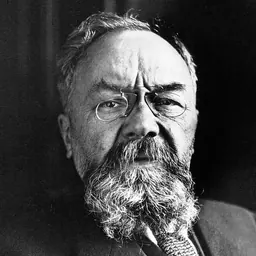
About Joseph Wharton
Lived 1826 – 1909 (aged 82). Joseph Wharton was an American engineer, metallurgist, scientist, entrepreneur, businessperson and business magnate.
Zinc and nickel manufacturing In 1853, Wharton joined the Pennsylvania and Lehigh Zinc Company near Bethlehem, Pennsylvania. He first managed the mining operation and then the zinc oxide works. Wharton negotiated a new charter for the works, and in the difficult financial environment of 1857–1858, he took over control of the zinc works, and managed it carefully so that it turned a profit. In 1859, he developed the first production of metallic zinc, or spelter, in the United States. In 1905, Wharton's American Nickel Works were merged with the Orford Copper Company which ended Wharton's involvement in nickel manufacturing.
Water supply efforts The Wharton family's Bellevue Mansion estate in North Philadelphia, along with several others nearby that had been annexed into the city, were threatened with condemnation by the city for the construction of a new reservoir to hold potable water. Wharton started purchasing land in South Jersey in the 1870s, eventually acquiring in the Pinelands, which contained an aquifer replenished by several rivers and lakes. The water from the Pinelands was relatively pure and he planned to export the water to Philadelphia. Wharton suggested that a city-controlled company could develop the necessary water mains and pump, funded by public purchase of company shares and bonds. Opposition to the plan emerged in Philadelphia and in New Jersey, and eventually, a law was passed in New Jersey preventing the export of water.
Mining and railroads Wharton traveled widely and became involved in many industrial enterprises such as mines, factories and railroads. He started several enterprises on South Jersey property, including a menhaden fish factory that produced fertilizer, and Hibernia Mine Railroad.
Bethlehem Steel
In the 1870s Wharton began to invest in Bethlehem Iron Company which produced pig iron and steel for railroads.
In the winter of 1883–1884 there was a period of several months when sunsets were extraordinarily red worldwide. Some imagined that the red color was from dust dispersed in the atmosphere worldwide by the volcano Krakatoa, which erupted. Others imagined that the reddish hue might come from iron and steel furnaces because they were known to create a reddish-brown dust. Wharton was curious, and one morning when a light snow was falling, collected some from a field near his house, melted and evaporated it, studying the remaining particles under a microscope, which he had on hand for metallurgy. The particles looked like "irregular, flattish, blobby" glass particles. He visited a ship from Manila that arrived in port in Philadelphia, a course that took a few hundred miles from Krakatoa. It had been slowed by a huge amount of pumice floating in the ocean, evidently spewed out by Krakatoa. Wharton obtained some pumice from one of the ship's crew, compared it with the dust he had collected, and found almost identical particles. In 1893, Wharton presented a paper about the dust to the 150th anniversary meeting of the American Philosophical Society.
Wharton also wrote a paper about the use of the Doppler effect on the color of light emitted by binary stars to determine their distance from Earth, and made the analogy to a train whistle which changes tone as it passes.
Wharton served as president of the American Iron and Steel Association and as a member of the Iron and Steel Institute.
Final years and death
Wharton was active to near the end of his life both physically and in business affairs. Until he was 72, he skated with guests on the pond at his Ontalauna estate near Philadelphia and would often go on walks with his family after dinner. He practiced total abstinence from tobacco and restricted use of alcohol. When he was nearly 80, he visited his Nevada silver mine by canoeing down the Colorado River and descending into the mine in a bucket, and when he was 81, he traveled to Germany with his grandson, Joseph Wharton Lippincott, to visit Kaiser Wilhelm II and had dinner on the kaiser's yacht.
He read widely in literature and was an accomplished poet. Many of his poems were inspired by trips abroad. He wrote "Stewardson's Yarn" after an 1873 visit to Europe, "The Royal Palm" and "The 'Sweet Reasonableness' of a Yankee Philistine in Cuba" after a visit to Cuba to inspect mines there, and "Mexico" after an 1889 visit to Mexico. A domestic journey to Nevada to see his gold mines there resulted in "The Buttes of the Canyon".
In 1907, Wharton experienced a stroke while travelling in London. He survived the stroke and was able to travel home but never fully recovered his health. In 1908 he established the Wharton Steel Company with assets valued over $10 million and transferred all of his coke, iron, limestone, pig iron and railroad interests into this entity. His health was worsened by a fall and he died at his Ontalauna estate on January 11, 1909, at age 82. He was interred at Laurel Hill Cemetery in Philadelphia.
Personal life Wharton married Anna Corbit Lovering, on June 15, 1854. After living with Anna's family for several months, the couple moved into a near 12th and Walnut streets in Philadelphia. They had a daughter named Joanna. Wharton lived apart from the family while managing the zinc works in Bethlehem, Pennsylvania, and Anna cared for their child at their home in Philadelphia.
He was a member of the Union League of Philadelphia. and the great-great-great-grandfather of former UCLA and Arizona Cardinals quarterback Josh Rosen.
Legacy In 1908, Wharton granted a plot of forested land to the city of Philadelphia for the creation of a park.
In 1981, a Joseph Wharton 18-cent commemorative postal stamp designed by Rudolph de Harak, was issued to commemorate the 100th anniversary of the founding of the Wharton School.
In 1997, Wharton was inducted into the National Mining Hall of Fame. was renamed in his honor.
Publications On Two Peculiar Products in the Nickel Manufacture, American Journal of Science, s2-49(147), 365–368, 1870 Memorandum Concerning Small Money and Nickel Alloy Coinage: With Illustrations and Descriptions of Existing Nickel Alloy Coins., Collins, 1877 Wharton, Joseph. Article on zinc manufacture in American Journal of Science, Sept 1871, p 168. Dust from the Krakatoa Eruption of 1883, Proceedings of the American Philosophical Society Held at Philadelphia for Promoting Useful Knowledge, American Philosophical Society, 32 (193), 343–345 Wharton, Joseph. Letter to the editor on plans for water supply, Evening Bulletin, June 17, 1891. The Creed in the Discipline, Philadelphia: Allen, Lane & Scott, 1892 Speculations Upon a Possible Method of Determining the Distance of Certain Variably Colored Stars, American Journal of Science and Arts: Series II, Vol 40:190–192, 1865 Mexico, Philadelphia: J.B. Lippincott Company, 1902
Don’t just read it —
keep it.
Full-length biographies made to live with: read them, listen on the way to work, watch them tonight.
- E-book
- Audio
- Video
Instant download · yours to keep · every purchase keeps this site free
Important facts
People in Joseph Wharton's life
Named in this biography and alive at the same time


Related people
Same field, nearest in time

Contemporaries
People whose lives overlapped Joseph Wharton's





Frequently asked questions
Who was Joseph Wharton?
American industrialist (1826–1909)
When was Joseph Wharton born?
Joseph Wharton was born on 3 March 1826 in Philadelphia.
When did Joseph Wharton die?
Joseph Wharton died on 11 January 1909 in Philadelphia.
What was Joseph Wharton's occupation?
Joseph Wharton was an engineer, metallurgist, scientist, entrepreneur, businessperson and business magnate.
What nationality was Joseph Wharton?
Joseph Wharton was American.
Sources & further reading
Cite this page
APA: Biography.guide. (2026). Joseph Wharton. https://biography.guide/joseph-wharton/
MLA: "Joseph Wharton." Biography.guide, https://biography.guide/joseph-wharton/.
Chicago: "Joseph Wharton." Biography.guide. https://biography.guide/joseph-wharton/.
Data last updated: 2026-09-20 · Spot an error? Report a correction.
Page generated 2026-09-27 05:31 UTC