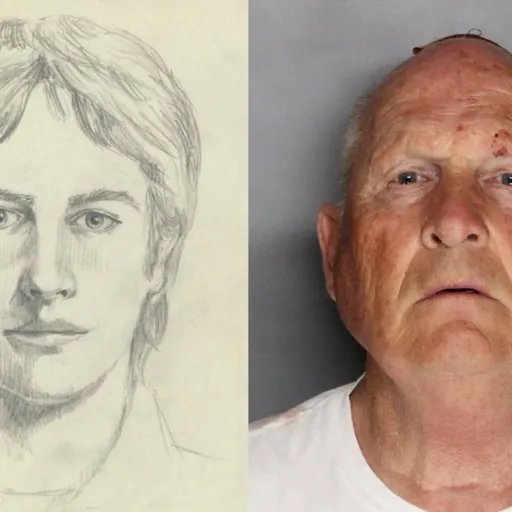
Joseph James Dengelo
American serial killer, rapist, burglar and former police officer
About Joseph James Dengelo
Born 1945. Joseph James Dengelo is an American military personnel, serial killer, thief, damage controlman, police officer and auto mechanic.
Personal life Early life and education Joseph James DeAngelo Jr. was born on November 8, 1945, in Bath, New York, to Kathleen "Kay" Louise DeGroat and Joseph James DeAngelo Sr, a sergeant in the United States Army. He was regularly beaten by both parents throughout his childhood. When he was a child, DeAngelo's family lived in West Germany where his father was stationed. There, DeAngelo says he was forced to witness the rape of one of his sisters by two airmen in a U.S. Air Force base warehouse. According to prosecutors, DeAngelo committed burglaries, mail theft, and tortured and killed animals during his teenage years. and served for 22 months during the Vietnam War as a damage controlman aboard the cruiser and the destroyer tender . Beginning in August 1968, he attended Sierra College in Rocklin, California; he graduated with an associate degree in police science with honors. He enrolled at Sacramento State University in 1971, earning a bachelor's degree in criminal justice.
Police officer
From May 1973 to August 1976, DeAngelo served as a burglary-unit police officer in Exeter, having relocated from Citrus Heights. He then worked in Auburn from August 1976 to July 1979. Nick Willick, who would later become Chief of Police, stated he was an unremarkable officer. DeAngelo also had a habit of standing too close to other officers and citizens, which made people uneasy and was potentially dangerous for himself as someone could have grabbed his gun. When Willick pointed this out to him and when other officers gave him basic policing advice, DeAngelo did not handle the criticism well and sulked. In July 1979, he was arrested for shoplifting a hammer and dog repellent. During the arrest he defecated himself, feigned a heart attack and fought store security. When deputies arrived, he rolled around on the chair he was tied to feigning madness, before admitting it was an act. He received a six-month probation sentence and was fired that October.
During the termination process, DeAngelo allegedly stalked the chief's home. Willick's daughter told Willick that a man had shone a flashlight into her room; however, he dismissed it. DeAngelo countered his termination by saying that Willick had harassed him, and bringing a work-related stress claim against the city. DeAngelo was required to see a therapist for his claim; he told the therapist that due to his distress he had gone to Willick's house intending to kill him, but was unable to locate Willick's window. Willick did not take this seriously, assuming it was a ploy by DeAngelo to boost his case for disability pay.
Marriage and relationships In May 1970, DeAngelo became engaged to nursing student Bonnie Jean Colwell, a classmate at Sierra College. She ended the relationship in 1971 after he became manipulative and abusive, culminating in his demand she help him cheat on a test for a psychology class he was failing. After the breakup, he attempted to force her to marry him by threatening her with a gun.
In November 1973, he married Sharon Marie Huddle of Citrus Heights in a ceremony held in Auburn. In 1980, they purchased a house in Citrus Heights, where he would eventually be arrested decades afterward. Huddle is an attorney. They had three daughters and later separated.
In July 2018, several months after DeAngelo's arrest, Huddle filed for a divorce, which was finalized the following year. Neither she nor their children suspected he had committed serious crimes. His eldest daughter described him as a "perfect father", while his wife accepted his explanations for being away from home. He was living with a daughter and granddaughter at the time of his arrest. He was arrested in 1996 for failing to pay for gasoline, but the charge was dismissed.
Loud outbursts DeAngelo's brother‑in‑law stated that DeAngelo would casually bring up the East Area Rapist in conversation around the time of the original crimes. Neighbors also reported that he frequently engaged in loud, profane outbursts.
Crimes
DNA evidence linked DeAngelo to eight murders in Goleta, Ventura, Dana Point, and Irvine; two other murders in Goleta, lacking DNA evidence, were linked by modus operandi. DeAngelo pleaded guilty to three other murders: two in Rancho Cordova and one in Visalia. He also committed more than 50 known rapes in the California counties of Sacramento, Contra Costa, Stanislaus, San Joaquin, Alameda, Santa Clara, and Yolo; and he was linked to hundreds of incidents of thefts, burglaries, vandalism, peeping, stalking, and prowling.
Visalia Ransacker (1974–1975) It was long suspected that the East Area Rapist used the community of Visalia as a training ground for his earliest crimes. Earlier Visalia crimes dating back as early as May 1973 and other sprees like that of the "Cordova Cat Burglar", during which he killed several dogs by blunt force, and the "Exeter Ransacker", as well as Visalia burglaries that took place after the shooting of Detective William McGowen (see below under "Shootings"), are now suspected to be linked also. Over a period of 20 months, DeAngelo is believed to have been responsible for one murder and around 120 burglaries.
In late April 2018, the Visalia chief of police stated that while there was no DNA linking DeAngelo to the Central Valley cases, his department had other evidence that played a role in the investigation; and he was "confident that the Visalia Ransacker has been captured". Though the statutes of limitations for the burglaries have each expired, DeAngelo was formally charged on August 13, 2018, with the first degree murder of Claude Snelling in 1975. In 2020, DeAngelo pleaded guilty to the Snelling murder.
Burglaries
The first recorded ransacking occurred on March 19, 1974, when a sum of $50 in coins was stolen from a piggy bank. Most of the Ransacker's activities involved breaking into houses, rifling through or vandalizing the owner's possessions, scattering women's underclothes and stealing a range of low-value items while often ignoring banknotes and higher-valued items in plain sight. The Ransacker would also often arrange or display items in the house. Items emptied included piggy banks and coin jars; and stolen items often included Blue Chip Stamps, foreign or historic coins, and personal items (such as single earrings, cuff-links, rings, or medallions) but also included six weapons and various types of ammunition. There were 12 separate incidents on November 30, 1974. climbing fences and moving through established routes such as parks, walkways, ditches, and trails attempting to pry open multiple points of entry, particularly windows leaving multiple points of escape open, especially windows, as well as the house, garage, and garden doors moving removed window screens onto beds or into bedrooms placing "warning items" such as dishes or bottles against doors and on door handles wearing gloves (given the absence of fingerprint evidence)
Shootings On September 11, 1975, DeAngelo broke into the home of Claude Snelling, 45. Snelling, a journalism professor at the College of the Sequoias, had previously chased a prowler discovered under his 16-year-old daughter's bedroom window around 10:00 p.m. on February 5, 1975. Upon leaving his bedroom, Snelling ran through the open back door and confronted a ski-masked intruder in his carport attempting to kidnap his daughter, who had been subdued with threats of being stabbed or shot. Snelling was then shot twice, staggered back into the house to his wife, and later died. After the shooting, the assailant punched and kicked the daughter, leaving her on the ground, and fled the scene. A stolen bicycle, linked to the assailant, was found nearby at 615 Redwood Street. a masked man entered the back yard of a house at 1505 W. Kaweah Avenue, near where the Ransacker had been reported to frequent. When Detective William McGowen (on stakeout inside the garage) attempted to detain the man, the suspect shrieked, removed his mask, and feigned surrender after McGowen fired a warning shot. However, after jumping the fence to the house at 1501, he pulled out a revolver with his left hand and fired once near McGowen's face, shattering his flashlight. Nearby officers rushed to aid McGowen, and the shooter was able to escape. most likely since DeAngelo assisted in the search for the Visalia Ransacker as a sergeant.
DeAngelo's initial modus operandi was to stalk middle-class neighborhoods at night in search of women who were alone in one-story homes, usually near a school, creek, trail or other open space that would provide a quick escape. He was seen a number of times but always successfully fled; on one occasion, he shot and seriously wounded a young pursuer.
Most victims had seen or heard a prowler on their property before the attacks, and many had experienced break-ins. Police believed that the offender would conduct extensive reconnaissance in a targeted neighborhood—looking into windows and prowling in yards—before selecting a home to attack. It was believed that he sometimes entered the homes of future victims to unlock windows, unload guns, and plant ligatures for later use. He frequently telephoned future victims, sometimes for months in advance, to learn their daily routines.
Although DeAngelo originally targeted women alone in their homes or with children, he eventually preferred attacking couples. This change in modus operandi is believed to be a direct result of media reports claiming he only attacked women alone in the home. His usual method was to break in through a window or sliding glass door and awaken the sleeping occupants with a flashlight, threatening them with a handgun. The bindings were often so tight that the victims' hands were numb for hours after being untied. He then separated the couple, often stacking dishes on the man's back and threatening to kill everyone in the house if he heard them rattle. He would then move the woman to the living room and rape her repeatedly. A decade later, police reported that DeAngelo repeatedly said, "I hate you, Bonnie" (the name of his former fiancée) during a 1978 rape, the 37th attack. DeAngelo sometimes spent hours in the home ransacking closets and drawers, eating food in the kitchen, drinking beer, raping the woman again, or making additional threats. Victims sometimes thought he had left the house before he "jump[ed] from the darkness".
Maggiore murders
A young Sacramento couple—21-year-old Brian Keith Maggiore, a military soldier at Mather Air Force Base, and his 20-year-old wife Katie Lee Maggiore—were walking their dog in the Rancho Cordova area on the night of February 2, 1978, near where five East Area Rapist attacks had occurred. The Maggiores fled after a confrontation in the street but were chased down and shot to death. Some investigators suspected that they had been murdered by the East Area Rapist because of their proximity to the other attacks' locations, and a shoelace was found nearby. The FBI announced on June 15, 2016, that it was confident that the East Area Rapist had murdered the Maggiores. On June 29, 2020, DeAngelo entered a plea of guilty to these murders.
Original Night Stalker (1979–1986) Shortly after the rape committed on July 5, 1979, DeAngelo moved to Southern California and began killing his victims, first striking in Santa Barbara County in October. The attacks lasted until 1981, with a lone 1986 attack. Only the couple in the first attack survived, alerting neighbors and forcing the intruder to flee; the other victims were murdered by gunshot or bludgeoning. Since DeAngelo was not linked to these crimes for decades, he was known as the Night Stalker by Santa Barbara County investigators. The other murders in Ventura, Irvine and Dana Point were linked together through DNA evidence prior to 2000, and the assailant was renamed the Original Night Stalker after serial killer Richard Ramirez had been designated with the former nickname. + Crimes
Irvine Paw prints of a large dog were found at the scene, leading to speculation that the killer may have brought one with him. The dog was later determined stolen. The killer ate leftover Christmas turkey from Offerman's refrigerator, leaving the remnants in the kitchen. There was also evidence the killer had broken into the vacant adjoining condo and stolen a bicycle, later found abandoned on a street north of the scene, from a third residence in the complex.
1980 On March 13, 33-year-old interior designer Charlene Smith and 43-year-old attorney Lyman Smith were murdered in their Ventura home. Charlene had also been raped. Their wrists and ankles had been bound with drapery cord.
On August 19, 24-year-old Keith Eli Harrington and 27-year-old Patrice Anne Harrington were found bludgeoned to death in their home on Cockleshell Drive in Dana Point's Niguel Shores gated community. Patrice Harrington had also been raped. She was bludgeoned so severely that her face and skull were pulverized. Although there was evidence that the Harringtons' wrists and ankles were bound, no murder weapon or ligatures were found at the scene. The Harringtons had been married for three months at the time of their deaths. Patrice was a pediatric nurse in Irvine, and Keith was a fourth year medical student at UC Irvine. He was on course to graduate early in December 1980.
1981 On February 6, 28-year-old Manuela Witthuhn was raped and murdered in her Irvine home. Although Witthuhn's body had signs of being tied before she was bludgeoned,
On July 27, 35-year-old Cheri Domingo and 27-year-old Gregory Sanchez became the Original Night Stalker's tenth and eleventh murder victims. Both were attacked in Domingo's residence on Toltec Way in Goleta (several blocks south of Robert Offerman's condominium), where Domingo was living temporarily; it was owned by a relative and up for sale. The offender entered the house through a small bathroom window. Sanchez was shot and bludgeoned. Authorities believed at the time that the attacker may have worked as a painter or in a similar job at the Calle Real Shopping Centre.
1986 On May 5, 18-year-old Janelle Lisa Cruz was found dead after she was raped and bludgeoned in her Irvine home. Her family was on vacation in Mexico at the time of the attack. The house was for sale and her body was discovered by a realtor who stopped by to show the house to a prospective buyer. Janelle's body was found on her bed, beaten beyond recognition, with her teeth found in both her hair and lungs.
Other suspected murders After DeAngelo was arrested, he was also suspected of committing the 1974 Visalia rape and murder of Jennifer Armour, the 1975 Exeter rape and murder of Donna Jo Richmond, and a 1978 murder of a woman and her son in Simi Valley, but was cleared as a suspect in all four murders by DNA testing. Victoria Police ruled out a link between DeAngelo, who docked in Australia during his Navy service, and the Melbourne serial child rapist and murderer known as "Mr Cruel".
Unsuccessful attempts to link perpetrators The lack of communication between departments made linking the perpetrator difficult. In addition, sharing information was territorial, with agencies not wanting other agencies solving their own cases. According to one deputy, The Sacramento Sheriff's Department wanted the glory of catching him, and egos were in the way. Carol Daly also stated there was competition with the various divisions. The department had linked four attacks by September 1976, but told the media not to report on it until October.
Visalia PD Detective Bill McGowen, who was shot at during the VR Crime Spree, went to Sacramento to determine if the EAR was the same perpetrator on May 18, 1977. At this point 23 rapes had occurred. After the Maggiore murders, the Sacramento County Sheriff's Office adamantly denied a link and accused Visalia investigators of looking for publicity.
After the first murders of Dr. Robert Offerman and Dr. Debra Manning, some law enforcement suspected that the EAR was responsible. Sergeant Jim Bevins of the Sacramento Sheriff's Department who headed the EAR Taskforce, along with Richard Shelby both believed it was the East Area Rapist. An LA times article confirms this, with the added detail that the Sheriffs had just finished handling the public outrage of Thor Christiansen. The Santa Barbara Sheriff's office later attempted to link the couple slayings as a "Night Stalker", however the Ventura and Orange County authorities were not convinced.
In 1997, Paul Holes contacted Crompton, who shared his theory that the Offerman-Manning murders were the work of the EAR. When Holes tried contacting the Santa Barbara Sheriffs office, they denied having any cases resembling the case, and flat-out stated they were unrelated. However, they did direct Holes with the Irvine Police department, who they knew were doing something with DNA. However, since Holes' lab was using older PCR technology, and the Irvine lab newer STR tech, Holes wasn't able to make the connection at the time.
Homework pages and punishment map (December 9, 1978)
During the investigation in Danville of the 42nd attack, investigators discovered three sheets of notebook paper near where a suspicious vehicle had reportedly been parked. They believe the pages were dropped accidentally, perhaps by falling out of a bag. The first sheet appears to be a homework essay on General George Armstrong Custer. Investigators were unable to identify the area depicted in the map, although the artist clearly had knowledge of architectural layout and landscape design. According to Detective Larry Pool, the map is a fantasy location representing the rapist's desired striking ground. The first two calls, received at 4:15 and 4:30 p.m., were identical and ended with the caller laughing and hanging up. During the third call, received at 5:00 p.m., the man on the other line said: "I'm the East Side Rapist and I have my next victim already stalked and you guys can't catch me."
"You're never gonna catch me" (December 2, 1977) A man claiming to be the rapist called the Sacramento Police Department, saying: "You're never gonna catch me, East Area Rapist, you dumb fuckers; I'm gonna fuck again tonight. Be careful!" The call was recorded and later released. That call was also recorded and identified by the victim as the voice of her assailant.
Later calls (1982–1991) In October 1982, a previous victim received a call at her place of work—a Denny's restaurant—during which the caller threatened to rape her again. According to Contra Costa County investigator Paul Holes, the caller must have chanced to patronize the restaurant and recognized his victim there.
In 1991, a previous victim received a phone call from the perpetrator and spoke with him for one minute. She could hear a woman and children in the background, leading to speculation that he had a family. The links were primarily due to similarities in modus operandi. One of the already-linked Original Night Stalker double murders occurred in Ventura, southeast of Goleta; and the remaining murders were committed in Orange County, an additional southeast. In 2001, several rapes in Contra Costa County believed to have been committed by the East Area Rapist were linked by DNA to the Smith, Harrington, Witthuhn, and Cruz murders. A decade later, DNA evidence indicated that the Domingo–Sanchez murders were also committed by the East Area Rapist (also identified as the Golden State Killer).
On June 15, 2016, the FBI released further information related to the crimes, including new composite sketches and crime details; The initiative included a national database to support law enforcement's investigating of the crimes and to handle tips and information.
Identification of DeAngelo began in December 2017 by officials, led by detective Paul Holes and FBI lawyer Steve Kramer. They hit a roadblock when then District Attorney Tony Rackauckas rejected their request for a DNA sample, directing the Irvine PD to not release the sample. A pristine sample from the Smith murder was taken from a duplicate rape kit, something uniquely done by Ventura's medical examiner. Once they uploaded the killer's DNA profile from a Ventura County rape kit to the personal genomics website GEDmatch. The website identified 10 to 20 people who had the same great-great-great-grandparents as the Golden State Killer; a team of five investigators working with genealogist Barbara Rae-Venter used this list to construct a large family tree. From this tree, they established two suspects; one was ruled out by a relative's DNA test, leaving DeAngelo the main suspect.
Eventually, "through the use of genetic genealogy searching on GEDmatch, investigators identified distant relatives of DeAngelo—including family members directly related to his great-great-great-great grandfather dating back to the 1800s. Based on this information, investigators built about 25 different family trees. The tree that eventually linked to [DeAngelo] alone contained approximately 1,000 people. Over the course of a few months, investigators used other clues like age, sex, and place of residence to rule out suspects populating these trees, eliminating suspects one by one until only DeAngelo remained." Both were matched to samples associated with Golden State Killer crimes. Paul "Cornfed" Schneider, a high-ranking member of the Aryan Brotherhood, was living in Orange County when the Harringtons, Manuela Witthuhn, and Janelle Cruz were killed. A DNA test cleared him in the 1990s. Joe Alsip, a friend and business partner of the victim Lyman Smith. Alsip's pastor said that Alsip had confessed to him during a family-counseling session. Alsip was arraigned for the Smith murders in 1982, but the charges were later dropped, and his innocence was confirmed by DNA testing in 1997. Gregory Gonzalez, from Garden Grove, attended the same drug rehabilitation class that Janelle Cruz was enrolled in. An informant told police that Gonzalez confessed to killing her and he was arrested, but charges were dropped a year later when a blood test confirmed his innocence.
Arrest, trial and incarceration On the afternoon of April 24, 2018, Sacramento County Sheriff's deputies arrested DeAngelo in the side yard of his Sacramento home. He was charged with eight counts of first-degree murder with special circumstances. On May 10, the Santa Barbara County District Attorney's office charged DeAngelo with four additional counts of first-degree murder.
According to Sacramento County prosecutor Thien Ho, DeAngelo said the following to himself while alone in a police interrogation room after his arrest in April 2018: "I didn't have the strength to push him out. He made me. He went with me. It was like in my head, I mean, he's a part of me. I didn't want to do those things. I pushed Jerry out and had a happy life. I did all those things. I destroyed all their lives. So now I've got to pay the price." Prosecutors believe this was a tactic to manipulate police, or to establish an insanity defense.
DeAngelo could not be charged with rapes or burglaries, as the statute of limitations had expired for those offenses, but he was charged with 13 counts of murder and 13 counts of kidnapping. DeAngelo was arraigned in Sacramento on August 23, 2018. In November 2018, prosecutors from six involved counties collectively estimated that the case could cost taxpayers $20 million and last 10 years. At an April 10, 2019, court proceeding, prosecutors announced that they would seek the death penalty, and the judge ruled that cameras could be allowed inside the courtroom during the trial.
On March 4, 2020, DeAngelo offered to plead guilty if the death penalty was excluded as a possible sentence, which was not accepted at the time. On June 29, as part of a plea bargain to avoid the death penalty, DeAngelo pleaded guilty to 13 counts of first-degree murder and special circumstances (including murder committed during burglaries and rapes), as well as thirteen counts of kidnapping. On August 21, 2020, DeAngelo received multiple consecutive life sentences without the possibility of parole. In November 2020, DeAngelo was transferred to the North Kern State Prison. As of February 2025, DeAngelo is incarcerated in protective custody at California State Prison, Corcoran.
Prosecutors have speculated that DeAngelo's motive for his crimes was a desire for power and control over the victims, due to a feeling of powerlessness and inadequacy in his personal life.
Don’t just read it —
keep it.
Full-length biographies made to live with: read them, listen on the way to work, watch them tonight.
- E-book
- Audio
- Video
Instant download · yours to keep · every purchase keeps this site free
Important facts
more
EARONS, Rancho Cordova Cat, EAR/ONS, East Area Rapist, Cordova Meadows Burglar, Cordova Cat Burglar, Exeter Ransacker, EAR, ONS, Golden State Killer, Joseph DeAngelo, Joe DeAngelo, JJD, The Night Stalker, Night Stalker, The Original Night StalkerPeople in Joseph James Dengelo's life
Named in this biography and alive at the same time








Related people
Same field, nearest in time




Contemporaries
People whose lives overlapped Joseph James Dengelo's



Frequently asked questions
Who is Joseph James Dengelo?
American serial killer, rapist, burglar and former police officer
When was Joseph James Dengelo born?
Joseph James Dengelo was born on 8 November 1945 in Bath.
What is Joseph James Dengelo's occupation?
Joseph James Dengelo is a military personnel, serial killer, thief, damage controlman, police officer and auto mechanic.
What nationality is Joseph James Dengelo?
Joseph James Dengelo is American.
Sources & further reading
· Wikipedia: Joseph James Dengelo
· DBpedia: Joseph James DeAngelo
Cite this page
APA: Biography.guide. (2026). Joseph James Dengelo. https://biography.guide/joseph-james-dengelo/
MLA: "Joseph James Dengelo." Biography.guide, https://biography.guide/joseph-james-dengelo/.
Chicago: "Joseph James Dengelo." Biography.guide. https://biography.guide/joseph-james-dengelo/.
Data last updated: 2026-09-22 · Spot an error? Report a correction.
Portrait: Wikimedia Commons · author & licence
Page generated 2026-09-27 05:04 UTC