
George Armstrong
Canadian professional ice hockey centre
About George Armstrong
Lived 1930 – 2021 (aged 90). George Armstrong was a Canadian ice hockey player and ice hockey coach.
George Edward Armstrong (July 6, 1930 – January 24, 2021) was a Canadian professional ice hockey player. A centre, he played 21 seasons in the National Hockey League (NHL) for the Toronto Maple Leafs. He played 1,188 NHL games between 1950 and 1971, all with Toronto and a franchise record. He was the team's captain for 13 seasons. Armstrong was a member of four Stanley Cup championship teams and played in seven NHL All-Star Games. He scored the final goal of the NHL's "Original Six" era as Toronto won the 1967 Stanley Cup.
Armstrong played both junior and senior hockey in the Toronto Marlboros organization and was a member of the 1950 Allan Cup winning team as senior champions of Canada. He returned to the Marlboros following his playing career and coached the junior team to two Memorial Cup championships. He served as a scout for the Quebec Nordiques, as an assistant general manager of the Maple Leafs and for part of the 1988–89 NHL season as Toronto's head coach. Armstrong was inducted into the Hockey Hall of Fame in 1975 and the Maple Leafs honoured his uniform number 10 in 1998, and later officially retired the number, along with ten others, during a pre-game ceremony on October 15, 2016.
Early life Armstrong was born in 1930 in Skead, Ontario, to an Irish Canadian father, Frederick James Armstrong, and a mixed Algonquin-Anishinabe mother, Alice Decaire. The couple were married in Sudbury in 1929 and George arrived eleven months later. He grew up in Falconbridge, Ontario, where his father was a nickel miner. He had one sister, Lillian Ellen McCourt. Sport was an important part of Armstrong's family as his father played soccer and his mother was a canoeist. The younger Armstrong developed a passion for hockey but was a poor skater, which his father believed was a consequence of a case of spinal meningitis George suffered at the age of six.
While attending Sudbury High School, Armstrong played on the hockey team with Red McCarthy and Tim Horton. Inspired by a newspaper advertisement offering tryouts with the Copper Cliff Redmen of the Northern Ontario Junior Hockey Association (NOJHA), Armstrong convinced Horton and McCarthy to join him in trying out. They made the team and Armstrong began his junior hockey career at age 16 in the 1946–47 season. He recorded six goals and five assists in nine games and caught the attention of scouts for the National Hockey League (NHL)'s Toronto Maple Leafs who added him to their protected list. He also played with the Prince Albert Blackhawks for part of that season. Armstrong quit school in grade 11 to focus on his hockey career. Promoted to the Toronto Marlboros for the 1948–49 season, Armstrong recorded 62 points in 39 games with the junior squad and played in three regular season and ten post-season matches for the senior team. Armstrong remained with the senior Marlboros in 1949–50 where he served as captain. He led the OHA senior division with 64 goals, at the time an OHA record,
Toronto Maple Leafs "This kid's got everything. He has size, speed, and he can shoot 'em into the net better that any hockey player I've known in a long time. I'll be surprised if he doesn't become a superstar." — —Toronto's assistant general manager King Clancy's assessment of Armstrong in 1952. He was recalled to Toronto during the season and scored his first NHL goal, against goaltender Gerry McNeil of the Montreal Canadiens. It was the first goal ever scored by a player with Native heritage. He finished the season with three goals and three assists in 20 games with Toronto. A 48-point season in 1955–56 was second on the team to Tod Sloan's 66. Armstrong then led the Maple Leafs in scoring with 44 points in 1956–57 despite missing 14 of his team's games. He was named to play in the NHL All-Star Game in both seasons. They were the first two of seven he ultimately played. He finished fourth in team scoring with 42 points, then played his third All-Star Game during the 1958–59 season. With 51 points in 1959–60, Armstrong finished one behind Bob Pulford for the team lead. Toronto again reached the Stanley Cup Final where they were again eliminated by Montreal.
The Maple Leafs finally reached the NHL's peak two seasons later. As Maple Leafs captain, Armstrong was presented the trophy by league president Clarence Campbell. Individually, Armstrong scored 21, 19 and 20 goals over the three seasons and by virtue of the NHL's All-Star Game format of the time that had the defending champion play the all-stars of the remaining teams, appeared in his fourth, fifth and sixth All-Star Games.
A 37-point season followed in 1964–65, then 51 points the 1965–66 season. The Maple Leafs dashed Montreal's hopes by winning the championship in six games. Armstrong scored the final goal of the series in a 3–1 victory in the deciding contest. It was also the last goal scored in the NHL's "Original Six" era as the league was set to double in size to 12 teams for the 1967–68 season. The Maple Leafs placed him on their protected list for the 1967 Expansion Draft and he remained with Toronto. He played in his seventh All-Star Game in 1968 and finished the season with 34 points. He remained a consistent scorer for Toronto, recording 27, 28 and 25 points in his following three seasons. At the time of his retirement, Armstrong was second to Dit Clapper for the longest tenure as a team captain in NHL history.
Coaching and scouting career Armstrong was announced as the head coach of his former junior team, the Toronto Marlboros, in July 1972. Though he had preferred his previous role as a scout to coaching, Armstrong led the Marlboros to Memorial Cup victories on two occasions: in 1973 and 1975. In 1977, Armstrong's name circulated as a possible successor to Maple Leafs coach Red Kelly when the latter was fired by the team. When approached by the organization with the prospect of assuming head coaching duties however, Armstrong rejected the possibility. His decision resulted in animosity from within the organization and subsequently led to his resignation as coach of the Marlboros that season to accept a scouting post with the Quebec Nordiques.
Some 10 years later, Armstrong returned to the Maple Leafs organization in the dual capacities of assistant general manager and scout. During the 1988–89 season, and after management had fired head coach John Brophy, team owner Harold Ballard was adamant that Armstrong be named Brophy's replacement. Armstrong agreed to take the position, but increasingly delegated majority of his duties to assistant coach Garry Lariviere. The Maple Leafs finished with 17 wins in 47 Armstrong's games coached, falling just short of the fourth and final playoff berth in the Norris Division. Needing a win in their final regular season game, against the Chicago Blackhawks at Chicago Stadium, to capture the playoff berth, the Leafs would heartbreakingly lose to the Hawks in overtime. Armstrong was replaced by Doug Carpenter the following season and returned to his scouting capacities with the team. Armstrong remained a scout for the rest of his life. In 1972–73, he was selected as Coach of the Year by his peers in the OHL (Toronto Marlboros).
Playing style The Toronto Maple Leafs described Armstrong as being a "consistent, durable and hardworking" player throughout his 21-season career that spanned parts of four decades. His 1,187 NHL games are the most by any player in Toronto history, and he remains the franchise leader with 417 career assists and 713 points by a right wing. In 2013, he ranked number 14 on Sportsnet's list of the greatest Maple Leafs. Armstrong was inducted into the Hockey Hall of Fame in 1975 and the Ontario Sports Hall of Fame in 2010.
Personal life Armstrong was a resident in Leaside, a neighbourhood in Toronto, for more than 55 years and often spent time with his family bike riding throughout the area. Aside from his coaching career in professional hockey, Armstrong coached sports teams around his community and contributed his time coaching the first floor hockey team for the Canadian Special Olympics. In Toronto, Beverley Street Public School was the foundation of this floor hockey team.
Armstrong resided in Toronto with his wife Betty. The couple had four children: Brian, Betty-Ann, Fred and Lorne. He was the uncle of Dale McCourt, a former first overall draft pick by the Detroit Red Wings in the 1977 NHL amateur draft. His nephew Dan McCourt, Dale's brother, officiated in excess of 1,700 NHL games.
When given a day with the Stanley Cup in 2005, Armstrong elected to have a family gathering with it at his son's home in Vaughan, Ontario. She joined Kelly Paton's coaching staff with the Western Mustangs women's ice hockey program in the autumn of 2016. After coaching a girls team in the Little Native Hockey League annual event for First Nation youth in Ontario, in 2019 she started Armstrong Hockey, running annual camps and programs providing hockey development opportunities for Indigenous youth, particularly girls, and working to honour and celebrate her grandfather's legacy in the Indigenous community.
Armstrong was recognized by the NHL for his charitable efforts in 1969 when he was named the inaugural recipient of the Charlie Conacher Humanitarian Award.
Armstrong had a brief film career, appearing as himself in the 1971 film Face-Off, a.k.a. "Winter Comes Early".
Armstrong died on January 24, 2021, at age 90, having suffered from heart complications in the time leading up to his death. Months later, following a family memorial service, his ashes were buried alongside his mother at Good Shepherd Cemetery, near his birthplace of Skead, Ontario.
Career statistics Source:
Playing career
Coaching record Professional hockey Source:
Team Year Regular season Postseason G W L T OTL Pts Finish ResultTOR1988–894717264—(62)5th in NorrisMissed playoffsTotal 4717264—380 Stanley Cups (0–0, 0.000)
Junior hockey Sources:
Team Year Regular season Postseason G W L T OTL Pts Finish ResultTOR1972–73634779—1031st in OHAWon in quarter-finals (8–0 vs. STC)Won in semi-finals (8–0 vs. OTT)Won J. Ross Robertson Cup (8–6 vs. PBO)Finished in 1st in round-robin at Memorial Cup (1–1)Won Memorial Cup (9–1 vs. QUE)TOR1973–747030319—698th in OHAWon in quarter-finals (9–1 vs. LDN)Lost in semi-finals (0–8 vs. STC)TOR1974–757048139—1051st in OMJHLWon in quarter-finals (9–7 vs. KGN)Won in semi-finals (9–7 vs. SBY)Won J. Ross Robertson Cup (8–6 vs. HAM)Finished in 2nd in round-robin at Memorial Cup (1–1)Won Memorial Cup semi-finals (10–4 vs. SHE)Won Memorial Cup (7–3 vs. NWB)TOR1975–7666263010—623rd in EmmsWon in division semi-finals (8–2 vs. LDN)Lost in division finals (1–9 vs. HAM)TOR1976–7766312312—743rd in EmmsLost in division semi-finals (3–9 vs. LDN)Total 33518210449—4132 J. Ross Robertson Cups (35–28–5, 0.551)2 Memorial Cups (5–2, 0.714)
Awards and honours AwardYearRef Red Tilson Trophy 1947–48, 1949–50 Stanley Cup champion 1961–62, 1962–63, 1963–64, 1966–67 Memorial Cup champion 1973, 1975 (as coach)
Don’t just read it —
keep it.
Full-length biographies made to live with: read them, listen on the way to work, watch them tonight.
- E-book
- Audio
- Video
Instant download · yours to keep · every purchase keeps this site free
Important facts
People in George Armstrong's life
Named in this biography and alive at the same time




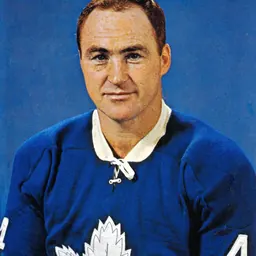


Related people
Same field, nearest in time
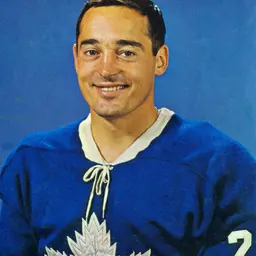
Contemporaries
People whose lives overlapped George Armstrong's



Frequently asked questions
Who was George Armstrong?
Canadian professional ice hockey centre (1930-2021)
When was George Armstrong born?
George Armstrong was born on 6 July 1930 in Nickel Centre.
When did George Armstrong die?
George Armstrong died on 24 January 2021 in Toronto.
What was George Armstrong's occupation?
George Armstrong was an ice hockey player and ice hockey coach.
What nationality was George Armstrong?
George Armstrong was Canadian.
Sources & further reading
· DBpedia: George Armstrong (ice hockey)
Cite this page
APA: Biography.guide. (2026). George Armstrong. https://biography.guide/george-armstrong-ice-hockey-player/
MLA: "George Armstrong." Biography.guide, https://biography.guide/george-armstrong-ice-hockey-player/.
Chicago: "George Armstrong." Biography.guide. https://biography.guide/george-armstrong-ice-hockey-player/.
Data last updated: 2026-09-20 · Spot an error? Report a correction.
Page generated 2026-09-27 05:29 UTC