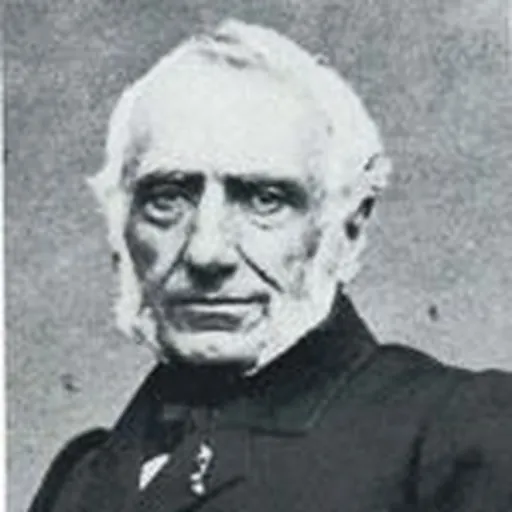
About Joseph-Désiré Court
Lived 1797 – 1865 (aged 67). Joseph-Désiré Court was a French painter, curator and conservator.
Joseph-Désiré Court (14 September 1797 – 23 January 1865) was a French painter who specialised in history painting and portrait painting.
Life and work He was a descendant of the portrait painter Hyacinthe Rigaud and displayed an early interest in art. His first studies were with , at a drawing school established by Descamps' father, Jean-Baptiste. Following that, he worked at the studios of Antoine-Jean Gros in Paris.
His allowance from his family was not quite enough for his needs, so he painted small pictures, which he sold through an agent. Despite this, he was unable to save enough money to continue his studies in Rome. Hoping that he could go at the expense of the state, he competed for the Prix de Rome and, in 1821, was awarded a prize for his depiction of Samson and Delilah. During his stay there, he continued to send works back to Paris for exhibition. His painting, "The Death of Caesar", was acquired by the Musée du Luxembourg in 1827.
In 1828, the Académie de Rouen named him a corresponding member, and commissioned a large painting for their new meeting room. Although their request was for an easel painting only, he produced a monumental canvas depicting the playwright Corneille, receiving honors from the nobility after the premiere of his tragedy, Cinna. Court was presented with a gold medal in gratitude.
Following the July Revolution, the government of King Louis-Philippe held a competition for a large canvas, to adorn the new room at the Chamber of Deputies. Three topics were offered. Court chose to paint Mirabeau facing Dreux-Brézé at the Estates General of 1789. His sketch came in second. Dissatisfied with the jury's decision, he executed the painting anyway; exhibiting it at the Salon of 1833. It may now be seen at the Musée des Beaux-Arts de Rouen. He did eventually receive some major public commissions, including figures for the Hôtel de Ville (1841), and paintings for the dome of Saint Isaac's Cathedral (1850). Much of his work was, however, devoted to portraiture.
He had long wanted to return to his hometown so, in 1853, he accepted an appointment as Conservator at the Musée de Rouen; immediately beginning a project to renovate the museum's rooms.
He succumbed to an unspecified chronic illness while in Paris receiving treatment. His remains were taken home and interred at the Rouen Monumental Cemetery. He had been the recipient of numerous honors, including the Legion of Honor in 1838.
Gallery
Don’t just read it —
keep it.
Full-length biographies made to live with: read them, listen on the way to work, watch them tonight.
- E-book
- Audio
- Video
Instant download · yours to keep · every purchase keeps this site free
Important facts
People in Joseph-Désiré Court's life
Named in this biography and alive at the same time

Related people
Same field, nearest in time




Contemporaries
People whose lives overlapped Joseph-Désiré Court's





Frequently asked questions
Who was Joseph-Désiré Court?
painter (1797-1865)
When was Joseph-Désiré Court born?
Joseph-Désiré Court was born on 14 September 1797 in Rouen.
When did Joseph-Désiré Court die?
Joseph-Désiré Court died on 23 January 1865 in Paris.
What was Joseph-Désiré Court's occupation?
Joseph-Désiré Court was a painter, curator and conservator.
What nationality was Joseph-Désiré Court?
Joseph-Désiré Court was French.
Sources & further reading
· Wikipedia: Joseph-Désiré Court
· DBpedia: Joseph-Désiré Court
Cite this page
APA: Biography.guide. (2026). Joseph-Désiré Court. https://biography.guide/joseph-desire-court/
MLA: "Joseph-Désiré Court." Biography.guide, https://biography.guide/joseph-desire-court/.
Chicago: "Joseph-Désiré Court." Biography.guide. https://biography.guide/joseph-desire-court/.
Data last updated: 2026-09-20 · Spot an error? Report a correction.
Portrait: Wikimedia Commons · author & licence
Page generated 2026-09-27 04:57 UTC