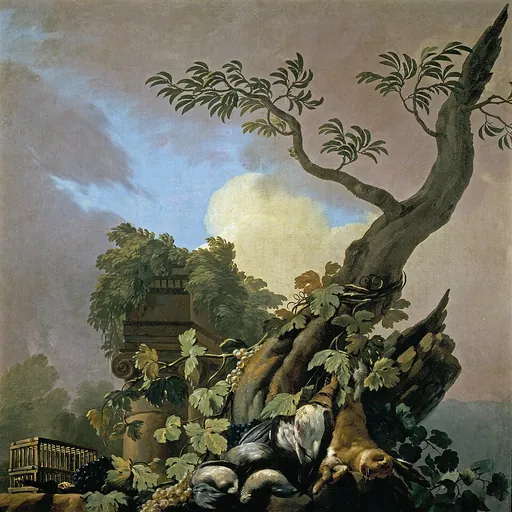
About José del Castillo
Lived 1737 – 1793 (aged 55). José del Castillo was a Spanish painter, printmaker, copyist, writer, draftsperson and illustrator.
José del Castillo (14 October 1737, Madrid - 5 October 1793, Madrid) was a Spanish painter and engraver in the Neoclassical style. Many of his paintings were done for tapestries.
Life and work
At the age of ten, he became an assistant in the preparatory drawing classes at the Real Academia de Bellas Artes de San Fernando. He showed so much promise that, in 1751, the Secretary of State, José de Carvajal y Lancaster, personally provided him with the funds to go to Rome and study under the direction of Corrado Giaquinto. In 1753, when Giaquinto was called to Spain by King Ferdinand VI, Castillo returned with him and returned to the Academia, where he won a gold medal in 1756. Two years later, he received an official stipend to continue his studies in Rome, where he was married. After completing his studies, he went back to Madrid, travelling through Italy in the company of Juan de Villanueva. He arrived there in 1764.thumb The Painter's StudioHe immediately joined the Royal Tapestry Factory; painting the designs and "cartones" (cartoons), under the stylistic direction of Anton Raphael Mengs. This would become his primary occupation. He originally copied works by other artists, such as Luca Giordano and his mentor, Giaquinto, but later created his own, based on scenes from daily life. He did execute an occasional religious painting, such as a depiction of Saint Dominic and Saint Francis embracing (1783), which is at the Basilica of San Francisco el Grande, Madrid. He also did some book illustrations: notably drawings for the 1780 edition of Don Quixote, which were engraved by Manuel Salvador Carmona and Fernando Selma.
In 1785, he was named an Academician of Merit at the Academia, but failed in his efforts to become a "Painter to the King". He also sought to become Director of the tapestry factory, with the support of Count Floridablanca, but was opposed by the painter Ramón Bayeu, who had the support of Count Aranda, a court favorite. Shortly after Bayeu's death (and not long before his own), he tried again, with recommendations from several artists, but was still unsuccessful and the post was left vacant.
He also did restorative work at the Palacio del Buen Retiro. Many of his sketches and engravings document works by other artists which have since been lost.
Don’t just read it —
keep it.
Full-length biographies made to live with: read them, listen on the way to work, watch them tonight.
- E-book
- Audio
- Video
Instant download · yours to keep · every purchase keeps this site free
Important facts
more
José S. de CastilloPeople in José del Castillo's life
Named in this biography and alive at the same time



Related people
Same field, nearest in time


Contemporaries
People whose lives overlapped José del Castillo's






Frequently asked questions
Who was José del Castillo?
Spanish painter and engraver (1737-1793)
When was José del Castillo born?
José del Castillo was born on 14 October 1737 in Madrid.
When did José del Castillo die?
José del Castillo died on 5 October 1793 in Madrid.
What was José del Castillo's occupation?
José del Castillo was a painter, printmaker, copyist, writer, draftsperson and illustrator.
What nationality was José del Castillo?
José del Castillo was Spanish.
Sources & further reading
· Wikipedia: José del Castillo
Cite this page
APA: Biography.guide. (2026). José del Castillo. https://biography.guide/jose-del-castillo/
MLA: "José del Castillo." Biography.guide, https://biography.guide/jose-del-castillo/.
Chicago: "José del Castillo." Biography.guide. https://biography.guide/jose-del-castillo/.
Data last updated: 2026-09-21 · Spot an error? Report a correction.
Portrait: Wikimedia Commons · author & licence
Page generated 2026-09-27 04:59 UTC