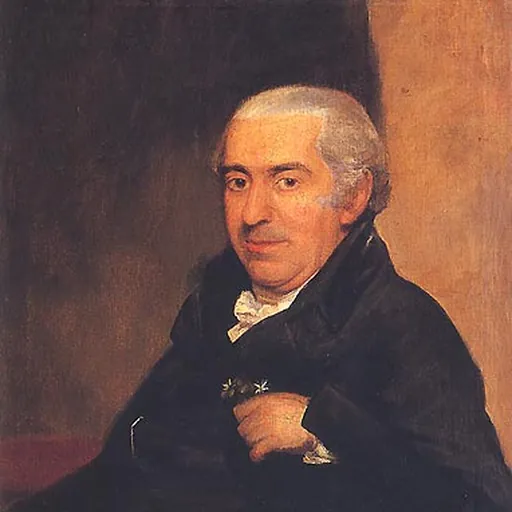
About José Correia da Serra
Lived 1750 – 1823 (aged 73). José Correia da Serra was a philosopher, politician, academic, diplomat, botanist and polymath.
José Francisco Correia da Serra (6 June 1750 – 11 September 1823) was a Portuguese abbot, polymath, philosopher, diplomat, politician and scientist. In some circumstances, he was also known as Abbé Correa. The plant genus Correa, native to Australia, is named in his honour.
Biography Correia da Serra was born at Serpa, in Alentejo, in 1750, and was educated at Rome, where he took holy orders. In 1777, he returned to Lisbon, where he was one of the founders of the Academia das Ciências de Lisboa in 1779 (then called Academia Real das Ciências de Lisboa; Royal Academy of Sciences of Lisbon).
His published writings brought him into conflict with reactionary members of the religious and political hierarchy in Portugal.
In 1786, he fled to France, and remained there till the death of Portuguese King-consort Pedro III, when he again returned to his homeland, but political difficulties forced him to leave the country again. He went to England, where he found a protector in Sir Joseph Banks, who was President of the Royal Society. With Banks' support, he was easily elected a fellow of the society. In 1797, he was elected a foreign member of the Royal Swedish Academy of Sciences.
In 1797, he was appointed secretary to the Portuguese embassy in London, but a quarrel with the ambassador prompted him to leave. He accompanied the Polish military leader Thaddeus Kosciusko and the Polish poet Julian Ursyn Niemcewicz to the United States, sailing on the ship Adriana from Bristol; the trio reached Philadelphia on 18 August 1797.
In 1813, he left Europe for the New World once again, arriving first in New York City. He settled in Philadelphia where he delivered lectures on botany at the University of Pennsylvania. His travels took him several times to Monticello, the home of former President Thomas Jefferson where his political views found a fulsome reception. He was elected a Foreign Honorary Member of the American Academy of Arts and Sciences in 1815.
In 1816, he was made Portuguese minister-plenipotentiary at Washington D.C., but resided in Philadelphia.
Works Colecção de livros inéditos da história Portuguesa, 4 vols., 1790–1816.
Articles: "On the fructification of the submersed Algae," Philosophical Transactions, 1799, pp. 494–505. "On a submarine forest on the coast of England," Philosophical Transactions, 1799, pp. 145–155. "On two genera of plants belonging to the natural family of the Aurantia," Transactions of the Linnean Society, Vol. 5, pp. 218–226. "On the Doryantha, a new genius of plants from New Holland next akin to the Agave," Transactions of the Linnean Society, 6, pp. 211–213. "Observations sur la famille des oranges et sur les limites qui la circonscrivent," Annales du Muséum d'Histoire Naturelle, 6, pp. 376–386. "Mémoire sur la germination du nelumbo," Annales du Muséum d'Histoire naturelle, 13, 174. "Vues Carpologiques/Observations Carpologiques," Annales du Muséum d'Histoire Naturelle, 8, 9, 10. "Mémoire sur la valeur du périsperme, considerée comme caractère d'affinité des plantes", Bulletin de la Société Philomatique, 11, 350. "De l'état des Sciences, et des lettres en Portugal, à la fin du dixhuitième siècle," Archives litteraires de l'Europe, Vol. I, 1804. "Sur l'agriculture des arabes en Espagne", Archives Littéraires de l'Europe, 2, pp. 239–404. "Observations and conjectures on the formation and nature of the soil of Kentucky," Transactions of the American Philosophical Society, Philadelphia, 1811. "Considerations générales sur l'etat passé et futur de l'Europe," The American Review, 1812.
Don’t just read it —
keep it.
Full-length biographies made to live with: read them, listen on the way to work, watch them tonight.
- E-book
- Audio
- Video
Instant download · yours to keep · every purchase keeps this site free
Important facts
People in José Correia da Serra's life
Named in this biography and alive at the same time


Related people
Same field, nearest in time



Contemporaries
People whose lives overlapped José Correia da Serra's




Frequently asked questions
Who was José Correia da Serra?
Portuguese academic and botanist (1751-1823)
When was José Correia da Serra born?
José Correia da Serra was born on 6 June 1750 in Serpa.
When did José Correia da Serra die?
José Correia da Serra died on 11 September 1823 in Caldas da Rainha.
What was José Correia da Serra's occupation?
José Correia da Serra was a philosopher, politician, academic, diplomat, botanist and polymath.
What nationality was José Correia da Serra?
José Correia da Serra's recorded nationality: Kingdom of Portugal, Portuguese People.
Sources & further reading
· Wikipedia: José Correia da Serra
· DBpedia: José Correia da Serra
Cite this page
APA: Biography.guide. (2026). José Correia da Serra. https://biography.guide/jose-correia-da-serra/
MLA: "José Correia da Serra." Biography.guide, https://biography.guide/jose-correia-da-serra/.
Chicago: "José Correia da Serra." Biography.guide. https://biography.guide/jose-correia-da-serra/.
Data last updated: 2026-09-24 · Spot an error? Report a correction.
Portrait: Wikimedia Commons · author & licence
Page generated 2026-09-27 05:09 UTC