
About José Ber Gelbard
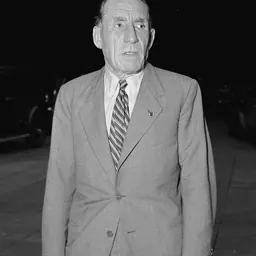
Lived 1917 – 1977 (aged 60). José Ber Gelbard was an Argentine economist and politician.
José Ber Gelbard (14 April 1917 4 October 1977) was a Polish-born Argentine activist and politician, and a member of the Argentine Communist Party. He also helped organize the Confederación General Económica (CGE), made up of small and medium-sized business. Beginning about 1954, he was appointed as an economic advisor to Juan Perón and repeatedly was called back to serve as Minister of Finance to successive governments until the military coup of March 1976. He fled with his family shortly before the coup, gaining political asylum in the United States and settling in Washington, D.C.
Early life and education Born Joseph Gelbard into a Jewish family in Radomsko, Poland, in 1917, his family emigrated in 1930 to Argentina. They settled in Tucumán, north of Buenos Aires. Other family were already there, as well as immigrant communities of Sephardic and European Jews, and Arabs from the Middle East (turcos). During the Great Depression, Gelbard helped support the family as a street peddler of men's ties and belts.
Marriage and family By 1938 Gelbard had saved some money and married Dina Haskel. They settled in Catamarca, where he started a men's clothing store named "Casa Nueva York". They had children together, including a son Fernando Gelbard. Fernando became a jazz pianist and flautist, composer and record producer. In 1974 he recorded Didi (named for his wife) with a five-man jazz group in Buenos Aires. Their music was ahead of its time in its combination of Latin and Afro-American music, bebop and bossa nova. The record was remastered and released in 2002.
Political career Gelbard became a Communist activist, involved in several causes, including Jewish armed groups defending the Jewish community in Tucumán from the abuses of local Nazi groups. He joined the Democratic Union, a loose alliance against candidate Juan Perón, during the 1945–46 electoral campaign.
Gelbard became involved in business politics, becoming a leader in the Chamber of Commerce in Catamarca. He represented the small and medium business sectors, many of whose owners were immigrants and new businessmen. He came to believe that the millions of small industries and merchants needed to unite to become a force that could negotiate with Perón's pro-labor forces. He became the "national bourgeoisie's" principal ideologue, and "the most articulate advocate of an alliance between business, the state and labor, behind a federalist and nationalist economic program."
During this period, he helped organize the CGE (Confederación General Económica), a union of millions of industrialists and businessmen, with enough strength to negotiate with the government and labor unions. In 1953, he traveled throughout the provinces organizing businessmen under the CGE and was named as its first president.
Cámpora stepped aside later that year and Perón was elected president. His third wife, Isabel Perón, ran and won as his vice president. Under Cámpora, Gelbard implemented "The Social Pact" (El Pacto Social), "cosigned in Congress by the CGE and CGT" which called for a freeze in prices and salaries so the country could progress economically, and for increased cooperation between business and government under a Three-Year Plan. The Peron government also nationalized the banking industry. Under a Radical government, his son Fernando later returned with his family to Argentina after the return of democratically elected government. In 1989 he was appointed as Argentine ambassador to France. He filed a claim for US$20,000,000 with the Argentine government, for "all the time he could not make use of the family assets confiscated by the military." It is unclear whether he succeeded in his claim.
Don’t just read it —
keep it.
Full-length biographies made to live with: read them, listen on the way to work, watch them tonight.
- E-book
- Audio
- Video
Instant download · yours to keep · every purchase keeps this site free
Important facts
People in José Ber Gelbard's life
Named in this biography and alive at the same time


Related people
Same field, nearest in time



Contemporaries
People whose lives overlapped José Ber Gelbard's

Frequently asked questions
Who was José Ber Gelbard?
Argentine politician and economist (1917-1977)
When was José Ber Gelbard born?
José Ber Gelbard was born on 14 April 1917 in Radomsko.
When did José Ber Gelbard die?
José Ber Gelbard died on 4 October 1977 in Washington, D.C..
What was José Ber Gelbard's occupation?
José Ber Gelbard was an economist and politician.
What nationality was José Ber Gelbard?
José Ber Gelbard was Argentine.
Sources & further reading
Cite this page
APA: Biography.guide. (2026). José Ber Gelbard. https://biography.guide/jose-ber-gelbard/
MLA: "José Ber Gelbard." Biography.guide, https://biography.guide/jose-ber-gelbard/.
Chicago: "José Ber Gelbard." Biography.guide. https://biography.guide/jose-ber-gelbard/.
Data last updated: 2026-09-25 · Spot an error? Report a correction.
Page generated 2026-09-27 05:13 UTC