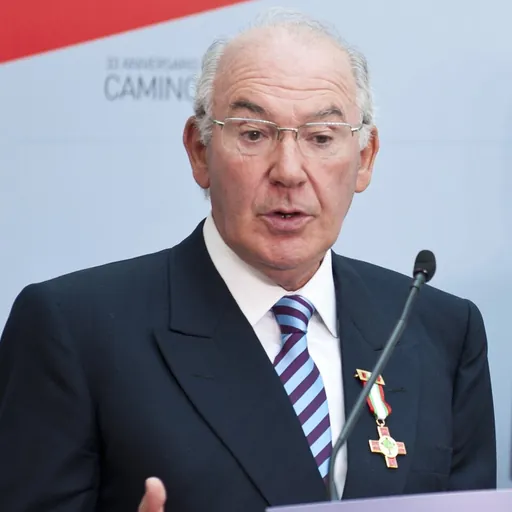
About José Antonio Ardanza
Lived 1941 – 2024 (aged 82). José Antonio Ardanza was a Spanish lawyer, politician, businessperson and mayor.
José Antonio Ardanza Garro (10 June 1941 – 8 April 2024) was a Spanish politician who became the second elected Lehendakari (President of the Basque Autonomous Community, Spain) after the approval of the Statute of Autonomy. He was in office between 1985 and 1999.
He was a member of the Basque Nationalist Party (EAJ/PNV). During his mandate, which was the longest for a lehendakari in democracy, he achieved the development of the Statute of Autonomy, the reindustrialization of the territory, the maintenance of good relations with Navarra, the territorial deployment of the Ertzaintza and promoted the Ajuria Enea pact in 1988, which at that time became the broadest political agreement to confront the terrorist group ETA and pacify the Basque Country, which during Ardanza's mandate the group killed more than three hundred people and which in 1998 announced the unsuccessful indefinite truce after the Estella pact.
Early life and education José Antonio Ardanza Garro was born in Elorrio, Basque Country, on 10 June 1941, to a Basque nationalist family of rural origin. Both of his parents, Damián Ardanza and María Garro were born in in Elorrio and Ziortza-Bolibar, respectively. Damián participated in the crackdown of the Asturian miners' strike of 1934 and later enrolled to the at the start of the Spanish Civil War. When Ardanza was 3 years old, María died, after which he moved to Ondarroa with his paternal family. Ardanza returned to Elorrio in September 1948 after Damián remarried with Pilar Macazaga. According to Ardanza, despite his initial sullenness towards his stepmother, they eventually accepted one another.
As a child he wanted to be a priest and studied at the Diocesan Seminary of Derio until he dropped out at the age of 18 and then attended the Jesuit College of Durango. In order to attend university he asked for a scholarship and worked as a teacher of Latin and Greek. After getting a Licentiate in Law from the University of Deusto he worked at as a legal advisor from 1969 until his election as General Deputy of Gipuzkoa in 1983. In 1961, he joined (EGI), the youth wing of the Basque Nationalist Party (PNV), both of which at the time were outlawed by Francoist Spain. During his time in the underground opposition, he was known by the pseudonym "Pimpinela". He became a member of EGI's board in 1961 or 1962, following the internal split that led to the formation of ETA. Initially, he maintained contact with members of ETA due to their common struggle for Basque independence, but he later distanced from ETA due to its support for violence and its adherence to the Marxist national liberation theory.
In January 1965, at the local festivals of a town, a group of young people, including some members of EGI were arrested for playing the txistu and the drum, instruments typical of Basque folklore that represented opposition to the Francoist dictatorship. He returned to his home in Elorrio and said goodbye to his stepmother by saying, "Mom, goodbye, see you!". For a short time, he stayed in a shack with a couple members of the Communist Party of Spain, and he then hid in a house close to Bilbao for a month. Later, thanks to a cousin who was a member of the Passionists, he took refuge in the Passionist convent of Euba for another month. Having entered the electoral list as an independent, he joined the PNV later that year. His tenure was marked by political tension, which caused him a health crisis, for which he was on sick leave for a time. While mayor of Mondragón, he was offered to lead the PNV's list for Gipuzkoa ahead of the 1982 Spanish general election and to become minister of Labour in the first government of Carlos Garaikoetxea, both of which he declined. Ultimately, in 1983, he was elected member of the General Assemblies of Gipuzkoa. Ardanza was elected as Lehendakari in the second round after securing support from his party and some deputies of the Socialist Party of the Basque Country (PSE–PSOE) at the Basque Parliament and took office on 26 January 1985.
Despite the victory of the PSE-PSOE in the 1986 Basque regional election, Ardanza achieved an absolute parliamentary majority to be re-elected lehendakari after winning back the votes of the Basque socialists again on 26 February 1987. Until 1990, Ardanza governed in coalition with PSE-PSOE. He was re-elected lehendakari in the elections of 1994 signing again a tripartite with PSE-PSOE and EA. Also in that year, ETA's "Estella truce" was achieved, after an agreement between EAJ/PNV and HB in which Ardanza did not intervene.
Honors Cross of the Tree of Gernika (Government of the Basque Country, 2012)
Don’t just read it —
keep it.
Full-length biographies made to live with: read them, listen on the way to work, watch them tonight.
- E-book
- Audio
- Video
Instant download · yours to keep · every purchase keeps this site free
Important facts
Related people
Same field, nearest in time




Contemporaries
People whose lives overlapped José Antonio Ardanza's

Frequently asked questions
Who was José Antonio Ardanza?
Spanish politician (1941–2024)
When was José Antonio Ardanza born?
José Antonio Ardanza was born on 10 June 1941 in Elorrio.
When did José Antonio Ardanza die?
José Antonio Ardanza died on 8 April 2024 in Gautegiz Arteaga.
What was José Antonio Ardanza's occupation?
José Antonio Ardanza was a lawyer, politician, businessperson and mayor.
What nationality was José Antonio Ardanza?
José Antonio Ardanza was Spanish.
Sources & further reading
· Wikipedia: José Antonio Ardanza
· DBpedia: José Antonio Ardanza
Cite this page
APA: Biography.guide. (2026). José Antonio Ardanza. https://biography.guide/jose-antonio-ardanza/
MLA: "José Antonio Ardanza." Biography.guide, https://biography.guide/jose-antonio-ardanza/.
Chicago: "José Antonio Ardanza." Biography.guide. https://biography.guide/jose-antonio-ardanza/.
Data last updated: 2026-09-23 · Spot an error? Report a correction.
Portrait: Wikimedia Commons · author & licence
Page generated 2026-09-27 05:07 UTC