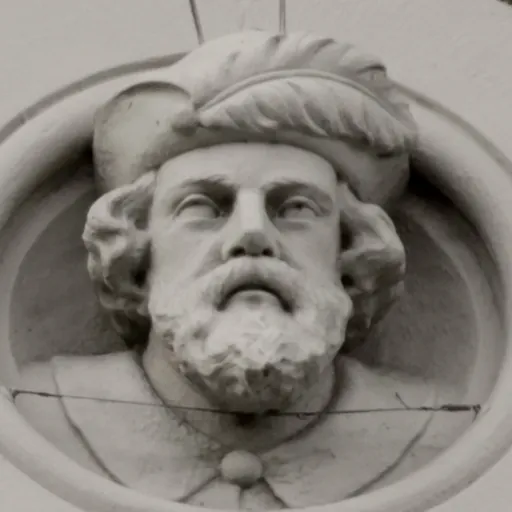
About John Wormald Appleyard
Lived 1831 – 1894 (aged 62). John Wormald Appleyard was a sculptor.
John Wormald Appleyard (10 September 1831 – 14 January 1894) (active 1851–1893) was a British sculptor and monumental mason based in Leeds, West Yorkshire, England.
He was sixteen years old when his apprenticeship as a stone carver was curtailed due to the death of his grandfather who was training him. He was versatile enough to turn his hand to wood carving, decorative ceiling work, stained glass and marble sculpture besides stone carving, so that from around the age of twenty-one years he was able to maintain a stoneyard and studio in Cookridge Street, Leeds, at least until 1891. He was generally known during his lifetime as a monumental mason.
He is mainly known today in Leeds for his wooden faux-Jacquemart figures of Robin Hood, Friar Tuck, Richard the Lionheart and the swineherd Gurth, which appear to strike the hours on the Ivanhoe clock at one end of Thornton's Arcade in Briggate. He is also known for his figure of Old Father Time on the Tempus Fugit clock on the Time Ball Buildings, Leeds.
Background Appleyard's maternal grandparents, both born in Yorkshire, were Abraham Wormald, His father was Jabez Appleyard,
Appleyard died on 14 January 1894 without issue, The funeral procession left 4 Hirst Square on 17 January at 2.30 pm, and he was buried at Burmantofts Cemetery in grave no.12542. He was sufficiently wealthy to bequeath £100 to Leeds General Infirmary, and to his relative Isaac Appleyard, a coal merchant. His effects, consisting of "china, books, pictures, and other effects" were auctioned at Hepper & Sons, Leeds, on 3 February 1894.
He was the uncle of the artist Fred Appleyard, via Appleyard's brother Isaac.
Career In 1841, by the time he was nine years old, Appleyard was already apprenticed in Drighlington to his maternal grandfather Abraham Wormald, a stonemason. He plied his trade as a "sculptor, stone and marble mason and monumental mason" until at least 1891, although he tended to call himself simply a stone carver or sculptor.
In 1892 Appleyard appeared as a witness, on behalf of architect Edward William Lockwood (1856–1934) of Huddersfield, in a Court case brought by sculptor Samuel Auty of Lindley for payment for some carving work on the factory of dry salters Clayton, Holroyd & Co., Longroyd Lane, off Manchester Road, Longroyd Bridge, Huddersfield, built 1890–1891 (now demolished). A comment from this case confirms that stones for architectural carving were roughed out by masons at ground level, and that the carving was completed when the stones were in situ on the building: "The stone for the gargoyles roughened into shape," then later "he could not work in such an exposed position as that in which the stone had in the meantime been placed, but that when the weather was better he would finish the work." Auty did not finish it, and Appleyard completed the six crockets and two gargoyles. Both sculptors were paid for their work.
The Beckett Street Cemetery record keeper knew him as a monumental mason. Appleyard was also in his later years a teacher of cabinet-making at the Leeds Institute. He was a leading member of Leeds Church Institute.
Works
Exhibitions, 1875–1891 The whereabouts of the following exhibits is unknown. At the Leeds Mechanics' Institution, Yorkshire Exhibition of Arts and Manufactures in 1875 Appleyard exhibited "several marble sculptures." At the Yorkshire Fine Art Society, Autumn Exhibition, 1880, he showed Sabrina. In 1888 he exhibited unknown works alongside Matthew Taylor at a show of international works of art, in the central court, at the Leeds Fine Art Gallery exhibition. In 1889 he entered a Medallion Portrait of Lady Jane Grey at the Leeds City Art Gallery, The Spring Exhibition. His The Elements was exhibited at the same spring exhibition in 1890, and again in spring 1891. Other exhibited pieces were Head of Christ, Neptune, Portrait, Medallion Portrait of Mozart and Head of Mozart 1880. Appleyard executed the sculpture on top of Dyson's cantilevered Tempus Fugit 'drum' clock, which is suspended from the front of the Time Ball Buildings, Leeds. The figure of Chronos or Old Father Time above the clock was created by Appleyard after Dyson bought 24 Briggate to add to the existing premises made from amalgamating 25 and 26 Briggate. (The date 1865 refers to the founding of Dyson's business.) When Susan Wrathmell wrote the Pevsner Guide to Leeds, the Old Father Time figure was gilded.
St Bartholomew's Church, Armley, Leeds, 1872–1877
St Bartholomew's, Armley, Leeds, was founded in 1872, and consecrated in 1877. The Caen stone reredos of this church erected in 1877 has alabaster carvings, Appleyard was present at the consecration on 24 August 1877, listed alongside the architects Henry Walker and Joseph Athron who designed the building and reredos. Since no other stone carver is credited for this work, it is reasonable to suppose that it could be the work of Appleyard.
The pulpit is of alabaster and marble, designed by architect Thomas Armfield after the pulpit at the shrine of Sebaldus in St. Sebaldus Church, Nuremberg. It was carved originally by Mawer and Ingle for the former St Bartholomew's Church, on the occasion of its 1861 restoration, then moved together with the font to the new building after the consecration.
Baptist Chapel, Normanton, 1877–1878
The foundation stone of this chapel was laid in August 1877. It was opened on the High Street of Normanton, West Yorkshire on 7 May 1878. It was designed at a cost of £3,000 by J.P. Kay of Leeds "after the classic order of architecture", and presented a "bold and substantial appearance". Appleyard was credited as carver. The Wakefield Free Press reported that, "the workmanship and finish throughout reflect great credit on the skill and taste of the gentlemen who took part in erecting this handsome edifice". The chapel has "a carved medallion, bearing the inscription and date". The building suffered a "devastating fire" in 2009, and was restored by William Birch.
Decorative ceilings, Grand Theatre, Leeds, 1877–1878
The Grand Theatre in Upper Briggate, Leeds, is a Grade II* listed building, designed by George Corson and his chief assistant James Robinson Watson, and opened in November 1878, having taken "thirteen months to build." It originally consisted of a theatre and assembly rooms, with shops in between. The interiors have been much changed, especially in the 1930s. contracted by J. Pollard of Bond Street. The auditorium has a "ribbed and domed ceiling with central chandelier and plaster pendentives," and the former assembly room (now the Opera North rehearsal room) has a "segmental-arched ceiling with ribs and panels decorated with reliefs of fruit and flowers." "The prevailing colour of the decorations (was) crimson and gold."
Ivanhoe Clock, Thornton's Arcade, Leeds, 1877–1878 Thornton's Arcade is a Grade II listed building, designed by George Smith, and located between Lands Lane and Briggate in Leeds, West Yorkshire. It was in the planning stage in 1875, approved in 1877 and completed in 1878. The Ivanhoe Clock is a large, automated, public timepiece manufactured by Potts of Leeds between 1877 and 1878 to strike on the hour and each quarter. Appleyard created the four life-sized, wooden, faux-Jacquemart figures of Richard I, Friar Tuck, Robin Hood and the swineherd Gurth. The Arcade's founder Charles Thornton already owned the music hall which later became the City Varieties, so these pantomime figures are in keeping with his showmanship.
Barran's Fountain, Roundhay Park, Leeds, 1882 This is a Grade II listed building, designed by Thomas Ambler (1838–1920) in Park Springs stone. It is a rotunda-shaped drinking fountain in Roundhay Park, Leeds, West Yorkshire, England. Appleyard executed the carving on this domed fountain, which was donated by the founder of Roundhay Park, Sir John Barran.
Central Library interior, Leeds, 1878–1884
Leeds Central Library is a listed building, designed as municipal buildings by George Corson to complement the Town Hall. The foundation stone was laid in 1878, and the building was completed in April 1884. Appleyard led the team of stone carvers who worked on the interior staircases, pillars and arches (except for the alabaster entrance-hall arch, carved by Farmer & Brindley). It was designed at a cost of £9,000 by William Henry Thorp (1852–1944) of Albion Street, Leeds, and opened by Archibald Witham Scarr (1827–1904), Mayor of Leeds, and Hubert von Herkomer on Wednesday 3 October 1888. Its ground floor gallery was called the Queen's Room (renamed as of 2019 the Ziff Gallery): The frieze and ceiling was painted ivory white, and the walls were maroon "of dead texture" to show off the artworks and frames.
Newton Park Union Church, Chapeltown/Potternewton, 1887–1889
Newton Park Union Church is a Grade II listed building. It was designed at a cost of £6,200 "in the fourteenth century decorated Gothic style" for the newly joined Congregationalists and Baptists by Archibald Neill (1856–1933), of East Parade, Leeds, and opened on Wednesday 3 April 1889. The new church was built on the eastern side on the original Lupton family's Congregational Chapel, built in 1870. The new church had a 70-foot tower with a clock by Pearce & Sons; on each angle was a turret with an octagonal crocketed pinnacle. It had an octagonal nave with arcading and clerestory. "The pulpit and communion rails, of oak, are beautifully carved." J. W. Appleyard was credited as one of the contractors, but it is not known whether he carved wood or stone here. At some point the clock was replaced by one by Potts of Leeds, which had originally been installed in Wellington Station, Leeds, in 1916. The building was deconsecrated in 1952 and became the Royal Air Force Association Club, The Old Central Hebrew Congregational Synagogue, then finally a Sikh temple. The original 1870 Chapel was damaged by fire in 2005 and as of 2019 was derelict.
Memorial to J.F. Longrigg, St Paul's, Shipley, 1890 This wall memorial to the Rev. John Fallowfield Longrigg MA, who died 8 September 1888, was produced in Appleyard's stoneyard. It is in St Paul's Church, Kirkgate, Shipley, West Yorkshire, a Grade II listed building, and consists of a white marble tablet on a slab of empress red marble which was originally "on the west wall, to the right of the central doorway, of St Paul's Church." It is now on the left side of the door. Longrigg had initiated a young men's class during his curacy, and this group organised the funding by subscription of the tablet, which was "completed in a very artistic manner". Longrigg also initiated the poor children's annual Christmas dinner at Shipley, and this work continued for many years after he left St Paul's. The dedication is to the "rarest devotion to duty" by Longrigg, who was curate of St Paul's 1885–1887, after which he was vicar of Emmanuel Church in Woodhouse Lane, Leeds from November 1887. He died suddenly in September of the following year.
London and Midland Bank, Leeds, 1890–1892 This is a listed building. It is on the south-west side of Kirkgate (number 110) where it meets Vicar Lane. It faces the south-west corner of Kirkgate Market. It was designed by William Bakewell (1839–1925) of Leeds at a cost of £4,500 , with carving by J.W. Appleyard. but did not move into the new premises until February 1892. The Pevsner Guide cites "fine carving, including King Midas." English Heritage says that above the pediment there is a "draped female statue flanked by animals, a lion and unicorn at corners," and completed in 1892. It has a decorated frieze. The Pevsner guide cites carved exterior detail by John Wormald Appleyard at the corner entrance, on the upper floor, and on Corinthian columns. The exterior is of "cleansed Bradford stone ... the frieze and pediment being carried by polished red granite columns. The architecture of the first and second floors is of a Corinthian order, having coupled columns, and the whole is crowned by richly carved frieze, cornice, and vase terminals." The walls of the banking hall were originally lined with Burmantofts faience. The hall's furnishings were of half-polished oak with specially designed brass fittings. The first and second floors were intended as offices, with their own strong room on each floor, and their own Bond Street entrance. There was also a "fine suite of offices" on the ground floor, with its own Park Row entrance.
Window, St John the Evangelist, Farsley, before 1894 This stained glass crucifixion window is in St John the Evangelist Church, Farsley, West Yorkshire, a listed building. The window was found in Appleyard's Cookridge Road studio after his death. It had been designed and executed by him during his lifetime. It was possibly intended in memory of his parents who are buried in St John's churchyard, although his friends added a dedication to Appleyard's memory only. It was installed in June or July 1894. The windows of St John's were restored in 2015.
Leeds School of Medicine, Thoresby Place, Leeds, 1891–1894
This is a listed building. It was designed initially for 400 students, in "collegiate Tudor Gothic" by Leeds-born William Henry Thorp FRIBA (1852–1944), and completed in October 1894. The building stands in Thoresby Place, beside George Gilbert Scott's original frontage of Leeds General Infirmary. It has three storeys plus attics, and was built of local brick with Morley Moor sandstone dressings and terracotta details. The interior hall is lined with Mansfield stone. The design of the eye sockets and visible vertebrae of the grotesques here are key to the identification of Appleyard's own work on Headingley Hill Congregational Church, and the liondogs on the staircase of Leeds Central Library mentioned above.
Don’t just read it —
keep it.
Full-length biographies made to live with: read them, listen on the way to work, watch them tonight.
- E-book
- Audio
- Video
Instant download · yours to keep · every purchase keeps this site free
Important facts
People in John Wormald Appleyard's life
Named in this biography and alive at the same time




Related people
Same field, nearest in time



Contemporaries
People whose lives overlapped John Wormald Appleyard's


Frequently asked questions
Who was John Wormald Appleyard?
(1831-1894)
When was John Wormald Appleyard born?
John Wormald Appleyard was born on 10 September 1831 in Leeds.
When did John Wormald Appleyard die?
John Wormald Appleyard died on 14 January 1894 in Leeds.
What was John Wormald Appleyard's occupation?
John Wormald Appleyard was a sculptor.
Sources & further reading
· Wikipedia: John Wormald Appleyard
· DBpedia: John Wormald Appleyard
Cite this page
APA: Biography.guide. (2026). John Wormald Appleyard. https://biography.guide/john-wormald-appleyard/
MLA: "John Wormald Appleyard." Biography.guide, https://biography.guide/john-wormald-appleyard/.
Chicago: "John Wormald Appleyard." Biography.guide. https://biography.guide/john-wormald-appleyard/.
Data last updated: 2026-09-23 · Spot an error? Report a correction.
Portrait: Wikimedia Commons · author & licence
Page generated 2026-09-27 05:05 UTC