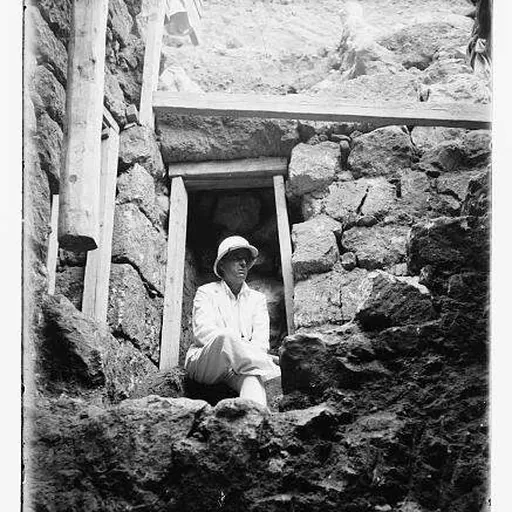
About John Winter Crowfoot
Lived 1873 – 1959 (aged 86). John Winter Crowfoot was a British archaeologist.
John Winter Crowfoot CBE (28 July 1873 – 6 December 1959) was a British educational administrator and archaeologist. He worked for 25 years in Egypt and Sudan, serving from 1914 to 1926 as Director of Education in the Sudan, before accepting an invitation to become Director of the British School of Archaeology in Jerusalem.
Origins, education and early career
John Winter Crowfoot was the eldest of three children, and the only son, of clergyman John Henchman Crowfoot (1841–1927) and his wife Mary (née Bayly). A Fellow of Jesus College, Oxford, and later the Chancellor of Lincoln Cathedral, John Henchman lived with his wife Mary in Lincoln for most of their married life, retiring to Worthing before World War I.
By long tradition, the Crowfoots were a medical family. Between 1783 and 1907 they provided five generations of surgeons and doctors to the market town of Beccles in Suffolk. John's uncles William Miller Crowfoot (1837–1918) and Edward Bowles Crowfoot (1845–1897) were doctors in Beccles, as was his cousin William Bayly Crowfoot (1878–1907). In 1921 John and his wife Molly leased a house in Geldeston, near Beccles, which became the family home for the next sixty years.
John was educated at the Fauconberge School (Beccles) before entering Marlborough College and then Brasenose College, Oxford, where he read Greats and was Senior Hulme Exhibitioner in 1896.
On graduating Crowfoot studied from 1896 to 1897 at the British School at Athens. He excavated at the site of Hala Sultan Tekke in Cyprus in 1898, on behalf of the British Museum. Lacking private means or other funding to continue an archaeological career, John accepted an appointment in 1899 as lecturer in classics at Birmingham University, John Crowfoot made a personal donation of £10 towards the costs. The school opened in 1907.
In the early 20th century the colonial authorities in Sudan still feared a further eruption of Mahdism. As a consequence the region was under quasi-military rule. There were no European women in the country and any man recruited to work in Sudan had to provide assurances that he was not only unmarried but also without a fiancée. In 1909 after John moved to Cairo he was able to marry Grace Mary Hood (Molly), whom he had met in Lincoln years before. She joined him in Egypt and over the next four years their three eldest daughters Dorothy, Joan and Elisabeth were born in Cairo.
In 1916, on the recommendation of Lord Kitchener, Crowfoot returned to the Sudan as the Director of Education and Principal of Gordon College, Khartoum. He was now accompanied by his wife Molly. John Crowfoot served, at the same time, as Director of the Department of Antiquities of the Sudan. included monitoring shipping in the Red Sea.
Government attitudes towards the provision of educational opportunities to the Sudanese hardened over time, particularly after political disturbances in 1924. Crowfoot, "who despite a lack of forcefulness was an educational administrator of long experience", decided to claim the pension to which he was already entitled and resigned in 1926.
Palestine That same year, still in his early fifties, John Crowfoot succeeded John Garstang as Director of the British School of Archaeology in Jerusalem. This enabled him and his wife Molly, at long last, to engage in archaeology full-time. He retained the directorship until his retirement in 1935.
Between 1928 and 1930 John Crowfoot directed the BSAJ-Yale University excavation of more than a dozen 5th- and 6th-century Christian churches at Jerash (Gerasa) in the Emirate of Transjordan. This broke with the prevailing "obsession" with the Old Testament among archaeologists in Palestine and their desire "to prove it true", i.e., that the words of the Old Testament could be taken as the literal truth. Under his guidance there was a shift to examining what survived of early Christian archaeology, which was "rich in architecture, art, epigraphy and the classical roots of Western society" (R.W. Hamilton).
From 1931 to 1935 John Crowfoot directed the Joint Expedition of the BSAJ, PEF, Harvard University and the Hebrew University at Samaria-Sebaste. These excavations made it possible to reconstruct the "dramatically changing fortunes" of this provincial capital of the ruler Omri and his son Ahab through twenty centuries, with the successive cultural contributions of Assyrians, Persians, Greeks, Romans, Byzantines and Crusaders. A botanist and fine draughtswoman, she became a distinguished scholar in her own right, an authority on archaeological textiles, and served as an equal partner in many of his professional activities. Their nephew (son of Molly's brother, Lt-Cmdr Martin Hood, RN) was the archaeologist Sinclair Hood.
In the years following the end of World War II Crowfoot was an active member of the housing committee at the Loddon Rural District Council, and took pride in his successful support of the distinctive local council housing designed by the Tayler & Green partnership.
At varying times and in varying ways his four daughters followed their parents in pursuing archaeological interests. Joan Crowfoot Payne (1912–2002) worked for thirty years on Egyptian antiquities at the Ashmolean Museum in Oxford; Elisabeth Crowfoot (1914–2005) succeeded her mother as a textile archaeologist; and Diana (1918–2018), a geographer, married Graham Rowley, the Arctic explorer and archaeologist.
Their eldest daughter, Dorothy, visited her parents on site in Jerash and helped with drawings of certain mosaics there. Her field was chemistry and in 1947, aged 36, she was elected a fellow of the Royal Society, only the third woman to have then received that honour. (In 1964 Dorothy would be awarded the Nobel Prize in Chemistry.)
John Winter Crowfoot died in 1959 and is buried, with his wife Molly, next to the tower of St Michael's parish church, Geldeston. The epigraph on their gravestone ("Shall not loveliness be loved forever?") is taken from Murray's translation of The Bacchae by Euripides.
Papers and publications
John Winter Crowfoot's unpublished papers relating to his time in Egypt, Sudan and Palestine are held, respectively, in the Sudan Archive at Durham University (see catalogue of his papers there) and the archives of the Palestine Exploration Fund in London. The published writings of John Winter Crowfoot include archaeological reports, articles on anthropology and folklore, and memoirs.
Early works (Anatolia) Survivals among the Kappadokian Kizilbash (Bektash) (1900) Kleinasien, ein Neuland der Kunstgeschichte (1903)
Sudan Some lacunae in the Anthropology of the Anglo-Egyptian Sudan (1907). A paper read before the British Association in August 1907 ..." The island of Meroë (London and Boston, 1911) Wedding Customs in the Northern Sudan (1922) Early Days, 1903–1931 (1954)
Palestine Palestine Exploration Quarterly, 1865 to present, online Excavations in the Tyropoeon Valley, Jerusalem, 1927 (Dawsons, 1929; with G.M. Fitzgerald) Churches at Jerash (1931) Churches at Bosra and Samaria-Sebaste (1937) Samaria-Sebaste 2: Early Ivories (1938) Gerasa, city of the Decapolis: The Christian churches (American Schools of Oriental Research, 1938) Early Churches in Palestine: Schweich Lectures of the British Academy, 1937 (Oxford University Press, 1941) Samaria-Sebaste 1: The Buildings (1942) Samaria-Sebaste 3: The Objects (1957)
Don’t just read it —
keep it.
Full-length biographies made to live with: read them, listen on the way to work, watch them tonight.
- E-book
- Audio
- Video
Instant download · yours to keep · every purchase keeps this site free
Important facts
People in John Winter Crowfoot's life
Named in this biography and alive at the same time




Related people
Same field, nearest in time



Contemporaries
People whose lives overlapped John Winter Crowfoot's


Frequently asked questions
Who was John Winter Crowfoot?
British archaeologist (1873-1959)
When was John Winter Crowfoot born?
John Winter Crowfoot was born on 28 July 1873.
When did John Winter Crowfoot die?
John Winter Crowfoot died on 6 December 1959.
What was John Winter Crowfoot's occupation?
John Winter Crowfoot was an archaeologist.
What nationality was John Winter Crowfoot?
John Winter Crowfoot was British.
Sources & further reading
· Wikipedia: John Winter Crowfoot
· DBpedia: John Winter Crowfoot
Cite this page
APA: Biography.guide. (2026). John Winter Crowfoot. https://biography.guide/john-winter-crowfoot/
MLA: "John Winter Crowfoot." Biography.guide, https://biography.guide/john-winter-crowfoot/.
Chicago: "John Winter Crowfoot." Biography.guide. https://biography.guide/john-winter-crowfoot/.
Data last updated: 2026-09-22 · Spot an error? Report a correction.
Portrait: Wikimedia Commons · author & licence
Page generated 2026-09-27 05:03 UTC