
About John Garstang
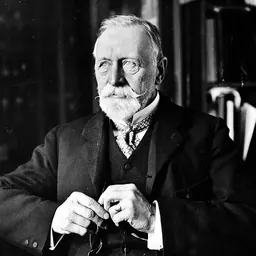
Lived 1876 – 1956 (aged 80). John Garstang was a British anthropologist, archaeologist, university teacher and orientalist.
alt=Museum display with artefacts and images relating to John Garstang. A black and white photograph of Garstang is displayed in the centre, under the signature of Garstang and the Garstang Museum logo. Garstang Museum of Archaeology, University of Liverpool. Redeveloped in 2014, the museum features artefacts and photographs from Garstang excavations in Egypt, Sudan, Anatolia and the Levant. John Garstang on site at Beni Hassan, from the glass plate negative collection at the Garstang Museum of Archaeology.
John Garstang (5 May 1876 – 12 September 1956) was a British archaeologist of the Ancient Near East, especially Egypt, Sudan, Anatolia and the southern Levant. He was the younger brother of Professor Walter Garstang, FRS, a marine biologist and zoologist. Garstang is considered a pioneer in the development of scientific practices in archaeology as he kept detailed records of his excavations with extensive photographic records, which was a comparatively rare practice in early 20th-century archaeology. He was educated at Blackburn Grammar School and in 1895 he obtained a scholarship for Jesus College, Oxford to study mathematics. Like Petrie before him, Garstang would continue to use Excavation Committees to fund his excavations for most of his career. Largely funded by private benefactors, the Institute contained both a library and a museum, intended to support the work of the staff and the teaching of its students. In 2004, this museum was officially renamed the Garstang Museum of Archaeology, to celebrate the centenary of the foundation of the Institute.
From 1907–41, Garstang was the first professorship in the methods and practice of archaeology at the university. On behalf of the institute, Garstang excavated sites in Egypt, Sudan and the Near East up to the out break of World War I. Some of his assistant excavators include E. Harold Jones, English artist and illustrator.
He served as the Director of the Department of Antiquities in the British Mandate of Palestine between 1920–26, and excavated at Ashkelon, 1920–21. He was also the Head of the British School of Archaeology in Jerusalem, 1919–26. He also carried out a major excavation of Jericho from 1930–36, funded by Sir Charles Marston.
He taught at the Egyptology section of the Faculty of Arts when this was established in the 1920s. One of his students was Pahor Labib, late Director of the Coptic Museum, Cairo.
From 1936 to the outbreak of World War II, Garstang excavated Yümük Tepe near Mersin.
Personal life Garstang married Marie Louise Berges, from France, in 1907. Over the years, Marie travelled extensively with him. "When in England, they lived in Formby, near Liverpool, where Marie died in 1949. He died some years later, in Beirut, on the return journey from a holiday cruise. It was 1956 and he was eighty years old. They had two children, John Berges Garstang who died in 1965, aged 57 years, and Meroe Fleming (born Garstang), who died in 1994 at the age of 79 years."
Garstang's posthumous monograph The Geography of the Hittite Empire was completed with the help of his sister R. Garstang and his colleague Oliver Gurney after John was disabled by illness in 1953. Gurney's wife, Diane Grazebrook, provided the maps.
Excavations Garstang excavated at various sites in his career, including: Bremetennacum (Ribchester), up to 1898; Ardotalia (Melandra), 1899; Rutupiae (Richborough Castle), 1900; Navio Roman Fort near Brough-on-Noe, 1903; Predynastic cemetery at Alawniyeh, 1900–1901; Predynastic settlement and Early Dynastic cemetery at El-Mahasna near Beit Khallaf, 1900–1901; Third dynasty mastaba tombs near Beit Khallaf, 1900–1901; Old Kingdom necropolis near Reqaqnah, 1901–1902; Beni Hasan, 1902–1904; Naqada, 1902–1904; Hierakonpolis, 1904–1906; Esna, 1905–1906 (Middle - New Kingdom necropolis); Ptolemaic graves west of Edfu, 1905-1906; Messawiyeh (south of Esna), 1905-1906 (Early Dynastic necropolis); El Kilh, 1905-1906 (Early Dynastic graves, between Hierakonpolis and Edfu); Hissayeh, 1905-1906 (Ptolemaic tombs); Dakka (Lower Nubia/Upper Egypt), 1905-1906 (New Kingdom burials); Koshtamna, Aswan region, Lower Nubia/Upper Egypt (few km down the Nile from the Temple of Dakka), 1905–1906; (A-Group - Middle Kingdom cemetery); Kubba (south of Dakka), 1905-1906 (Middle - New Kingdom burials, Byzantine fort); Abydos, Egypt, 1906–1909; Sakçagözü, 1908,1911; Meroë, 1909–1914; Ashkelon, 1920–1921; Dor (Tantura), 1923–1924, where a field school for the BSAJ students took place; Jericho, 1930–1936; Yümük Tepe near Mersin, 1948.
Publications
Primary sources The Garstang Museum of Archaeology, University of Liverpool, holds a large collection of John Garstang's archaeological and photographic records,1900-1936, including records from El-Mahasna; Bet Khallaf; Reqaqnah; Beni Hasan; Hierakonpolis; Hissayeh; Esna; Kostamneh; Dakka; Abydos; his survey of Hittite sites in Anatolia; Sakçagözü; Meroë; Jericho. (Reference Number: GB/3431/JG). University College, London Archives holds a collection of John Garstang's papers, including material relating to Beisan, Boğazkale, Hazor, and Jericho; albums and other material relating to Yümük Tepe near Mersin; rolled diagrams relating to Sakçagözü; plans relating to Ashkelon. (Reference No: UCLCA/IA/A/17). The Palestine Exploration Fund Archives hold Garstang's field notebooks, drawings, papers and photographs, 1930–1936, (Reference Number: PEF/JER/GAR). The Abbey House Museum hold Garstang's diaries and papers relating to Jericho, (Reference Number: JC).
Further research Many of Garstang's excavations were never fully published in his lifetime and have subsequently been published by other authors after his death:
Don’t just read it —
keep it.
Full-length biographies made to live with: read them, listen on the way to work, watch them tonight.
- E-book
- Audio
- Video
Instant download · yours to keep · every purchase keeps this site free
Important facts
People in John Garstang's life
Named in this biography and alive at the same time




Related people
Same field, nearest in time




Contemporaries
People whose lives overlapped John Garstang's

Frequently asked questions
Who was John Garstang?
British archaeologist (1876-1956)
When was John Garstang born?
John Garstang was born on 5 May 1876 in Blackburn.
When did John Garstang die?
John Garstang died on 12 September 1956 in Beirut.
What was John Garstang's occupation?
John Garstang was an anthropologist, archaeologist, university teacher and orientalist.
What nationality was John Garstang?
John Garstang was British.
Sources & further reading
Cite this page
APA: Biography.guide. (2026). John Garstang. https://biography.guide/john-garstang-anthropologist/
MLA: "John Garstang." Biography.guide, https://biography.guide/john-garstang-anthropologist/.
Chicago: "John Garstang." Biography.guide. https://biography.guide/john-garstang-anthropologist/.
Data last updated: 2026-09-20 · Spot an error? Report a correction.
Page generated 2026-09-27 05:28 UTC