About John Wilmot
Lived 1748 – 1815 (aged 66–67). John Wilmot was a politician.
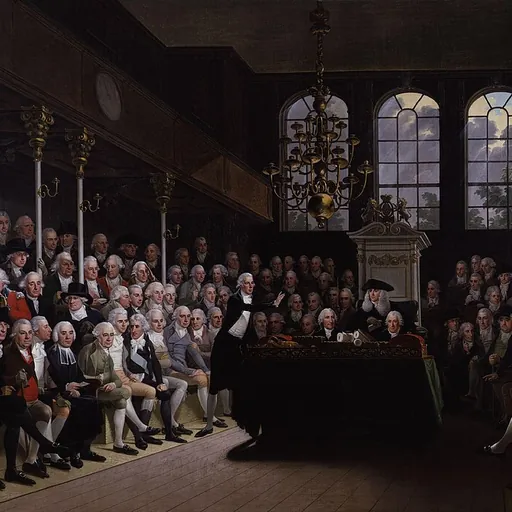
John Eardley Wilmot painted by Benjamin West in 1812 (detail). The history painting Reception of the American Loyalists is visible in the background.
John Eardley Wilmot (1748 – 23 June 1815) was a British lawyer and politician who sat in the House of Commons from 1776 to 1796.
Early life The younger son of Sir John Eardley Wilmot, Chief Justice of the Common Pleas, Wilmot was born at Derby in 1748, and was educated at Westminster School and Oxford, where he went on to become a fellow of All Souls. He studied for the church under Dr William Warburton, but afterwards decided to pursue the law instead and was called to the Bar, which his father called "quitting a bed of roses for a crown o' thorns."
Career In 1776, about five years after his call to the bar, Wilmot was returned to parliament for Tiverton in Devon; and, taking part with the opposition, attacked the ministerial party in a pamphlet, denouncing the continuance of the American Revolutionary War. In 1781, he was appointed a master in Chancery; and, in 1782, was commissioned, in conjunction with others, to inquire into the distribution of the sums destined for the relief of the American loyalists. In the following year, he spoke on the subject in parliament; and, in reply to Charles James Fox's condemnation of the large sums expended on the American sufferers, he declared "he would share with them his last shilling and his last loaf." In 1784 he was a member of the St. Alban's Tavern group who tried to bring Fox and Pitt together.
In 1784, and the parliament which followed in 1790, Wilmot sat as member for Coventry, and supported the views of Pitt during every session. He was hostile to the French Revolution and obtained the distribution of a fund, under the sanction of parliament, on behalf of the emigrants from that country. He was the author of A Treatise on the Laws and Customs of England. The other member for Coventry was his brother-in-law Sir Sampson Gideon, who in 1789 changed his name to Sampson Eardley.
In November, 1779 he was elected a Fellow of the Royal Society.
Private life He was twice married. In 1776 he married Fanny, only daughter of Samuel Sainthill (1727–1767), son of Peter Sainthill. Fanny and Wilmot had one son, Sir John Eardley-Wilmot, 1st Baronet, and four daughters. They were divorced by a private act of Parliament, (32 Geo. 3. c. 15 ), on grounds of her adultery with a footman. Wilmot married secondly, in 1793, Sarah Anne, daughter of Anthony Haslam, a lieutenant colonel in the 5th Regiment of Foot. They had a son and daughter, who each died young.
His third daughter Jemima Arabella Wilmot (1779–1865) married John Holt (c.1787–1838) of Tottenham.
In 1793 Wilmot donated to the British Museum a roll illustrating the funeral procession of Elizabeth I, ascribed to William Camden, which his first wife had inherited from Peter Sainthill.
He lived at Berkswell Hall and was also the last private resident of Bruce Castle. In 1813 he was lord of the manor of the Prebend of Calne. He was reported to be a man of upright and unimpeachable character, learned and eloquent.
He died on 23 June 1815, aged 66, and was buried at St John the Baptist, Berkswell, Warwickshire.
Publications John Eardley Wilmot, A Treatise on the Laws and Customs of England John Eardley Wilmot, Memoirs of the life of the Right Honourable Sir John Eardley Wilmot (1802, 2nd edition 1811) John Eardley Wilmot, The Life of the Rev. John Hough, D.D. (1812) John Eardley Wilmot, An Historical Review of the Commission relative to the American Loyalists (1815)
Don’t just read it —
keep it.
Full-length biographies made to live with: read them, listen on the way to work, watch them tonight.
- E-book
- Audio
- Video
Instant download · yours to keep · every purchase keeps this site free
Important facts
People in John Wilmot's life
Named in this biography and alive at the same time




Related people
Same field, nearest in time



Contemporaries
People whose lives overlapped John Wilmot's




Frequently asked questions
Who was John Wilmot?
English politician; (1750-1815)
When was John Wilmot born?
John Wilmot was born in 1748.
When did John Wilmot die?
John Wilmot died on 23 June 1815.
What was John Wilmot's occupation?
John Wilmot was a politician.
Sources & further reading
· DBpedia: John Wilmot (politician)
Cite this page
APA: Biography.guide. (2026). John Wilmot. https://biography.guide/john-wilmot/
MLA: "John Wilmot." Biography.guide, https://biography.guide/john-wilmot/.
Chicago: "John Wilmot." Biography.guide. https://biography.guide/john-wilmot/.
Data last updated: 2026-09-23 · Spot an error? Report a correction.
Portrait: Wikimedia Commons · author & licence
Page generated 2026-09-27 05:06 UTC