
About Sampson Gideon
Lived 1699 – 1762 (aged 62–63). Sampson Gideon was a British banker, known for Jacobite Rising of 1745.
Sampson Gideon (February 1699 – 17 October 1762) was a British banker and philanthropist active in the City of London during the Georgian era. Gideon is most prominently known for his financing of the Hanoverian-Whig government's suppression of the Jacobite rising of 1745, subsequently becoming a trusted "adviser of the Government" who supported the passage of the Jewish Naturalisation Act 1753. Historian James Picciotto, in his 1875 book Sketches of Anglo-Jewish History described Gideon as the "Rothschild of his day" and the "pillar of state credit".
Background Sampson Gideon was born at London Wall in the City of London, second son of five children of Rowland Gideon (né Rohiel Abudiente), who traded in the West Indies, and his second wife, Esther de Porto (also Jewish), daughter of Domingo (or Abraham) do Porto, a diamond buyer in Madras, India. Sampson Gideon's paternal grandfather Moses Abudiente was a Sephardi born at Lisbon, Portugal, but moved to Glückstadt in Holstein, an area close to Hamburg, where Rowland Gideon was born. The Abudientes (including Rowland and his brother) were part of the elite Sephardic planter ruling class in the West Indies, active in the production of sugar cane in first Barbados, Antigua and then Nevis (moving each time to avoid taxes). The Abudientes made their extensive fortune from the sugar cane, worked by the labour of enslaved Africans and European indentured servants on their plantations.
After moving to London, Rowland Gideon was admitted to the Worshipful Company of Painter-Stainers on 17 February 1698 and was likely the first Jewish Freeman of the City of London. He was admitted to the company due to his Barbados trading connections, through the person of Samuel Swynock, one of the Wardens of the Painter-Stainers. Swynock had been close to Antonio Fernandez Carvajal, one of the Sephardic merchants allied with Oliver Cromwell and the Roundheads. Indeed, Carvajal founded the Creechuch Lane Synagogue where Sampson Gideon's parents were married by Haham Aylion on 26 December 1693. Rowland Gideon himself was the Treasurer of Bevis Marks Synagogue in the year that it was founded. His capital rose to £45,000 in 1740, £180,000 in 1750, and £350,000 in 1759. Gideon was involved in financial activities as a broker, a middle-man in the metal trade with the East India Company. He was one of a number of contemporary Sephardic financiers in British public life who specialised in metal brokering, along with Abraham Mocatta.
The Hats government in Sweden (controlled by pro-Jacobite freemasons) had invited Sephardic Jews in Britain to join the Swedish East India Company, which also included a number of Scotsmen who were members of Masonic lodges. The British government then encouraged pro-Hanoverian Freemasons Joseph Salvador and Sampson Gideon to entice influential Scots to join the East India Company to undermine the Swedish-based Jacobite masonry.
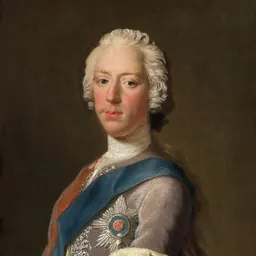
Charles Edward Stuart. Gideon financially backed the Whig regime against the Jacobites.
Sampson Gideon was able to successfully navigate the South Sea Company bubble, which bankrupted many prominent people in Britain (James Picciotto in his Sketches of Anglo-Jewish History states that no "Hebrew" name is to be found on the list of insolvencies). Gideon offered his services, both private and political, to Robert Walpole and his ruling Whig government under the new Hanoverian monarchy. The first major conflict that he helped to finance was the War of Jenkins' Ear against Spain. The Spanish Inquisition, which persecuted Jews, was still active, and many of the Sephardi traders in the West Indies consequently viewed the Spanish cause in the conflict as a potential threat to their trade interests.
Gideon's most significant act came during the Jacobite rising of 1745 during the War of the Austrian Succession, when he provided assistance to the sitting Whig-Hanoverian regime against Charles Edward Stuart (the Young Pretender) and the Jacobites who were attempting to restore the Stuart monarchy, with the help of their Bourbon French allies. When the Young Pretender landed on the west coast of Scotland in July 1745, there was panic in London as most of the British Army was engaged on the European Continent at the time. Consequently, there was a run on the banks, which was especially problematic for the Bank of England. Jews had gradually begun to resettle in England during the times of Cromwell, having been barred from the country since the Edict of Expulsion at the close of the 13th century. In the previous century, Gideon's fellow Sephardi, Antonio Fernandez Carvajal, had become the first endenizened Jew. However, following the English Reformation, those who did not conform to the Church of England (including English Dissenters and Catholics, as well as Jews) could not hold office, be called to the bar, obtain a naval commission, study for a university degree or vote in elections. There were additional commercial restrictions on endenizened Jews and they had to have the approval of the British parliament to own real estate. As Sampson Gideon and Joseph Salvador had provided a useful service to the Hanoverian-Whig regime against their rivals, they were confident enough to lobby Henry Pelham to introduce the Jewish Naturalisation Act 1753 to Parliament.
Death
Gideon died of dropsy at Belvedere House, near Erith, Kent, in October 1762, aged 63, having a gained a fortune recorded as £350,000 (equivalent to $ million in ). He left £1000 to the Sephardi Jewish congregation in London on condition he was buried with honour as a married man in their cemetery in Mile End.
Don’t just read it —
keep it.
Full-length biographies made to live with: read them, listen on the way to work, watch them tonight.
- E-book
- Audio
- Video
Instant download · yours to keep · every purchase keeps this site free
Important facts
People in Sampson Gideon's life
Named in this biography and alive at the same time



Related people
Same field, nearest in time





Contemporaries
People whose lives overlapped Sampson Gideon's



Frequently asked questions
Who was Sampson Gideon?
British banker (1699-1762)
When was Sampson Gideon born?
Sampson Gideon was born in 1699 in City of London.
When did Sampson Gideon die?
Sampson Gideon died on 17 October 1762 in Erith.
What was Sampson Gideon's occupation?
Sampson Gideon was a banker.
What was Sampson Gideon known for?
Sampson Gideon was known for Jacobite Rising of 1745.
What nationality was Sampson Gideon?
Sampson Gideon was British.
Sources & further reading
Cite this page
APA: Biography.guide. (2026). Sampson Gideon. https://biography.guide/sampson-gideon/
MLA: "Sampson Gideon." Biography.guide, https://biography.guide/sampson-gideon/.
Chicago: "Sampson Gideon." Biography.guide. https://biography.guide/sampson-gideon/.
Data last updated: 2026-09-22 · Spot an error? Report a correction.
Page generated 2026-09-27 05:22 UTC