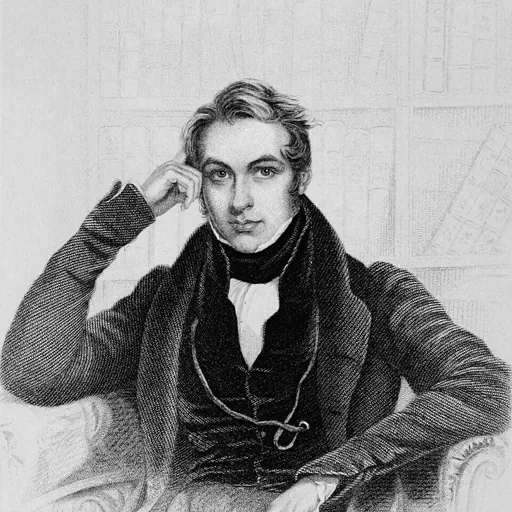
About John Sterling
Lived 1806 – 1844 (aged 38). John Sterling was a British writer and poet.
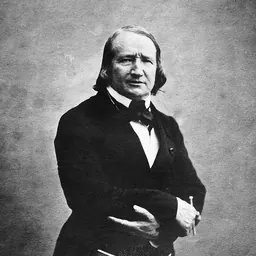
John Sterling (20 July 1806 – 18 September 1844) was a Scottish writer.
Life Sterling was born at Kames Castle on the Isle of Bute, the son of Edward Sterling. After studying for a year at the University of Glasgow, he in 1824 entered Trinity College, Cambridge, where he had for tutor Julius Charles Hare. At Cambridge he took part in the debates of the Cambridge Union Society, and became a member of the Cambridge Apostles, forming friendships with Frederick Denison Maurice and Richard Trench. He moved to Trinity Hall with the intention of graduating in law but left the university without taking a degree.
During the next four years, Sterling resided chiefly in London, employing himself actively in literature and making a number of literary friends. With F. D. Maurice he purchased the Athenaeum magazine in 1828 from James Silk Buckingham, but the enterprise was not a financial success. He also formed an intimacy with the Spanish revolutionary General Torrijos, in whose unfortunate expedition he took an active interest. On 2 November 1830, at Christ Church, Marylebone, Sterling married Susannah, daughter of Lieutenant-General Charles Barton (1760–1819) and his wife Susannah.
Shortly after his marriage in 1830 symptoms of tuberculosis induced Sterling to take up his residence on the island of St Vincent, where he had inherited some property, and he remained there for fifteen months before returning to England. After spending some time on the Continent in June 1834, Sterling was ordained and became curate at Hurstmonceux, where his old tutor Julius Hare was vicar. Acting on the advice of his physician, he resigned from his clerical duties in the following February, but, according to Carlyle, the primary cause was a divergence from the opinions of the Church. There remained to him the "resource of the pen," but, having to "live all the rest of his days as in continual flight for his very existence," his literary achievements were necessarily fragmentary. He died at Ventnor on 18 September 1844, his wife having died in the preceding year.
John Sterling's papers were given to the joint care of Thomas Carlyle and Hare. Essays and Tales, by John Sterling collected and edited, with a memoir of his life, by Julius Charles Hare, appeared in 1848 in two volumes. Carlyle was dissatisfied with the Memoir and wrote a vivid Life (1851).
Family His son, Major-General John Barton Sterling (1840–1926), after entering the navy, went into the army in 1861, and had a distinguished career (wounded at Tel-el-Kebir in 1882), both as a soldier and as a writer on military subjects. He commanded the Coldstream Guards until his retirement in 1901. He was a member of the Athenaeum Club and the Royal Yacht Squadron.
Don’t just read it —
keep it.
Full-length biographies made to live with: read them, listen on the way to work, watch them tonight.
- E-book
- Audio
- Video
Instant download · yours to keep · every purchase keeps this site free
Important facts
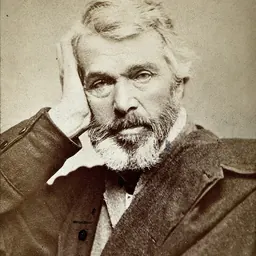
People in John Sterling's life
Named in this biography and alive at the same time


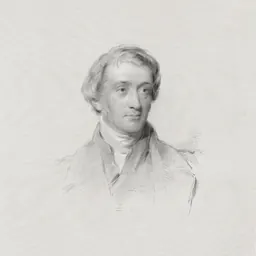


Related people
Same field, nearest in time

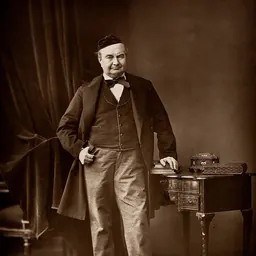


Contemporaries
People whose lives overlapped John Sterling's





Frequently asked questions
Who was John Sterling?
British author
When was John Sterling born?
John Sterling was born on 20 July 1806 in Isle of Bute.
When did John Sterling die?
John Sterling died on 18 September 1844.
What was John Sterling's occupation?
John Sterling was a writer and poet.
What nationality was John Sterling?
John Sterling was British.
Sources & further reading
· DBpedia: John Sterling (author)
Cite this page
APA: Biography.guide. (2026). John Sterling. https://biography.guide/john-sterling-writer/
MLA: "John Sterling." Biography.guide, https://biography.guide/john-sterling-writer/.
Chicago: "John Sterling." Biography.guide. https://biography.guide/john-sterling-writer/.
Data last updated: 2026-09-23 · Spot an error? Report a correction.
Portrait: Wikimedia Commons · author & licence
Page generated 2026-09-27 05:06 UTC