
About John Scott Haldane
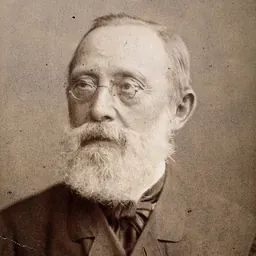
Lived 1860 – 1936 (aged 75). John Scott Haldane was a British inventor, physiologist, philosopher and physician, known for Black Veil Respirator, Haldane effect and Haldane's decompression model.
John Scott Haldane He also experimented on his son, the celebrated and polymathic biologist J. B. S. Haldane, even when he was quite young. Haldane locked himself in sealed chambers breathing potentially lethal cocktails of gases while recording their effect on his mind and body. When the Germans used poison gas in World War I, Haldane went to the front at the request of Lord Kitchener and attempted to identify the gases being used. One outcome of this was his invention of a respirator, known as the black veil. daughter of Coutts Trotter FRGS and Harriet Augusta Keatinge. The couple had two children, the biologist J.B.S. 'Jack' Haldane (born in 1892) and the writer Naomi Mitchison (born in 1897). After the birth of Naomi, the family lived for a time in a house at 10 Randolph Crescent in Edinburgh's New Town before returning to Oxford. They spent summers at the Haldane family's country house at Cloan in Perthshire.
John Scott Haldane's nephew was the New Zealand doctor and public health administrator Robert Haldane Makgill.
Education Haldane attended Edinburgh Academy, Edinburgh University and the Friedrich Schiller University of Jena. He graduated in medicine from Edinburgh University Medical School in 1884, after which he was a Demonstrator at University College, Dundee. From 1907 to 1913 he was a Reader in Physiology at Oxford University where his uncle, John Burdon-Sanderson, was Waynflete Professor of Physiology. and Honorary Professor of the University of Birmingham. Haldane received numerous honorary degrees. He was also President of the English Institution of Mining Engineers, a Member of the Order of the Companions of Honour, a Fellow of the Royal Society, a member of the Royal College of Physicians and of the Royal Society of Medicine.
Sir Henry Newbolt wrote a poem called "For J. S. Haldane", published in his anthology A Perpetual Memory and other Poems in 1939.
Accomplishments
Respiration and anaesthesia Haldane was an international authority on ether and respiration and the inventor of the Black Veil Respirator, an early gas mask, during World War I.
He was also an authority on the effects of pulmonary diseases, such as silicosis caused by inhaling silica dust. After being forced out of combatting poison gases in World War I, through alleged German sympathies, he shifted into working with victims of gas warfare and developed oxygen treatment including the oxygen tent.
Haldane helped determine the regulation of breathing, and discovered the Haldane effect in haemoglobin: Deoxygenated haemoglobin has a greater affinity for carbon dioxide than oxygenated haemoglobin, so the release of oxygen from the capillaries to the tissues facilitates the removal of carbon dioxide in those capillaries, and in the lung capillaries the high oxygenation of the blood promotes the release of carbon dioxide to the plasma, which allows it to diffuse into the alveolar gas. Electronic gas detectors rely on a catalytic chip which can be poisoned by atmospheric impurities.
Pike's Peak expedition
Haldane pioneered the study of the reaction of the body to low air pressures, such as that experienced at high altitudes. He led an expedition to Pike's Peak in 1911, which examined the effect of low atmospheric pressure on respiration. Since then, Pike's Peak has continued to be a site of research into respiration.
Sewer gas In addition to his work on mine atmospheres, he investigated the air in enclosed spaces such as wells and sewers. One surprising result of his analysis of the air in the sewers beneath the House of Commons was to show that the level of bacterial contamination was relatively low.
Don’t just read it —
keep it.
Full-length biographies made to live with: read them, listen on the way to work, watch them tonight.
- E-book
- Audio
- Video
Instant download · yours to keep · every purchase keeps this site free
Important facts
Family & relationships
People in John Scott Haldane's life
Named in this biography and alive at the same time





Related people
Same field, nearest in time

Contemporaries
People whose lives overlapped John Scott Haldane's
Frequently asked questions
Who was John Scott Haldane?
British physiologist (1860–1936)
When was John Scott Haldane born?
John Scott Haldane was born on 3 May 1860 in Edinburgh.
When did John Scott Haldane die?
John Scott Haldane died on 15 March 1936 in Oxford.
What was John Scott Haldane's occupation?
John Scott Haldane was an inventor, physiologist, philosopher and physician.
What was John Scott Haldane known for?
John Scott Haldane was known for Black Veil Respirator, Haldane effect and Haldane's decompression model.
What nationality was John Scott Haldane?
John Scott Haldane was British.
Sources & further reading
· Wikipedia: John Scott Haldane
Cite this page
APA: Biography.guide. (2026). John Scott Haldane. https://biography.guide/john-scott-haldane/
MLA: "John Scott Haldane." Biography.guide, https://biography.guide/john-scott-haldane/.
Chicago: "John Scott Haldane." Biography.guide. https://biography.guide/john-scott-haldane/.
Data last updated: 2026-09-20 · Spot an error? Report a correction.
Page generated 2026-09-27 05:24 UTC