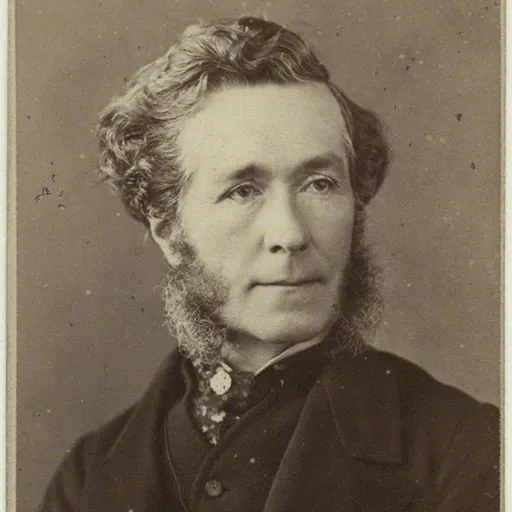
About John Pyke Hullah
Lived 1812 – 1884 (aged 71). John Pyke Hullah was a British composer, teacher, musicologist, music teacher and organist.
John Pyke Hullah (27 June 1812 – 21 February 1884) was an English composer and teacher of music, whose promotion of vocal training is associated with the singing-class movement. He worked with Charles Dickens and knew Felix Mendelssohn.
Life and career Hullah was born at Worcester. He was a pupil of William Horsley from 1829, and entered the Royal Academy of Music in 1833. He wrote an opera to words by Dickens, The Village Coquettes, produced in 1836; The Barbers of Bassora in 1837; and The Outpost in 1838, the last two at Covent Garden. From 1839, when he went to Paris to investigate various systems of teaching music to large masses of people, he identified himself with Wilhem's system of the fixed "do," in contrast to the moveable "do" of the Tonic sol-fa. His adaptation of Wilhem's system was taught with enormous success from 1840 to 1860. His first-ever lesson was given at the Battersea College for training teachers (now University St Mark and St John Plymouth), in 1840, at the instigation of educationalist and college Principal James Kay Shuttleworth. His pupils included William Carter and Edmund Hart Turpin.
In 1847 a large building in Long Acre, called St Martin's Hall, was built by subscription and presented to Hullah. It was inaugurated in 1850 and burnt to the ground in 1860, a blow from which Hullah was long in recovering. In 1849 William Sterndale Bennett, founder and chairman of the Bach Society, invited Hullah to join his committee, with a view to producing the first English performance of Johann Sebastian Bach's St Matthew Passion, which took place on 6 April 1854. As a sight-singing pioneer, Hullah produced his popular series Vocal Scores (1846) and Part-Music (1867). A series of lectures was given at the Royal Institution in 1861, and in 1864 he lectured in Edinburgh, but in the following year he was unsuccessful in his application for the Reid professorship.
He conducted concerts in Edinburgh in 1866 and 1867, and the concerts of the Royal Academy of Music from 1870 to 1873; he had been elected to the committee of management in 1869. In 1872 he was appointed by the Council of Education as Musical Inspector of Training Schools for the United Kingdom. In 1878 he went abroad to report on the condition of musical education in schools, and wrote a very valuable report, quoted in the memoir of him published by his wife in 1886. He was attacked by paralysis in 1880, and again in 1883.
Dr. Hullah was Honorary Fellow of King's College, London, and Professor of Vocal Music at Queen's College, London, and Bedford College, London. He succeeded Dr. Horsley as organist of the Charterhouse (in its original London location) in 1858, and held the post until his death. He received the honorary degree of Doctor of Laws from the University of Edinburgh in 1876.
His compositions, which remained popular for some years after his death in 1884, consisted mainly of ballads (such as his musical adaptation of Charles Kingsley's poem "Three Fishers"), but his importance in the history of music is due to his exertion in popularizing musical education, and his persistent opposition to the Tonic sol-fa system, which had a success he could not foresee. His objections to it were partly grounded on the character of the music which was in common use among the early teachers of the system.
The novelist Elizabeth Sara Sheppard portrayed Hullah as the character Lenhart Davy in her 1853 novel Charles Auchester. His widow, Frances Rosser Hullah, published a biography of her late husband.
Don’t just read it —
keep it.
Full-length biographies made to live with: read them, listen on the way to work, watch them tonight.
- E-book
- Audio
- Video
Instant download · yours to keep · every purchase keeps this site free
Important facts
People in John Pyke Hullah's life
Named in this biography and alive at the same time





Related people
Same field, nearest in time

Contemporaries
People whose lives overlapped John Pyke Hullah's




Frequently asked questions
Who was John Pyke Hullah?
English composer and teacher of music
When was John Pyke Hullah born?
John Pyke Hullah was born on 27 June 1812 in Worcester.
When did John Pyke Hullah die?
John Pyke Hullah died on 21 February 1884 in London.
What was John Pyke Hullah's occupation?
John Pyke Hullah was a composer, teacher, musicologist, music teacher and organist.
What nationality was John Pyke Hullah?
John Pyke Hullah was British.
Sources & further reading
Cite this page
APA: Biography.guide. (2026). John Pyke Hullah. https://biography.guide/john-pyke-hullah/
MLA: "John Pyke Hullah." Biography.guide, https://biography.guide/john-pyke-hullah/.
Chicago: "John Pyke Hullah." Biography.guide. https://biography.guide/john-pyke-hullah/.
Data last updated: 2026-09-20 · Spot an error? Report a correction.
Portrait: Wikimedia Commons · author & licence
Page generated 2026-09-27 04:57 UTC