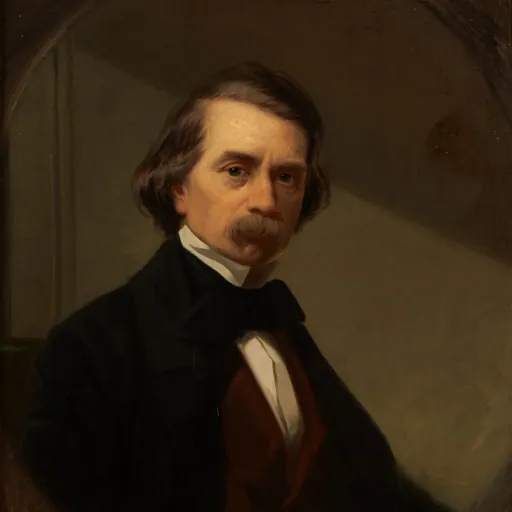
About John Mix Stanley
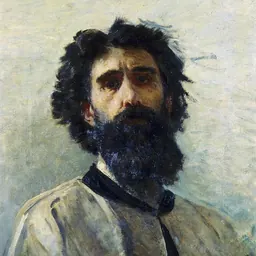
Lived 1814 – 1872 (aged 58). John Mix Stanley was an American painter.
John Mix Stanley (January 17, 1814 – April 10, 1872) was an artist-explorer, an American painter of landscapes, and Native American portraits and tribal life. Born in the Finger Lakes region of New York, he started painting signs and portraits as a young man. In 1842 he traveled to the American West to paint Native American life. In 1846 he exhibited a gallery of 85 of his paintings in Cincinnati and Louisville. During the Mexican–American War, he joined Colonel Stephen Watts Kearney's expedition to California and painted accounts of the campaign, as well as aspects of the Oregon Territory.
Stanley continued to travel and paint in the West, and mounted a major exhibit of more than 150 works at the Smithsonian Institution in 1852. Although he had some Congressional interest in purchasing the collection, he was unsuccessful in completing a sale to the government. He never recovered his expenses for a decade of intensive work and travel.
In 1854 he exhibited a 42-scene panorama of western scenes in Washington, DC; Baltimore, New York and London, but it has been lost. More than 200 of his paintings, maps and other work being held at the Smithsonian were lost in an 1865 fire. The irreparable loss of most of his works caused the eclipse of Stanley's reputation for some time in American art history. His appreciation and portrayal of the American West is valued, and today his few surviving works are held by national and numerous regional museums.
Early life and education John Mix Stanley was born in Canandaigua, New York, to Seth and Sally (McKinney) Stanley. He was orphaned at the age of 12. At age 14, Stanley was`apprenticed to a coach maker. He taught himself painting skills, and at the age of 20 moved to Detroit, the largest city in the Michigan Territory, and started doing itinerant work.
Career River in a Mountain Landscape, oil on canvas painting by John Mix Stanley, c. 1840s Stanley moved to what was considered the frontier town of Detroit in 1832, where he became an itinerant painter of signs and portraits. He traveled also to Fort Snelling, Galena and Chicago. In the latter part of the decade, he returned East, apparently to Washington, D.C., where he briefly had a studio.
In 1842, accompanied by Sumner Dickerman of Troy, New York, as an assistant, Stanley went to the American Southwest expressly to paint Native Americans, perhaps inspired by the work of the artist George Catlin. They settled at Fort Gibson in Indian Territory (present-day Oklahoma); the community was a crossroads of many Indian nations.
That year Stanley traveled to Hawaii, where he spent nearly twelve months painting portraits of King Kamehameha III, his wife, and the royal family. His collection numbered nearly 200 works and was celebrated at the time. Seth Eastman, also an artist of Native American life, wrote to Stanley of his gallery: "that I consider the artistic merits of yours far superior to Mr. Catlin's; and they give a better idea of the Indian than any works in Mr. Catlin's collection." for Isaac I. Stevens' expedition to survey a northern railroad route to the Pacific Coast; he made the most of this chance for travel and work in the Northwest. They traveled from St. Paul Minnesota Territory, to the Washington Territory. Stanley observed gatherings of nearly 1,500 Assiniboine, traveled to a distant Blackfoot (Piegan) village, and saw a large hunting party of several hundred, including families from the Pembina area near the Canada–US border.
Maps As an artist-explorer, Stanley had traveled extensively, especially in the American West. He created a large collection of maps, which was held by the Smithsonian Institution. They were also destroyed in the 1865 fire.
Paintings of Native Americans
Stanley's primary interest and sympathies were with the American Indians. The Smithsonian had a large and successful exhibit of his paintings in 1852, but Congress never appropriated monies to acquire them. More than 200 of his works, as well as many of his maps and other documentation, were destroyed in the Smithsonian fire of 1865. This loss likely contributed to the decline in his reputation and lack of knowledge about him in later American art history.
His surviving works are held by national museums as well as numerous regional institutions: National: Corcoran Gallery of Art (Washington, D.C.), Metropolitan Museum of Art (New York City), National Gallery of Art, (Washington, D.C.), National Portrait Gallery (Washington, D.C.), and Smithsonian American Art Museum (Washington, D.C.)
Regional:
Amon Carter Museum (Fort Worth, Texas), Arizona State University Art Museum (Tempe, Arizona), Buffalo History Museum (Buffalo, NY), Buffalo Bill Historical Center (Cody, Wyoming), Denver Art Museum, Detroit Institute of Arts, Eiteljorg Museum of American Indians & Western Art (Indianapolis, Indiana), Galena Historical Museum (Galena, Illinois), Gilcrease Museum (Tulsa, Oklahoma), Honolulu Museum of Art, Joslyn Art Museum (Omaha, Nebraska), National Museum of Wildlife Art (Jackson Hole, Wyoming), Phoenix Art Museum (Phoenix, Arizona), https://www.120nhiggins.com Relic Gallery (Missoula, Montana), Rockwell Museum (Corning, New York), Stark Museum of Art (Orange, Texas), University of Arizona Museum of Art (Tucson, Arizona), University of Michigan Museum of Art (Ann Arbor, Michigan), Westervelt Warner Museum of American Art (Tuscaloosa, Alabama), William L. Clements Library (University of Michigan, Ann Arbor, Michigan), Worcester Art Museum (Worcester, Maine), and Yale University Art Gallery (New Haven, Connecticut).
Marriage and family Stanley married Alice C. English in 1854, when he was 40 and essentially finished with his western travels. They had five children together, two of whom died as infants. Their son, L. C. Stanley, published a biographical account of his father, entitled "John Mix Stanley, Artist-Explorer," in the 1924 Annual Report Smithsonian Institution, edited by David I. Bushnell, Jr. Their daughter, Stanley's granddaughter, was fellow artist and painter Alice Caroline Stanley (1895–1996), the wife of former Secretary of State Dean Acheson (1893–1971) and mother to David Campion Acheson (born 1921).
Gallery
Don’t just read it —
keep it.
Full-length biographies made to live with: read them, listen on the way to work, watch them tonight.
- E-book
- Audio
- Video
Instant download · yours to keep · every purchase keeps this site free
Important facts
People in John Mix Stanley's life
Named in this biography and alive at the same time


Related people
Same field, nearest in time


Contemporaries
People whose lives overlapped John Mix Stanley's





Frequently asked questions
Who was John Mix Stanley?
American artist (1814-1872)
When was John Mix Stanley born?
John Mix Stanley was born on 17 January 1814 in Canandaigua.
When did John Mix Stanley die?
John Mix Stanley died on 10 April 1872 in United States.
What was John Mix Stanley's occupation?
John Mix Stanley was a painter.
What nationality was John Mix Stanley?
John Mix Stanley was American.
Sources & further reading
Cite this page
APA: Biography.guide. (2026). John Mix Stanley. https://biography.guide/john-mix-stanley/
MLA: "John Mix Stanley." Biography.guide, https://biography.guide/john-mix-stanley/.
Chicago: "John Mix Stanley." Biography.guide. https://biography.guide/john-mix-stanley/.
Data last updated: 2026-09-20 · Spot an error? Report a correction.
Portrait: Wikimedia Commons · author & licence
Page generated 2026-09-27 04:57 UTC