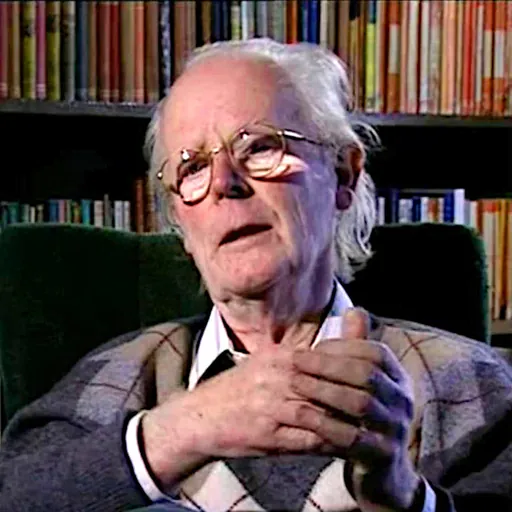
John Maynard Smith
British theoretical evolutionary biologist and geneticist
About John Maynard Smith
Lived 1920 – 2004 (aged 84). John Maynard Smith was a British biologist, theoretical biologist, geneticist, zoologist, writer and economist, known for Evolution of sex, Game theory and Signalling theory.
John Maynard Smith (6 January 1920 – 19 April 2004) was a British theoretical and mathematical evolutionary biologist and geneticist. Originally an aeronautical engineer during the Second World War, he took a second degree in genetics under the biologist J. B. S. Haldane. Maynard Smith was instrumental in the application of game theory to evolution with George R. Price, and theorised on other problems such as the evolution of sex and signalling theory.
Biography Early years John Maynard Smith was born on 6 January 1920 in London, the son of the surgeon Sidney Maynard Smith. Following his father's death in 1928, the family moved to Exmoor, where he became interested in natural history. Quite unhappy with the lack of formal science education at Eton College, Maynard Smith took it upon himself to develop an interest in Darwinian evolutionary theory and mathematics, after having read the work of old Etonian J. B. S. Haldane, whose books were in the school's library despite the bad reputation Haldane had at Eton for his communism. He became an atheist at age 14.
On leaving school, Maynard Smith joined the Communist Party of Great Britain and started studying engineering at Trinity College, Cambridge. When the Second World War broke out in 1939, he defied his party's line and volunteered for service. He was rejected, however, because of poor eyesight and was told to finish his engineering degree, which he did in 1941. He later quipped that "under the circumstances, my poor eyesight was a selective advantage—it stopped me getting shot". The year of his graduation, he married Sheila Matthew, and they later had two sons and one daughter (Tony, Carol, and Julian). Between 1942 and 1947, he applied his degree to military aircraft and he worked as an aircraft stressman at factories in Coventry and Reading. then took a change of career, entering University College London to study fruit fly genetics under Haldane.
University of Sussex In 1962 he was one of the founding members of the University of Sussex and was a dean between 1965 and 1985. He subsequently became a professor emeritus. Prior to his death the building housing much of life sciences at Sussex was renamed the John Maynard Smith Building in his honour.
Evolution and the Theory of Games In 1973 Maynard Smith formalised a central concept in evolutionary game theory called the evolutionarily stable strategy (ESS), based on a verbal argument by George R. Price. This area of research culminated in his 1982 book Evolution and the Theory of Games. The Hawk-Dove game is arguably his single most influential game theoretical model.
He was elected a Fellow of the Royal Society in 1977. In 1986 he was awarded the Darwin Medal.
Evolution of sex and other major transitions in evolution Maynard Smith published a book titled The Evolution of Sex which explored in mathematical terms, the notion of the "two-fold cost of sex". During the late 1980s he also became interested in evolutionary transitions in individuality (ETIs) and worked with the evolutionary biologist Eörs Szathmáry. A popular science version of the book, The Origins of Life: From the birth of life to the origin of language, was published in 1999.
In 1991 he was awarded the Balzan Prize for genetics and evolution "for his powerful analysis of evolutionary theory and of the role of sexual reproduction as a critical factor in evolution and in the survival of species; for his mathematical models applying the theory of games to evolutionary problems" (motivation of the Balzan General Prize Committee). In 1995 he was awarded the Linnean Medal by the Linnean Society and in 1999 he was awarded the Crafoord Prize jointly with Ernst Mayr and George C. Williams. In 2001 he was awarded the Kyoto Prize.
In his honour the European Society for Evolutionary Biology has an award for extraordinary young evolutionary biology researchers named The John Maynard Smith Prize.
Animal Signals His final book, Animal Signals, co-authored with David Harper, on signalling theory was published in 2003. Maynard Smith acted as a reviewer of the paper after two other reviewers had been unable to understand it, and requested that Hamilton revise it into two parts due to concerns about its accessibility, later describing it as "deeply obscure". In March 1964, Maynard Smith published the article "Group Selection and Kin selection" in Nature, which covered concepts from Hamilton's article. Although Maynard Smith cited an earlier paper by Hamilton published in The American Naturalist, Hamilton felt Maynard Smith had not given him sufficient credit.
Richard Dawkins dedicated The Ancestor's Tale (2004) to Maynard Smith: “He saw a draft and graciously accepted the dedication, which now, sadly, must become In Memoriam.”
Awards and fellowships Fellow, Royal Society (1977) Member, American Academy of Arts and Sciences (1977) Member, American Philosophical Society (1980) Member, United States National Academy of Sciences (1982) Darwin Medal (1986) Frink Medal (1990) Balzan Prize (1991) Linnean Medal (1995) Royal Medal (1997) Crafoord Prize (1999) Copley Medal (1999) Kyoto Prize (2001) Darwin–Wallace Award (2008). This used to be bestowed every 50 years by the Linnean Society of London; Maynard Smith was one of thirteen co-recipients, and one of only two recipients ever awarded post-mortem. Since 2010, the medal has been awarded annually.
Publications Maynard Smith, J. (1958). The Theory of Evolution. London, Penguin Books. 1993 edn Maynard Smith, J. (1968) Mathematical Ideas in Biology. Cambridge University Press. Maynard Smith, J. (1972) On Evolution. Edinburgh University Press.
Maynard Smith, J. (1974b) Models in Ecology. Cambridge University Press. Maynard Smith, J. (1978d) The Evolution of Sex. Cambridge University Press. Maynard Smith, J. (ed.) (1981d) Evolution Now. London, Macmillan. Maynard Smith, J. (1982d) Evolution and the Theory of Games. Cambridge University Press. Maynard Smith, J. (1986b) The Problems of Biology. Oxford: Oxford University Press. Maynard Smith, J. (1988a) Did Darwin Get it Right?: Essays on Games, Sex and Evolution. London, Chapman & Hall. Maynard Smith, J. (1989a) Evolutionary Genetics. Oxford: Oxford University Press. Maynard Smith, J. and Szathmáry, E. (1997) The Major Transitions in Evolution. New York: Oxford University Press. Maynard Smith, J. and Szathmáry, E. (1999) The Origins of Life: From the Birth of Life to the Origin of Language. Oxford: Oxford University Press. Maynard Smith, J. and Harper, D. (2003) Animal Signals. Oxford University Press.
Don’t just read it —
keep it.
Full-length biographies made to live with: read them, listen on the way to work, watch them tonight.
- E-book
- Audio
- Video
Instant download · yours to keep · every purchase keeps this site free
Important facts
more
J. M. SmithPeople in John Maynard Smith's life
Named in this biography and alive at the same time






Related people
Same field, nearest in time




Contemporaries
People whose lives overlapped John Maynard Smith's





Frequently asked questions
Who was John Maynard Smith?
British theoretical evolutionary biologist and geneticist (1920-2004)
When was John Maynard Smith born?
John Maynard Smith was born on 6 January 1920 in London.
When did John Maynard Smith die?
John Maynard Smith died on 19 April 2004 in Lewes.
What was John Maynard Smith's occupation?
John Maynard Smith was a biologist, theoretical biologist, geneticist, zoologist, writer and economist.
What was John Maynard Smith known for?
John Maynard Smith was known for Evolution of sex, Game theory and Signalling theory.
What nationality was John Maynard Smith?
John Maynard Smith was British.
Sources & further reading
· Wikipedia: John Maynard Smith
Cite this page
APA: Biography.guide. (2026). John Maynard Smith. https://biography.guide/john-maynard-smith/
MLA: "John Maynard Smith." Biography.guide, https://biography.guide/john-maynard-smith/.
Chicago: "John Maynard Smith." Biography.guide. https://biography.guide/john-maynard-smith/.
Data last updated: 2026-09-24 · Spot an error? Report a correction.
Portrait: Wikimedia Commons · author & licence
Page generated 2026-09-27 05:08 UTC