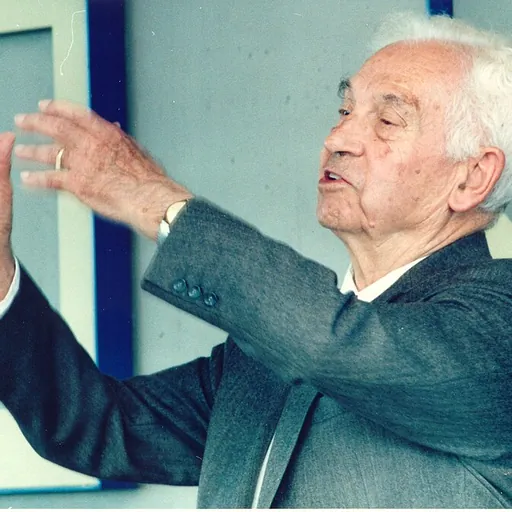
About Ernst Mayr
Lived 1904 – 2005 (aged 100). Ernst Mayr was an American and German curator, ornithologist, philosopher, writer, university teacher and evolutionary biologist.
Biography
Early life and studies Mayr was the second son of Helene Pusinelli and Otto Mayr. His father was a district prosecuting attorney at Würzburg but took an interest in natural history and took the children out on field trips. Mayr learnt all the local birds in Würzburg from his elder brother Otto. He also had access to a natural history magazine for amateurs, Kosmos. His father died just before he was thirteen. The family then moved to Dresden, where he studied at the Staatsgymnasium in Dresden-Neustadt and completed his high school education. In April 1922, while still in high school, he joined the newly founded Saxony Ornithologists' Association. There he met Rudolf Zimmermann, who became his ornithological mentor. In February 1923, Mayr passed his high school examination (Abitur) and his mother rewarded him with a pair of binoculars.
On 23 March 1923 on one of the lakes of Moritzburg, the Frauenteich, he spotted what he identified as a red-crested pochard. The species had not been seen in Saxony since 1845 and the local club argued about the identity. Raimund Schelcher (1891–1979) of the club then suggested that Mayr visit his classmate Erwin Stresemann on his way to Greifswald, where Mayr was to begin his medical studies. Mayr was endlessly interested in ornithology and "chose Greifswald at the Baltic for my studies for no other reason than that ... it was situated in the ornithologically most interesting area." In 1925, Stresemann suggested that he give up his medical studies, in fact he should leave the faculty of medicine and enrol into the faculty of Biology and then join the Berlin Museum with the prospect of bird-collecting trips to the tropics, on the condition that he completed his doctoral studies in 16 months. Mayr completed his doctorate in ornithology at the University of Berlin under Dr. Carl Zimmer, who was a full professor (Ordentlicher Professor), on 24 June 1926 at the age of 21. On 1 July he accepted the position offered to him at the museum for a monthly salary of 330.54 Reichsmark.
At the International Zoological Congress at Budapest in 1927, Mayr was introduced by Stresemann to banker and naturalist Walter Rothschild, who asked him to undertake an expedition to New Guinea on behalf of himself and the American Museum of Natural History (AMNH) in New York. In New Guinea, Mayr collected several thousand bird skins (he named 38 new bird species during his lifetime) and, in the process also named 38 new orchid species. During his stay in New Guinea, he was invited to accompany the Whitney South Sea Expedition to the Solomon Islands. Also, while in New Guinea, he visited the Lutheran missionaries Otto Thiele and Christian Keyser, in the Finschhafen district; there, while in conversation with his hosts, he uncovered the discrepancies in Hermann Detzner's popular book Four Years among Cannibals: New Guinea, in which Detzner claimed to have seen the interior, discovered several species of flora and fauna, while remaining only steps ahead of the Australian patrols sent to capture him. He returned to Germany in 1930.
Move to the United States Mayr moved to the United States in 1931 to take up a curatorial position at the American Museum of Natural History, where he produced numerous publications on bird taxonomy, naming 26 new species and 445 new subspecies of birds.
Modern Synthesis While in New York, Mayr regularly attended seminars at Columbia University, assimilating the latest findings in biology and incorporating them into his thought. The long defunct Jesup Lectures in Columbia's Department of Zoology started up again in 1936 with Theodosius Dobzhansky presenting findings that would shortly afterwards form the nucleus of his magnum opus, Genetics and the Origin of Species. The Jesup Lectures brought Dobzhansky and Mayr together, an event that would catalyse the climax of the Modern Synthesis of Darwinian evolution and Mendelian heredity.
When Dobzhansky permanently moved from the California Institute of Technology to Columbia in 1940, Mayr and Dobzhansky became close friends, with their consonant personalities enabling efficient exchange of ideas that enhanced both individuals' thinking. In 1942, Mayr published Systematics and the Origin of Species, his first book and a seminal work in the Synthesis. Mayr also partook in the establishment of the Society for the Study of Evolution and its scientific journal Evolution, which served as an academic forum for evolutionary biologists working in the research programme of the Modern Synthesis. Mayr developed a conceptual framework for examining intraspecific variation that he coined "population thinking". He opposed biological typology and essentialism, emphasising that individual variation was the basis on which natural selection could act.
At the Linnean Society of New York Mayr organized a monthly seminar under the auspices of the Linnean Society of New York. Under the influence of J.A. Allen, Frank Chapman, and Jonathan Dwight, the society concentrated on taxonomy and later became a clearing house for bird banding and sight records.
The awards that Mayr received include the National Medal of Science, the Balzan Prize, the Sarton Medal of the History of Science Society, the International Prize for Biology, the Loye and Alden Miller Research Award, and the Lewis Thomas Prize for Writing about Science. In 1939 he was elected a Corresponding Member of the Royal Australasian Ornithologists Union. He was awarded the 1946 Leidy Award from the Academy of Natural Sciences of Philadelphia. He was awarded the Linnean Society of London's prestigious Darwin-Wallace Medal in 1958 and the Linnaean Society of New York's inaugural Eisenmann Medal in 1983. For his work, Animal Species and Evolution, he was awarded the Daniel Giraud Elliot Medal from the National Academy of Sciences in 1967. Mayr was elected a Foreign Member of the Royal Society (ForMemRS) in 1988. In 1995, Harvard University renamed the Library of the Museum of Comparative Zoology the Ernst Mayr Library, in his honor. Mayr never won a Nobel Prize, but he noted that there is no prize for evolutionary biology and that Darwin would not have received one, either. (In fact, there is no Nobel Prize for biology.) Mayr did win a 1999 Crafoord Prize. It honors basic research in fields that do not qualify for Nobel Prizes and is administered by the same organization as the Nobel Prize. In 2001, Mayr received the Golden Plate Award of the American Academy of Achievement. Since winning Balzan Prize, Crafoord Prize and the International Prize for Biology, are usually regarded as a "Triple Crown in Biology," he won this crown too.
Mayr was co-author of six global reviews of bird species new to science (listed below).
Mayr said he was an atheist in regards to "the idea of a personal God" because "there is nothing that supports [it]".
Ideas
Beanbag genetics As a traditionally-trained biologist, Mayr was often highly critical of early mathematical approaches to evolution, such as those of J.B.S. Haldane, and famously called such approaches "beanbag genetics" in 1959. He maintained that factors such as reproductive isolation had to be taken into account. In a similar fashion, Mayr was also quite critical of molecular evolution studies such as those of Carl Woese. Current molecular studies in evolution and speciation indicate that although allopatric speciation is the norm, there are numerous cases of sympatric speciation in groups with greater mobility, such as birds. The precise mechanisms of sympatric speciation are usually a form of microallopatry enabled by variations in niche occupancy among individuals within a population.
Units of selection In many of his writings, Mayr rejected reductionism in evolutionary biology, arguing that evolutionary pressures act on the whole organism, not on single genes, and that genes can have different effects depending on the other genes present. He advocated a study of the whole genome, rather than of only isolated genes. Mayr insisted that the entire genome should be considered as the target of selection (thus genome evolution) rather than individual genes:
Species concepts After articulating the biological species concept in 1942, Mayr played a central role in the species problem debate over what was the best species concept. He staunchly defended the biological species concept against the many definitions of "species" that others proposed.
Teleonomy Mayr argued that the seeming goal-directedness of many biological process did not require vitalistic explanations or cosmic teleology invoking backwards causation. He popularised the term teleonomy to refer to programmatic biological processes like organismal growth and development and emphasised that the genetic programmes encoding these processes were heavily selected for and stabilised by natural selection to give the appearance of being goal-directed but required no supernatural explanations.
Scientific method Mayr was an outspoken defender of the scientific method and was known to critique sharply science on the edge. As a notable example, in 1995, he criticized the Search for Extra-Terrestrial Intelligence (SETI), as conducted by fellow Harvard professor Paul Horowitz, as being a waste of university and student resources for its inability to address and answer a scientific question. Over 60 eminent scientists, led by Carl Edward Sagan, rebutted the criticism.
Racism Mayr disliked racism, Understanding that every individual being unique, Mayr stated that while it was inarguable that biological variation was geographically distributed in such a way that biological races did exist in humans, one's race was not a useful predictor of an individual's attributes. He was a strong proponent of civic equality.
Social Darwinism Mayr was a strong critic of Social Darwinism and argued that the ideas of Herbert Spencer were substantially divergent from Darwin's. Mayr believed that it was inaccurate to associate Spencer with Darwinism, pointing out not only that Spencer's theory of evolution preceded Darwin's but that it was based primarily on neo-Lamarckian inheritance and orthogenesis and thus conflicted with Darwin's. For this reason, Mayr preferred the term "Social Spencerism" when referring to Social Darwinism. Mayr argued this incorrect association of Spencer with Darwin was damaging and led to resistance of acceptance of Darwinism in the social sciences, which undermined their credibility.
Lysenkoism Mayr was an outspoken critic of Lysenkoism and of ideologically motivated opposition to scientific findings as a whole. In his book The Growth of Biological Thought, Mayr asserted that much of contemporary hostility to sociobiology was politically motivated and stemmed from the same ideological roots as Lysenkoism.
Currently recognised taxa named in his honour Bismarck black myzomela (Myzomela psammelaena ernstmayri) Meise, 1929 - a subspecies of bird, a honeyeater, family Meliphagidae, confined to several small islands to the west of the Admiralty Islands, in western Oceania, northeast of New Guinea. Mayr's forest rail (Rallicula mayri) (Hartert, 1930) - a species of bird found in New Guinea. Mayr's honeyeater (Ptiloprora mayri) Hartert, 1930 - a species of bird found in New Guinea. Mayr's swiftlet (Aerodramus orientalis) (Mayr, 1935) - a species of bird found in New Ireland and Guadalcanal. Ernst Mayr's water rat (Leptomys ernstmayri) Rümmler, 1932 - a species of rodent, of the family Muridae, from the Foja Mountains of Papua Province, Indonesia, and Central Cordillera, Adelbert Range, and Huon Peninsula of Papua New Guinea. a roundworm - Poikilolaimus ernstmayri Sudhaus & Koch, 2004 - a new species of nematode, family Rhabditidae, associated with termites of the genus Reticulitermes, in Corsica. New Ireland rail (Gallirallus ernstmayri) † (Kirchman & Steadman, 2006) - a relatively large, probably flightless, extinct rail, family Rallidae, known from subfossil remains found on prehistoric archeological sites, in caves on New Ireland, in the Bismarck Archipelago, western Oceania. ) Star Mountains worm-eating snake (Toxicocalamus ernstmayri) O'Shea, Parker & Kaiser, 2015 - a 1.2 m, rare and secretive, venomous snake from the family Elapidae, believed to feed exclusively of earthworms, particularly the giant earthworms of the Megascolecidae. The etymology reads: The species name ernstmayri is a patronym honoring the German-American ornithologist, systematist, and evolutionary thinker Ernst Mayr (1904–2005). There are several connections linking Ernst Mayr to this new species of Toxicocalamus, which make him, and this snake, the ideal candidates for a patronym. First, Mayr himself visited New Guinea, and during the late 1920s he spent over 2 years conducting fieldwork in an area now part of PNG, as a member of a joint Rothschild–AMNH expedition focusing on birds of paradise (Aves, Passeriformes, Paradisaeidae), during which he collected many new bird and orchid species. Second, the holotype of T. ernstmayri has been housed in the MCZ collection, mislabeled as Micropechis ikaheka, after having arrived and been accessioned in June 1975, the month and year that Mayr retired. Third, the true identity of this specimen was recognized by one of us (MOS) during a visit to the MCZ in May 2014, undertaken with the financial support of an Ernst Mayr Travel Grant from Harvard University, awarded to enable examination of the Toxicocalamus holdings at the MCZ and the AMNH, the two U.S. institutions where Mayr worked. Finally, 2015, the publication year of this description, marks the decennial of Mayr's passing at age 100, and naming a New Guinea snake after him seems a suitable tribute. an assassin bug - Bagauda ernstmayri Kulkarni & Ghate, 2016 - a species of cavernicolous, thread-legged assassin bug, known only from Satara, in the Western Ghats of Maharashtra State, India. a genus of pseudoscorpions - Ernstmayria Curcic et al., 2006 (Neobisiidae) a species of spider - Cebrennus mayri Jäger, 2000 a species of damselfly - Palaiargia ernstmayri Lieftinck, 1972 a species of bird lice - Anaticola ernstmayri Eichler, 1954 (Philopteridae) a species of earwig - Irdex ernstmayri Günther, 1930
Summary of Darwin's theory
Darwin's theory of evolution is based on key facts and the inferences drawn from them, which Mayr summarised as follows:
Every species is fertile enough that if all offspring survived to reproduce, the population would grow (fact). Despite periodic fluctuations, populations remain roughly the same size (fact). Resources such as food are limited and are relatively stable over time (fact). Struggle for survival ensues (inference). Individuals in a population vary significantly from one another (fact). Much of the variation is heritable (fact). Individuals less suited to the environment are less likely to survive and less likely to reproduce; individuals more suited to the environment are more likely to survive and more likely to reproduce and leave their heritable traits to future generations, which produces the process of natural selection (fact). This slowly effected process results in populations changing to adapt to their environments, and ultimately, these variations accumulate over time to form new species (inference).
In relation to the publication of Darwin's Origins of Species, Mayr identified philosophical implications of evolution: Evolving world, not a static one. Implausibility of creationism. Refutation that the universe has purpose. Defeating the justifications for a human-centric world. Materialistic processes explain the impression of design. Population thinking replaces essentialism.
Don’t just read it —
keep it.
Full-length biographies made to live with: read them, listen on the way to work, watch them tonight.
- E-book
- Audio
- Video
Instant download · yours to keep · every purchase keeps this site free
Important facts
People in Ernst Mayr's life
Named in this biography and alive at the same time




Related people
Same field, nearest in time


Contemporaries
People whose lives overlapped Ernst Mayr's




Frequently asked questions
Who was Ernst Mayr?
German-American evolutionary biologist (1904-2005)
When was Ernst Mayr born?
Ernst Mayr was born on 5 July 1904 in Kempten.
When did Ernst Mayr die?
Ernst Mayr died on 3 February 2005 in Bedford.
What was Ernst Mayr's occupation?
Ernst Mayr was a curator, ornithologist, philosopher, writer, university teacher and evolutionary biologist.
What nationality was Ernst Mayr?
Ernst Mayr was American and German.
Sources & further reading
Cite this page
APA: Biography.guide. (2026). Ernst Mayr. https://biography.guide/ernst-mayr/
MLA: "Ernst Mayr." Biography.guide, https://biography.guide/ernst-mayr/.
Chicago: "Ernst Mayr." Biography.guide. https://biography.guide/ernst-mayr/.
Data last updated: 2026-09-22 · Spot an error? Report a correction.
Portrait: Wikimedia Commons · author & licence
Page generated 2026-09-27 05:02 UTC