
About John Irving
Lived 1815 – 1848 (aged 32–33). John Irving was a British naval officer and royal Navy, known for Franklin's lost expedition.
John Irving (8 February 1815 – c. 1848) was a British officer in the Royal Navy and polar explorer. He served under Francis Crozier as Third Lieutenant on the ship HMS Terror during the 1845 Franklin Expedition which sought to discover and chart as-yet unexplored parts of the Canadian Arctic, including the Northwest Passage, and make scientific observations. All personnel of the expedition, including Irving, perished in and around King William Island in what is now Nunavut, Canada. Irving is one of the few men whose remains have been supposedly identified and re-interred in Britain.
Early life John Irving was born on Princes Street in Edinburgh, Scotland on 8 February 1815, the fourth son of John Irving, a lawyer who was a member of the Society of Writers to the Signet and childhood friend of Sir Walter Scott, and Agnes Hay, daughter of Colonel Lewis Hay, a noted engineering officer who perished in the 1799 Anglo-Russian Invasion of Holland. John Irving attended school in Edinburgh, and then on 25 June 1828 at age 13 entered the navy, attending the Royal Naval College in Portsmouth, England. Five Franklin Expedition officers last served on Excellent prior to serving in the expedition: Irving and George Henry Hodgson (Terror), James Walter Fairholme, Robert Sargent, and Charles Frederick Des Voeux (Erebus). He was fourth in command of Terror, behind Captain Francis Crozier, First Lieutenant Edward Little, and Second Lieutenant George Henry Hodgson. alt=The Victory Point Note, re-found by Irving in 1848 a year after it was deposited by Graham Gore and Charles Des Voeux. It is the last known communication of the Franklin Expeditions. Irving's name is mentioned by James Fitzjames in the margins. The Victory Point Note, re-found by Irving in 1848 a year after it was deposited by Graham Gore and Charles Des Voeux. It is the last known communication of the Franklin Expeditions. Irving's name is mentioned by James Fitzjames in the margins. In April 1848, Irving rediscovered a cairn where Lieutenant Graham Gore and Mate Charles Des Voeux had left a written message on command of Franklin and Fitzjames the year prior. Fitzjames added an addendum to the record, now called the Victory Point Note, explaining that several officers and men (including Franklin and Gore) had died and that the ships were being abandoned in an effort by the surviving men to reach mainland Canada. This is the last known official communication of the Franklin Expedition.
Alleged grave and re-burial Skeletal remains found by the 1879 expedition of Frederick Schwatka in a shallow grave on Cape Jane Franklin on the west coast of King William Island have been proposed to belong to John Irving. The identification of the remains is based on the fact that Irving's second mathematical medal earned during his time at the Royal Naval College was found alongside the grave. The grave also contained the object-glass of a marine telescope, an officer's gilt buttons, and a coloured silk handkerchief. Schwatka retrieved the skeletal remains and brought them to Scotland.
A fiddle-patterned silver table fork belonging to Irving was obtained from the Inuit at Repulse Bay by Scottish explorer John Rae in 1854. The initials of William Wentzell, a London-born Able Seaman aboard Terror, were scratched into the back and front of the fork's handle.
Legacy An island in the vicinity of King William Island was named "Irving Island" by explorer Francis Leopold McClintock in memory of John Irving.
Don’t just read it —
keep it.
Full-length biographies made to live with: read them, listen on the way to work, watch them tonight.
- E-book
- Audio
- Video
Instant download · yours to keep · every purchase keeps this site free
Important facts
People in John Irving's life
Named in this biography and alive at the same time



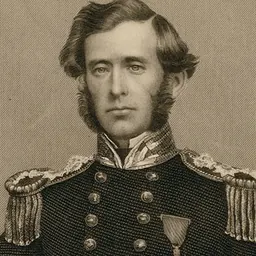
Related people
Same field, nearest in time



Contemporaries
People whose lives overlapped John Irving's




Frequently asked questions
Who was John Irving?
Scottish Royal Navy officer and explorer
When was John Irving born?
John Irving was born on 8 February 1815 in Edinburgh.
When did John Irving die?
John Irving died in 1848 in Victory Point.
What was John Irving's occupation?
John Irving was a naval officer and royal Navy.
What was John Irving known for?
John Irving was known for Franklin's lost expedition.
What nationality was John Irving?
John Irving was British.
Sources & further reading
· DBpedia: John Irving (Royal Navy officer)
Cite this page
APA: Biography.guide. (2026). John Irving. https://biography.guide/john-irving-naval-officer/
MLA: "John Irving." Biography.guide, https://biography.guide/john-irving-naval-officer/.
Chicago: "John Irving." Biography.guide. https://biography.guide/john-irving-naval-officer/.
Data last updated: 2026-09-22 · Spot an error? Report a correction.
Page generated 2026-09-27 05:28 UTC