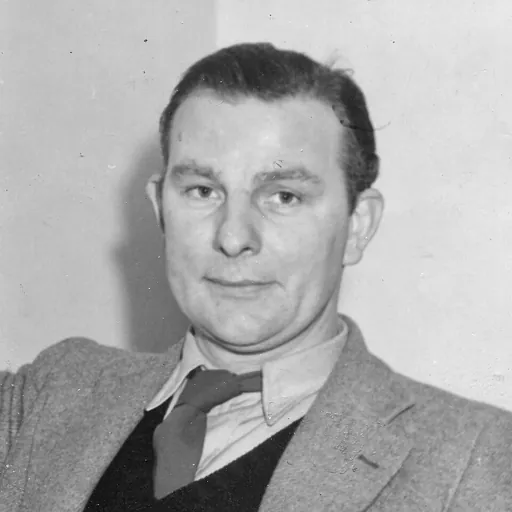
About John Horner
Lived 1911 – 1997 (aged 85). John Horner was a British politician and trade unionist.
Frederick John Horner (5 November 1911 – 11 February 1997) was a British firefighter, trade unionist and politician, best known for creating the modern Fire Brigades Union.
Early life Horner was born and grew up in the working-class London suburb of Walthamstow, the son of an illiterate building labourer. Encouraged by his mother, he won a rare scholarship to the Sir George Monoux Grammar School but his father's work was irregular and because of the pressure on family finances, the headmaster advised Horner to skip a year of schooling to matriculate early. He was found a job as a junior trainee buyer at Harrods, the luxury department store but already radicalised by the 1926 General Strike and by the socialists he was meeting at a local Quaker evening school, he found the job intolerable and after a year left Harrods for the Merchant Navy.
In 1933, Horner returned home from sea to take the examination for a second mate's certificate but the depression of the 1930s meant many ships were laid up and it was impossible for a newly qualified officer to find work. After some months of unemployment Horner was recruited into the London Fire Brigade (LFB) and following his getting top marks at the training school he was summoned before the LFB's deputy Chief Officer, Sir Aylmer Firebrace to learn he was to be posted to headquarters at Southwark on a fast track for promotion. When Kingdom failed to respond, this radical group nominated Horner to stand against Kingdom for election as FBU General Secretary and when Kingdom then unexpectedly resigned, Horner engaged in a confused process, described by one obituarist as ' a left-wing coup', that found him elected in June 1939 as the new General Secretary, aged 27.
When the Second World War started a few weeks later, tens of thousands of auxiliary firefighters were called up and flooded into the fire stations. Horner ignored the advice of the General Secretary of the Trades Union Congress (TUC), Walter Citrine, that the FBU should ignore the auxiliaries and instead created an AFS section of the FBU that was eventually merged with the regular FBU in 1943. Union membership jumped to over 70,000. During the Blitz of 1940–41, Horner visited every fire station in the country, supporting his members on the front line of the UK's civil defence against the bombs and successfully campaigned for improvement in the AFS employment conditions. When the Government created the National Fire Service in 1941, he launched a high-profile campaign for the Firemen's Charter that included a nationally set wage and other improvements. He enlisted the support of well-known public figures and 400 mass meetings were organised across the country. Not all of the Charter's demands were met but they had won a significant pay increase and 'it was an impressive beginning to an era of increasing success for the FBU'. After twenty-five years as General Secretary, he stepped down in 1964 and later that year was elected as Labour MP for Oldbury and Halesowen. Many of the FBU's officials were communists, including Bob Darke whose book, The Communist Technique (Penguin 1952) made detailed allegations about Horner and the influence of the Communist Party on the FBU.
In 1956, Horner and his wife Pat resigned from the Communist Party around the time of the Soviet invasion of Hungary. Horner rejoined the Labour Party and threw himself into supporting the Campaign for Nuclear Disarmament, founded in 1958. At the 1960 Labour Party Conference, he seconded Frank Cousins in moving the successful resolution for unilateral nuclear disarmament. In 1970, Horner lost his seat in the general election and retired to live with Pat in Ross-on-Wye. His book, Studies in Industrial Democracy (Gollancz) was published in 1974. Horner was known as a great raconteur and a polymath, fascinated by art, literature and philosophy with a deep interest in history and 'an impeccable guide to the castles, churches and village inns of the Welsh borders'.
Don’t just read it —
keep it.
Full-length biographies made to live with: read them, listen on the way to work, watch them tonight.
- E-book
- Audio
- Video
Instant download · yours to keep · every purchase keeps this site free
Important facts
People in John Horner's life
Named in this biography and alive at the same time



Related people
Same field, nearest in time





Contemporaries
People whose lives overlapped John Horner's





Frequently asked questions
Who was John Horner?
British politician, died 1997
When was John Horner born?
John Horner was born on 5 November 1911 in Walthamstow.
When did John Horner die?
John Horner died on 11 February 1997.
What was John Horner's occupation?
John Horner was a politician and trade unionist.
What nationality was John Horner?
John Horner was British.
Sources & further reading
· DBpedia: John Horner (British politician)
Cite this page
APA: Biography.guide. (2026). John Horner. https://biography.guide/john-horner-politician/
MLA: "John Horner." Biography.guide, https://biography.guide/john-horner-politician/.
Chicago: "John Horner." Biography.guide. https://biography.guide/john-horner-politician/.
Data last updated: 2026-09-20 · Spot an error? Report a correction.
Portrait: Wikimedia Commons · author & licence
Page generated 2026-09-27 04:57 UTC