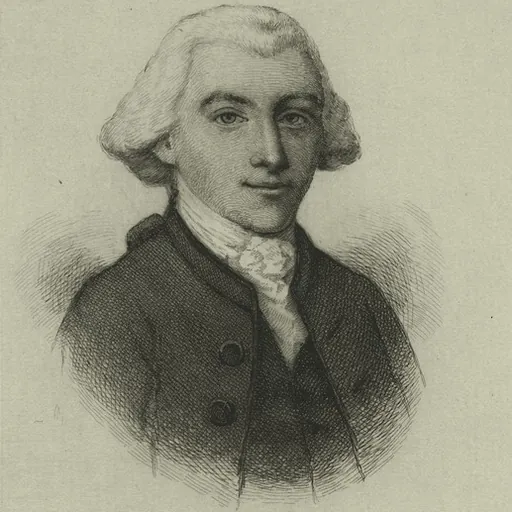
John Harvie
United States Founding Father. He signed the Articles of Confederation, served as mayor of Richmond, Virginia, and cast an electoral vote for George Washington.
About John Harvie
Lived 1742 – 1807 (aged 64–65). John Harvie was an American lawyer.
John Harvie (1742 – February 6, 1807) was an American Founding Father, lawyer and builder from Virginia. He was a delegate to the Second Continental Congress, where he signed the Articles of Confederation, in 1777 and 1778. He was a successful lawyer and landowner, as well as the fourth mayor of Richmond, Virginia. Thomas Jefferson was a friend since his childhood; his father was Jefferson's guardian. He negotiated a peace treaty in 1774 after the Battle of Point Pleasant. During the American Revolutionary War, he was on the Board of War and operated a prison of war camp on his property, The Barracks.
Personal life Harvie was born at Belmont Plantation in Albemarle County, Virginia, in 1742, to Scottish immigrant John Harvie Sr. (1706–1767) and Martha Gaines Harvie. His brother Richard managed a store in Charlottesville and had established R. Harvie & Company or Harvie & Company with a partner. Harvie was a lawyer who settled in Augusta County.
Margaret Strother Morton Jones bracelet – miniature portraits of Margaret and four children, including Margaret Morton Jones who married John Harvie.
In 1767, Harvie inherited Belmont Plantation. His mother moved to Georgia with his eight siblings. They had four sons—Lewis, John, Edwin, and Jacquelin—and three daughters, Gabriella, Emily, and Julia.
Politics After Governor Dunmore dissolved the House of Burgesses, West Augusta County voters elected Harvie as one of their two delegates to its successor, the five Virginia revolutionary conventions legislature in 1775 and 1776. The following year fellow legislators elected Harvie as one of Virginia's delegate to the Second Continental Congress. Harvie never lived in West Augusta County, which never incorporated (the land ultimately became Ohio County, Monongalia County and Yohogania Counties) but trans-Appalachian counties had difficulties both in financing their representatives travel and in finding men willing to take the long and grueling journey to the state capitol.
While at the Continental Congress, Harvie was one of five Virginia delegates to sign the Articles of Confederation on July 9, 1778. He was appointed the registrar of the Land Office in 1780, for which he moved to Richmond. His office was responsible for transactions in the Northwest Territory, western Virginia, Ohio and Kentucky. served as a purchasing agent and supply organizer for Virginia's militia and Continental Army units. Becoming aware of the conditions at Valley Forge, members of Congress came to the encampment to inspect for themselves. Washington's reputation and ability to lead were questioned. Harvie told Washington, "My dear General, if you had given some explanation, all these rumors [denigrating Washington] would have been silenced a long time ago."
Based upon his influence, Harvie procured the establishment of the Prison Camp at The Barracks Harvey purchased the 240 acre property from Richard Anderson around 1778. It is located west of Charlottesville.
He had 12 enslaved men in 1782 and no mention of free males. He had 6 cattle and 7 colts and mules. On January 24, 1782, an ad was published in the Virginia Gazette and American Advertiser about Jordan, one of his slaves who ran away. In 1789, Harvie owned 17 enslaved males, 2 of whom were between 12 and 16. He was taxed for his property in Fredricksville Parish of Albemarle County; there were 2 white males and 10 horses.
Death and legacy
While he was inspecting the construction of a mansion being built by Benjamin Latrobe, Harvie fell from the roof and suffered injuries that resulted in his death. He died on February 6, 1807, and was buried at the family plot at Belvidere. His wife Margaret inherited the 20-acre Belvidere estate and lived there until 1814, when she sold it.
Don’t just read it —
keep it.
Full-length biographies made to live with: read them, listen on the way to work, watch them tonight.
- E-book
- Audio
- Video
Instant download · yours to keep · every purchase keeps this site free
Important facts
People in John Harvie's life
Named in this biography and alive at the same time
Related people
Same field, nearest in time


Contemporaries
People whose lives overlapped John Harvie's





Frequently asked questions
Who was John Harvie?
United States Founding Father. He signed the Articles of Confederation, served as mayor of Richmond, Virginia, and cast an electoral vote for George Washington.
When was John Harvie born?
John Harvie was born in 1742 in Albemarle County.
When did John Harvie die?
John Harvie died on 6 February 1807 in Richmond.
What was John Harvie's occupation?
John Harvie was a lawyer.
What nationality was John Harvie?
John Harvie was American.
Sources & further reading
Cite this page
APA: Biography.guide. (2026). John Harvie. https://biography.guide/john-harvie/
MLA: "John Harvie." Biography.guide, https://biography.guide/john-harvie/.
Chicago: "John Harvie." Biography.guide. https://biography.guide/john-harvie/.
Data last updated: 2026-09-21 · Spot an error? Report a correction.
Portrait: Wikimedia Commons · author & licence
Page generated 2026-09-27 04:58 UTC