
John Halsted
Royal Navy officer during the French Revolutionary Wars and Napoleonic Wars.
About John Halsted
Lived 1768 – 1830 (aged 61–62). John Halsted was a British military personnel.
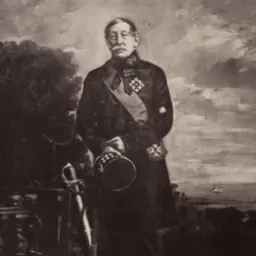
Captain John Halsted (1768 – 2 November 1830) was a Royal Navy officer who served in the American War of Independence and French Revolutionary and Napoleonic Wars.
Born into a naval family, Halsted went to sea at an early age with his father and at least one of his brothers. After a period of schooling he rejoined the navy and served aboard a number of ships and under a variety of notable commanders of the age, until reaching the rank of lieutenant shortly after the outbreak of the French Revolutionary Wars. He went out to the East Indies for much of them, serving onshore with troops and later commanding a sloop, before returning to Britain hoping to receive post-rank and the command of a frigate. He was disappointed, the Admiralty declined to confirm his appointment and he spent a number of years without a ship.
He returned to active service only in 1804, with the command of a defence and storeship, followed by a position as agent for transports for the expedition to Copenhagen in 1807. He again escaped official notice, and it was not until 1808 that he received a promotion to post-captain. He took command of the 74-gun in 1810, followed by the 74-gun in 1813, commanding them in the North Sea. His final service during the wars was to oversee the impress service at Gosport, a post that allowed him to meet Prince Regent. He seems to have had no further service after the wars ended in 1815, and eventually died, still a post-captain, in 1830.
Family and early life Relief of Gibraltar by Earl Howe, 11 October 1782, depicted by Richard Paton. Halsted served aboard the 98-gun during both the relief and the subsequent Battle of Cape Spartel.
Halsted was born in Gosport, Hampshire in 1768, the third son of naval officer Captain William Anthony Halsted, and his wife Mary, née Frankland. Three of John's brothers had naval careers; Charles Halsted became a lieutenant and was lost with in 1780, Lawrence Halsted had a long career and became an admiral, and George Halsted rose to be a commander. John Halsted also embarked on a naval career in 1776, joining his brother Lawrence aboard their father's ship, the 60-gun , for service off North America. John was eight years old at the time. William Anthony Halsted died while in command off New York City in 1778, and John was transferred to the 32-gun , where he remained into 1779. He was then entered into a school for the next three years, rejoining the navy in 1782 as a midshipman aboard the 98-gun . The expedition was cancelled before it left India, and November 1797 Halsted received a new commission, to take over the 32-gun from Captain John Murray, Murray having been ordered by the Admiralty to take command of the 36-gun . Crescent was based at the Cape of Good Hope Station, but Murray had affairs to settle in India. Rainier therefore asked Halsted to exchange with Murray and instead sail to take over Crescent on the Cape Station, and at the same time carry despatches to be forwarded back to Britain from there.
On arriving at the Cape, Halsted found his ship had sailed. Rear-Admiral Thomas Pringle, the station's commander-in-chief, had sailed for England sometime before, taking passage on Crescent as his flagship. Halsted followed on, delivering his despatches, but to his "mortification", he found that the Admiralty would not confirm his post-rank, but only offered him the rank of commander, dated from June 1798, the time of his arrival in Britain. During this time Bellerophon was employed with the North Sea squadron, blockading the Dutch ports. Halsted's time in command was relatively brief, he was superseded by Captain Augustus Brine on 5 November 1810. He left Scarborough in early 1814 and took charge of the impress service at Gosport, holding the position until the end of the Napoleonic Wars in 1815. During his time in the role, he met the Prince Regent during his visit to Portsmouth Dockyard, and was allowed to kiss his hand. Halsted was later sent with a delegation from the town to read an address to the former Prince Regent, who had since succeeded as King George IV. Halsted was again allowed to kiss the monarch's hand.
Don’t just read it —
keep it.
Full-length biographies made to live with: read them, listen on the way to work, watch them tonight.
- E-book
- Audio
- Video
Instant download · yours to keep · every purchase keeps this site free
Important facts
People in John Halsted's life
Named in this biography and alive at the same time




Related people
Same field, nearest in time


Contemporaries
People whose lives overlapped John Halsted's



Frequently asked questions
Who was John Halsted?
Royal Navy officer during the French Revolutionary Wars and Napoleonic Wars.
When was John Halsted born?
John Halsted was born in 1768 in Gosport.
When did John Halsted die?
John Halsted died on 2 November 1830 in Exeter.
What was John Halsted's occupation?
John Halsted was a military personnel.
What nationality was John Halsted?
John Halsted was British.
Sources & further reading
Cite this page
APA: Biography.guide. (2026). John Halsted. https://biography.guide/john-halsted/
MLA: "John Halsted." Biography.guide, https://biography.guide/john-halsted/.
Chicago: "John Halsted." Biography.guide. https://biography.guide/john-halsted/.
Data last updated: 2026-09-20 · Spot an error? Report a correction.
Page generated 2026-09-27 05:30 UTC