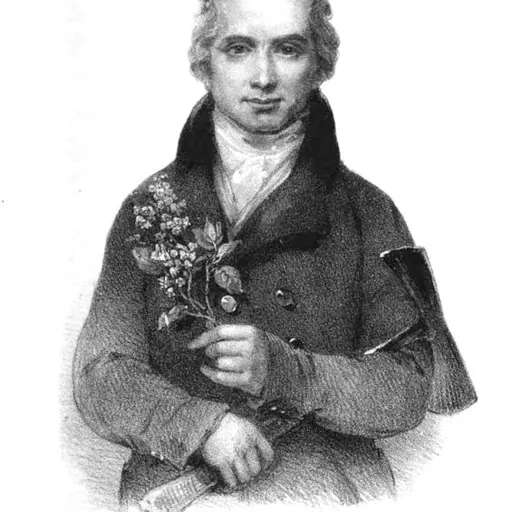
About John Fraser
Lived 1750 – 1811 (aged 60). John Fraser was a British botanist, businessperson and physician.
John Fraser, FLS, F.R.H.S., (14 October 1750 – 26 April 1811) was a Scottish botanist who collected plant specimens around the world, from North America and the West Indies to Russia and points between, with his primary career activity from 1780 to 1810. Fraser was a commissioned plant collector for Catherine, Czar of Russia in 1795, Paul I of Russia in 1798, and for the Dowager Empress Maria Feodorovna in 1806; he issued nursery catalogues c. 1790 - 1796 and had an important herbarium that was eventually sold to the Linnean Society.
Early life Fraser was born during the Age of Enlightenment at Tomnacross, the Aird, Inverness-shire on 14 October 1750. His father was Donald Fraser, (a.k.a. Donald Down, a patronymic descriptive of hair colour traditional amongst the Scots Highlanders); his mother was Mary McLean, and his siblings included a brother James (b. 16 March 1753) and sister Christiana (b. 5 December 1756). In the 1780s, Fraser established the American Nursery at Sloane Square, King's Road. Fraser travelled extensively, from Scotland to England, the Americas, the West Indies, Russia, and points between. He began by collecting in Newfoundland from 1780 to 1783 or 1784, and then moved on to the Appalachian Mountains in eastern North America, sending home consignments of plants to Frank Thorburn of Old Brompton. Returning to England in 1785 with the expectation of recompense for his labour and risk, he was astonished to learn that all the valuable plants he had forwarded were dead, and the survivors, which were common, could not be disposed of. He continued on to the Piedmont region of the Appalachians, discovering Phlox stolonifera (Creeping Phlox) in Georgia along the southeastern edge of the Blue Ridge Mountains, and in 1787, he arrived in Pickens County near Chickamauga Cherokee land during the Cherokee–American wars. There, he collected what became known later as Magnolia fraseri. Fraser met the explorers Alexander von Humboldt and Aimé Bonpland on their circuitous journey from the Amazon to Cartagena. one of which was his discovery (as a European) of Jatropha pandurifolia. In 1807, both father and son again sailed for North America and the West Indies. and made a manufacturing proposal for hand-weaving of hats and bonnets from its leaves; Fraser's sister Christiana "Christy" Fraser, opened an establishment for the purpose under Queen Charlotte's patronage (the Queen was an amateur botanist) and employed a number of people,
Later voyages Fraser made his seventh and last voyage to the United States in 1807. Near Charleston, he fell from his horse and broke several of his ribs; an injury from which he never fully recovered. at age 60, leaving two sons; William Roscoe wrote of him: "John Fraser brought more plants into this kingdom [Britain] than any other person." Fraser was hailed early on by his biographers as "ne of the most enterprising, indefatigable, and persevering men that ever embarked in the cause of botany and natural science." The Fraser's Saint John's wort (Triadenum fraseri) is also named in honour of Fraser.
Progeny Fraser's eldest son John Jr. (c. 1779–1852) continued in his father's footsteps as a plant hunter after Fraser's death Fraser, John, Nursery Catalogues, repub. in Journal of Botany, British and Foreign, vol. 45, 1907, p. 255; and vol. 53, 1915, p. 271. Fraser, John, Nursery Catalogues, repub. in Journal of Botany, 1921, pp. 69–71.
Agrostis Cornucopiae. Aletris aurea. Allium cernuum, Bot. 1324. — reticulatum. Andromeda cassinaefolia, Bot. Mag. t. 970. — Catesbaei, Bot. Mag. t. 1955. — dealbata, Bot. Reg. t. 1010. — ferruginea. — floribunda, Bot. Reg. t. 1566. — serratifolia. Annona pygmaea. Asarum arifolium. Hook Ex. Fl. t. 40. Asclepias amplexicaulis. — acuminata. — Linaria. — pedicellata. — perfoliata. — salviaefolia. Azalea arborescens. — calendulacea, Bot. Mag. t. 1721(β) — canescens. — coccinea, Bot. Mag. t 180. — glauca. — nitida. Bartsia coccinea. Befaria racemosa. Betula lutea. Blandfordia cordata. Buchnera pedunculata. Calycanthus glaucus, Bot. Reg. t. 404. — laevigatus, Bot. Reg. t. 481. Carex Fraseriana, Bot. Mag. t. 1391. Chaptalia tomentosa, Bot. Mag. (Tussilago integrifolia) t. 2257. Clethra scabra. Collinsonia ovalis. — tuberosa. Commelina angustifolia. Convolvulus tenellus. Coreopsis latifolia. Corypha Hystrix. Cristaria coccinea, Bot. Mag. t. 1673. Croton maritimum. Cypripedium Calceolus. Cypripedium pubescens, Lodd. t. 895. Cypripedium reginae. Cyrilla Caroliniana, Bot. Mag. t. 2456. Diospyros pubescens. Dracocephalum caeruleum. Echites difformis. Elaeagnus argenteus. Erigeron bellidifolium. — compositum. — nudicaule. Euphorbia Ipecacuanha, Bot. Mag. t. 1494. — marginata. Frasera Walteri. Galardia bicolor, Bot. Mag. t. 1602, and vars. 2940, and 3368. Gentiana crinita, Bot. Mag. t. 1039 (G. fimbriata). — incarnata, Bot. Mag. t. 1856. Gerardia flava. — quercifolia. — tenuifolia. Gnaphalium undulatum. Halesia parviflora. Hamamelis macrophylla. Helonias angustifolia, Bot. Mag, t. 1540. Hydrangea quercifolia, Bot. Mag. t. 975. — radiata. Hypoxis juncea. Ilex angustifolia. Illicium parviflorum. Ipomaea Jalapa, Bot. Mag. t. 1572. — Michauxii. — sagittifolia. Ipomopsis elegans, Bot. Reg. t. 1281. Jeffersonia diphylla, Bot. Mag. t. 1513. Juglans amara. — porcina. — sulcata. Kalmia hirsuta, Bot. Mag. t. 138. — rosmarinifolia. Larix Fraseri. Laurus Caroliniensis — Catesbaei. — Diospyros, Bot. Mag. t. 1470. — melissaefolia, Bot. Mag. t. 1470. Liatris cylindracea — elegans. — odoratissima. — pilosa. — sphaeroidea. Lilium Catesbei Bot. Mag. t. 259. Lobelia puberula, Bot. Mag. t. 3292. Lonicera Caroliniensis. — flava, Bot. Mag. t. 1318. Lupinus villosus. Macbridea pulchra. Magnolia auriculata, Bot. Mag. t. 1206. — Fraseri. — cordata, Bot. Reg. t. 325. — macrophylla, Bot. Mag. t. 2189. — pyramidata, Bot. Reg. t. 407. Malachodendron ovatum, Bot. Reg. t. 1104. Malaxis unifolia. Menziesia ferruginea, Bot. Mag. t. 1571. — globularis. Mespilus spathulata. Muhlenbergia diffusa. Nelumbium macrophyllum. Neottia cernua, Bot. Mag. t. 1568. — tortilis. Nymphsea odorata, Bot. Mag. t. 819. — reniformis. Oenothera caespitosa, Bot. Mag. t. 1593. — Fraseri, Bot. Mag. t 1674. — glauca, Bot. Mag. t. 1606. — macrocarpa, Bot. Mag. t. 1592. — Missourensis. Orchis spectabilis, Exot. Fl. t. 69. Pachysandra procumbens, Bot. Mag. t. 1964. Pancratium Carolinianum, Bot. Reg. t. 926. Pavia macrostachya. Pedicularis Canadensis, Bot. Mag. t. 2506. Phalangium esculentum, Bot. Mag. t. 1574. — (Quamash). Pinckneya pubescens. Pinguicula lutea, Bot. Reg. t. 126. Pinus Cedrus. Pinus lutea. — palustris. — pungens. Phlox acuminata, Bot. Mag. t 1880. — amaena Bot. Mag. t. 1308. — Carolina, Bot. Mag. t. 1344. — nivea. — pyramidalis. — setacea, Bot. Mag. t. 415. — stolonifera, Bot. Mag. t. 563. — subulata, Bot. Mag. 411. Polygonum arifolium. Pontederia lanceolata. Prunus Chicasa. — maritima. Prunus pygmaea. Pycnanthemum lanceolatum. — verticillatum. Pyrola maculata, Bot. Mag. t. 897. — repens. Pyxidanthera barbulata. Quercus Bannisteri. — Catesbaei. — castanea. — hemisphaerica. — imbricaria. — laurifolia. — lyrata. — Michauxii. — montana. — olivaeformis. — prinoides. — tinctoria. Rhexia Caroliniensis Rhododendron Catawbiense, Bot. Mag. t. 1671. — punctatum, Bot. Reg. 37. Ribes aureum, Bot. Reg. t. 125. — hirtellum. — resinosum, Bot. Mag. t. 1583. Rosa Caroliniensis. — laevigata. Rudbeckia pinnata, Bot. Mag. t. 2310. Sagittaria falcata. — graminea. — latifolia. Salix cordifolia. — falcata. Salvia azurea, Bot. Mag. t. 1728. Sarracenia adunca, Bot. Mag. t. 1710. — rubra, Bot. Mag. t. 3515. Satyrium repens. Schizandra coccinea, Bot. Mag. t. 1413. Scutellaria Canadensis. Sideranthus pinnatifidus. — villosus. Silene pennsylvanica, Bot. Mag. t. 3342. — Virginica. Smilax lanceolata. — pubera. — quadrangularis. Streptopus roseus. Thalia dealbata, Bot. Mag. t. 1690. Thymbra Caroliniana, Bot. Mag. t. 997. Tradescantia rosea. Trillium pictum. — pusillum. Vaccinium buxifolium, Bot. Mag. t. 928. — frondosum. — myrsinites, Bot. Mag. t. 1550. — myrtifolium. — nitidum, Bot. Mag. t. 1550. — parviflorum, Bot. Mag. t. 1288. Verbena bracteosa, Bot. Mag. t. 2910. — rugosa. Viola papilionacea. — pedata, Bot. Mag. t. 89. — pubescens. — rotundifolia. Virgilia lutea. Ulmus alata. Uniola paniculata. Uvularia grandiflora, Bot. Mag. t. 1112. Waltheria Caroliniana. Xyris Canadensis. Yucca Missourensis. — recurva. — serrulata. Zamia pumila.
Don’t just read it —
keep it.
Full-length biographies made to live with: read them, listen on the way to work, watch them tonight.
- E-book
- Audio
- Video
Instant download · yours to keep · every purchase keeps this site free
Important facts
People in John Fraser's life
Named in this biography and alive at the same time

Related people
Same field, nearest in time




Contemporaries
People whose lives overlapped John Fraser's




Frequently asked questions
Who was John Fraser?
botanist from Scotland (1750-1811)
When was John Fraser born?
John Fraser was born on 14 October 1750 in Inverness.
When did John Fraser die?
John Fraser died on 26 April 1811 in Chelsea.
What was John Fraser's occupation?
John Fraser was a botanist, businessperson and physician.
What nationality was John Fraser?
John Fraser was British.
Sources & further reading
· DBpedia: John Fraser (botanist)
Cite this page
APA: Biography.guide. (2026). John Fraser. https://biography.guide/john-fraser-botanist/
MLA: "John Fraser." Biography.guide, https://biography.guide/john-fraser-botanist/.
Chicago: "John Fraser." Biography.guide. https://biography.guide/john-fraser-botanist/.
Data last updated: 2026-09-22 · Spot an error? Report a correction.
Page generated 2026-09-27 05:10 UTC