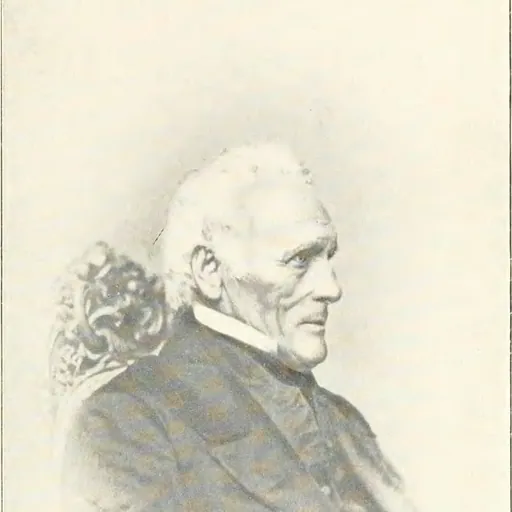
John D'Wolf
Sea captain, possibly first American in Siberia
About John D'Wolf
Lived 1779 – 1872 (aged 92). John D'Wolf was a sea captain, fur trader and seafarer.
John DeWolf (6 September 1779 - 6 March 1872), also known as John D'Wolf, John D'Wolfe, John DeWolfe, John DeWolf II, Norwest John or Nor'west John, was a sea captain, merchant, and businessman known for his role in the maritime fur trade in the Pacific Northwest, and his influence on the Russian-American Company in Novo-Arkhangelsk (today Sitka, Alaska) in Russian America, and for being an uncle of Herman Melville. Melville was inspired by DeWolf's stories, including an encounter with a large whale that contributed to Melville's Moby-Dick, which Melville describes explicitly in Moby Dick, "Chapter XLV: The Affidavit". "Captain D'Wolf" is also described in the same chapter. John DeWolf was the first American known to have travelled overland across Siberia, and probably the first person to circumnavigate the globe by way of crossing Asia overland.
Early life John DeWolf was born in Bristol, Rhode Island, the only child of Simon DeWolf and Hannah May, Simon having died in 1779 at age 26. John was part of the prominent DeWolf family of Rhode Island, which had become wealthy through the Atlantic slave trade, starting with DeWolf's grandfather Mark Anthony DeWolf. The DeWolf family had a major influence on Bristol during the early United States era. The family dominated Bristol shipping, slaving, banking, trading, and politics from the late 18th century through the early 19th century. DeWolf lived through the family's mid-19th century shift from maritime commerce to industry in Bristol.
DeWolf went to sea at a young age, participating in his family's slave trading business. He wrote that he disliked the slave trade and wished to end his involvement in it by trying his luck in the maritime fur trade, which involved trading with the Indigenous peoples of the Pacific Northwest Coast for sea otter furs, which commanded a high price in China. At the same time, about 1800, James DeWolf, the elder patriarch of the DeWolf family and John's uncle, began working to diversify the DeWolf family business, due to increasing restrictions on the slave trade. The maritime fur trade was booming around 1800 and the DeWolf family was well positioned to join in the trade. At least one maritime fur trading expedition was conducted by the DeWolf family from 1801 to 1804. This voyage, done with one of the DeWolf family's ships, Juno, under Captain Jabez Gibbs, returned to New England in 1804.
DeWolf also returned to New England in 1804, after a long voyage around the Cape of Good Hope, on what was probably a slave trading venture. Shortly after DeWolf's return the Juno was re-registered with George and John DeWolf as the primary owners, in preparation for the Juno being sent on another maritime fur-trading venture, this time with DeWolf as captain.
Juno was taken to the Pacific Northwest on a maritime fur trading venture from 1802 to 1804, under Captain Jabez Gibbs. This voyage was not well documented and little is known about it. As during the second voyage under John DeWolf, at times Juno sailed in company with Mary, another maritime fur trading ship, based out of Boston and under the command of Captain William Bowles during the first voyage, and Captain Trescott during the second. On the first voyage, Mary and Juno unsuccessfully attempted to rescue the survivors of the Boston at Nootka Sound. Earlier in 1803 the Boston, under John Salter, had been captured by Chief Maquinna. The two survivors, John Thompson and John R. Jewitt, lived as Maquinna's slaves. Their plight was well known to other trading ships. They were eventually rescued in July 1805 by Captain Samuel Hill of the trading ship Lydia. He passed Cape Verde on 20 September. On 9 October crossed the equator and soon was near Rio de Janeiro.
On 13 November 1804 Juno fell in with the Mary, another maritime fur trading vessel heading for the Pacific Northwest under Captain Trescott of Boston. Sailing together the two ships passed the Falkland Islands in mid-November, then prepared to round Cape Horn. They experienced rough seas and gale force winds. On 19 November 1804 the Juno and Mary collided during a storm. They suffered damage of various kinds, especially to their rigging, but were able to continue on after getting untangled. The ships lost sight of each other for most of the rest of December. resulting in the death of the captain, first mate, second mate, supercargo, cooper, cook, and many seamen. The various ships were working to transfer crew members and cargos and make repairs so that the Atahualpa could sail to China and then New England. DeWolf assisted in the effort. DeWolf, surprised by Rezanov's earnestness, began talks about actually selling his ship. After some deliberations, it was agreed that the Juno would be sold to the RAC for $68,000 (worth approximately $1,500,000 in 2023), which would be paid with bills of exchange on the Directors of the RAC in Saint Petersburg worth $54,638, 572 sea otter furs worth $13,062, a small and poorly built Russian vessel called Ermak (also transliterated as Yermak) with which DeWolf's crew could take the furs to China, and $300 in cash. perhaps on one of the small islands nearby in the eastern end of Peril Strait; or at Lindenberg Head in Peril Strait, about west of Point Craven. Langsdorff described the house of Chief Dlchaetin as having a raised hearth in the middle of an interior open space large enough to hold the several hundred Tlingit who gathered to see Langsdorff and DeWolf.
DeWolf noted that both Tlingit men and women "are expert in the use of fire-arms, and are excellent judges of their quality." Langsdorff wrote that Tlingit weapons "consist principally of bows and arrows; but since their trade with the American States, they have acquired so large a stock of guns, powder, and shot, that they scarcely use their arrows except in hunting sea otters and [seals]." And that the Tlingit "understand the qualities of a good gun so well that it is impossible to impose a bad one upon them: even the women are accustomed to the use of fire-arms, and often go out on the hunting parties". He also wrote that DeWolf "assured me that the best English guns may now be bought cheaper upon the north-west coast of American than in England".
In May, while Juno was away, the American ship O'Cain, under Jonathan Winship, arrived from Boston via Hawaii. Winship, hoping to repeat the earlier joint venture done with O'Cain under Captain Joseph O'Cain, proposed a joint venture with Baranov to hunt California sea otters with Alutiiq and Aleut hunters brought to California on the O'Cain. This was agreed to and arranged, with O'Cain leaving in mid-May with over 120 Alutiiq and Aleut hunters and 75 baidarkas. DeWolf asked if he could captain Rostislav to Siberia himself. Langsdorff, who had also grown tired of Russian America, was excited by the idea. Baranov and Rezanov agreed, and on 30 June 1806 the Rostislav was made ready to sail with a crew of ten men. Shortly after, DeWolf and Langsdorff left Sitka. The Rostislav proved seaworthy but very slow, especially in the light summer winds. They reached Kodiak on 13 July, and Unalaska on 12 August. They then sailed for the Kuril Islands, hoping to reach Okhotsk, the starting point of the overland route across Siberia. DeWolf neared the Sea of Okhotsk in early September, but bad weather prevented Rostislav from entering the sea. DeWolf was forced to instead sail to Petropavlovsk on the coast of the Kamchatka Peninsula, where he would have to spend the winter of 1806–07. The Rostislav arrived at Petropavlovsk on 22 September 1806. Due to ice in the Sea of Okhotsk, DeWolf and Langsdroff had to wait until 26 May 1807 to depart Petropavlovsk for Okhotsk with Rostislav. On 30 May they ran into a large whale. DeWolf later wrote that the impact was "like striking a rock" and that the Rostislav, upon the whale's back, was raised 2–3 feet out of the water. Langsdorff recalled the incident in a similar way—that they had run into a whale, which "could have been disastrous if the boat listed or was shaken too hard by the impact, but Captain DeWolf acted quite competently". These trading houses were stocked with goods that were in demand by Native Hawaiians and the growing number of Americans and other foreigners who lived in Hawaii. Profits were made by selling goods mostly in exchange for Hawaiian sandalwood (ʻiliahi or ʻiliahialoʻe), which was a booming business in the 1820s. As whaling ships began visiting Hawaii in larger numbers the mercantile community grew and whaling bills of exchange became increasingly common. By 1830 Hawaii had become a major commercial center for the entire North Pacific, with connections to California, China, Russia, and many Pacific Islands. The main ports of call were Honolulu on Oahu and Lahaina on Maui. American goods were largely brought from New England, and buildings commonly used a distinctly New England style similar to the "Yankee" architecture of the whaling centers of New Bedford and Nantucket.
In 1829 DeWolf gave up sea voyages and settled down in Bristol. He lived on Hope Street, in what became known as the "Capt. John DeWolf House". He managed what is now known as "Capt. John DeWolf's Store", at 54 State Street. Both buildings were in what is now the Bristol Waterfront Historic District. The National Register of Historic Places describes "Capt. John DeWolf's Store" as "owned by the famous "Nor'west John" DeWolf, first American to cross Siberia after selling his ship in Alaska to a fur trade official of the Russian-American Company".
In 1814 DeWolf married Mary Melville, aunt of Herman Melville. They had two children: Nancy Melville DeWolf (1814–1901) and John Langsdorff DeWolf (1817–1886). In 1850, he and Mary moved in with their married daughter, Nancy Downer, in Dorchester, Massachusetts.
DeWolf is known for inspiring his nephew Herman Melville, including a dramatic account of an encounter with a huge whale that lifted his ship out of the water—a story which contributed to Melville's conception of Moby Dick. DeWolf is mentioned in Moby Dick. Herman Melville spent the summer of 1828 living with the DeWolfs in Bristol, during which time "Nor'west John" told him many stories about his adventures, which contributed to Herman's later inspiration to write Moby Dick. In Moby Dick Melville included explicit mentions of DeWolf and George Heinrich von Langsdorff, who DeWolf met and befriended in Russian Alaska.
DeWolf died in Dorchester, Massachusetts, at the home of his daughter, on 8 March 1872. He was inducted into the Rhode Island Heritage Hall of Fame in 1967. He is buried in Forest Hills Cemetery, Jamaica Plain, Boston.
Don’t just read it —
keep it.
Full-length biographies made to live with: read them, listen on the way to work, watch them tonight.
- E-book
- Audio
- Video
Instant download · yours to keep · every purchase keeps this site free
Important facts
more
John D'Wolfe, John DeWolfe, John DeWolf II, Nor'west JohnPeople in John D'Wolf's life
Named in this biography and alive at the same time


Related people
Same field, nearest in time


Contemporaries
People whose lives overlapped John D'Wolf's



Frequently asked questions
Who was John D'Wolf?
sea captain, possibly first American in Siberia (1779-1872)
When was John D'Wolf born?
John D'Wolf was born on 6 September 1779 in Bristol.
When did John D'Wolf die?
John D'Wolf died on 8 March 1872 in Dorchester.
What was John D'Wolf's occupation?
John D'Wolf was a sea captain, fur trader and seafarer.
Sources & further reading
· DBpedia: John DeWolf (sea captain)
Cite this page
APA: Biography.guide. (2026). John D'Wolf. https://biography.guide/john-d-wolf/
MLA: "John D'Wolf." Biography.guide, https://biography.guide/john-d-wolf/.
Chicago: "John D'Wolf." Biography.guide. https://biography.guide/john-d-wolf/.
Data last updated: 2026-09-24 · Spot an error? Report a correction.
Portrait: Wikimedia Commons · author & licence
Page generated 2026-09-27 05:09 UTC