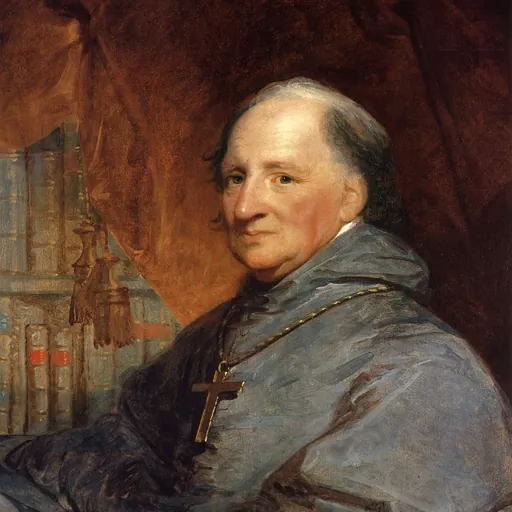
John Carroll
First Roman Catholic bishop and archbishop in the United States
About John Carroll
Lived 1735 – 1815 (aged 80). John Carroll was an American catholic missionary, catholic priest, catholic bishop, regular cleric and bishop.
John Carroll (January 8, 1735 – December 3, 1815 ) was an American Catholic prelate who served as the nation's first Catholic bishop, overseeing the Diocese of Baltimore, then the only diocese in the nascent United States, from 1789 to 1815. He became Archbishop of Baltimore in 1808, up to which point Carroll had also administered the entire U.S. Catholic Church.
Born to an aristocratic family in the colonial-era Province of Maryland, Carroll spent most of his early years as a priest in Europe, teaching and serving as a chaplain. After returning to Maryland in 1773, he started organizing the Catholic Church in America with a small cadre of priests. The Vatican appointed him to several roles as leader of the American Catholic hierarchy, culminating in his appointment as archbishop.
Carroll founded Georgetown University in Washington, D.C., and St. John the Evangelist Parish in Silver Spring, Maryland, the first secular parish in the country.
Early life and education Carroll was born on January 8, 1735, in Upper Marlborough, Maryland, in the colonial-era Province of Maryland, to Daniel Carroll I and Eleanor Darnall Carroll at the noble Carroll family plantation. John Carroll grew up on the plantation.
Carroll's older brother, Daniel Carroll II (1730–1796), was one of five men to sign both the Articles of Confederation (1778) and the US Constitution (1787). Carroll's cousin, Charles Carroll (1737–1832), was the last surviving signer of the Declaration of Independence (1776). He participated in the 1828 setting of the "first stone" in the construction of the Baltimore and Ohio Railroad.
John Carroll was home-schooled by Eleanor Carroll, then sent to a Catholic school in Bohemia Manor, Maryland. As the Province of Maryland did not allow Catholic education, the school was run secretly by the Jesuit Reverend Thomas Poulton. When Carroll reached age 13, his family sent him and his cousin Charles to the College of St. Omer in the Artois region of France. The school was a popular destination for the education of boys from wealthy Catholic families in Maryland.
Jesuit
Carroll joined the Society of Jesus as a postulant at age 18 in 1753. In 1755, he began his studies of philosophy and theology at a Jesuit seminary in Liège, Belgium.
On February 14, 1761, Carroll was ordained to the priesthood in Liège by Bishop Pierre Louis Jacquet. Carroll was formally professed as a Jesuit in 1771. Carroll remained in Europe until he was almost 40, teaching at St Omer and in Liège. He also served as chaplain to a British aristocrat traveling in Europe.
In 1776, the Continental Congress asked Charles Carroll, attorney Samuel Chase and Benjamin Franklin to travel to the British Province of Canada on a diplomatic mission. Charles persuaded his cousin John to join the delegation. The goal of the mission was to persuade the French population of the province to ally themselves with the Thirteen Colonies in the American Revolution. Carroll then returned to the family plantation, performing ministerial duties during the war years. That same year, Carroll and several supporters began fundraising for an Academy of Georgetown for educating Maryland Catholics.
Regarding the leadership of the American church, the Maryland priests felt it was too soon to have an American bishop. The papal nuncio in France, Cardinal Giuseppe Doria Pamphili, then asked Benjamin Franklin, at that point in Paris as American Minister to the French court, for advice on the matter. Franklin responded that the separation of church and state did not permit the U.S. government officially to indicate a preference. Privately, Franklin suggested that the Vatican could put a French bishop in charge of the American church, but also expressed his admiration for Carroll's abilities. The Vatican reportedly appointed Carroll to please Franklin.
Reforms
Financial reform and lay involvement Unlike in other countries, Catholicism was not regulated by government in the new United States. With little contact with the Vatican and no American hierarchy, local parishes were setting their own standards and practices. Some communities created churches administered by laity without Carroll's permission. Other parishes were controlled exclusively by their clergy.
Through his meetings with the clergy, Carroll sought to build a church structure that accepted the need for lay involvement while providing a reasonable degree of hierarchical control.
Early ecumenical efforts Carroll frequently published articles refuting anti-Catholic slanders and misinformation. He also fought proposals to establish a Protestant denomination as a state religion. However, Carroll always treated non-Catholics with respect and said that Catholics and Protestants should work together. Carroll suggested that the chief obstacles to Christian unity were the lack of clarity by the Vatican on the boundaries of papal primacy and the use of Latin in the Catholic liturgy. When it was established, the Diocese of Baltimore had jurisdiction over what is today the area of the United States east of the Mississippi River.
Carroll selected the Church of St. Peter in Baltimore to serve as his pro-cathedral. Constructed in 1770, St. Peter was the first Catholic church in Baltimore. The pro-cathedral was the site of the first synod of American priests and deacons in 1791. It also hosted the first ordination of a priest (1793) and the first consecration of a bishop (1800) in the United States.
In March 1790, Carroll sent a message of congratulations, along with a blessing, to the newly elected president, George Washington, on behalf of all American Catholics. In 1795, at Carroll's request, the Vatican appointed the Reverend Leonard Neale as a coadjutor bishop in Baltimore to assist him.
In 1804, the Vatican gave Carroll jurisdiction over the Catholic Church in the Danish West Indies. In 1805, the Louisiana Territory was added. Carroll was elected a member of the American Antiquarian Society in July 1815.
Founding of Georgetown University
Since 1783, Carroll had been striving to build a Catholic institution to train American priests and educate Catholic lay people, both men and women. Construction of Georgetown College started in 1788 in the Village of Georgetown in the newly established District of Columbia. With the ending of the Jesuit suppression, the order was able to administer the new college. Georgetown College opened on November 22, 1791 The Bishop John Carroll statue is located at the university.
First diocesan synod In 1791, Carroll convened a synod in Baltimore, the first diocesan synod in American history. It was attended by 21 priests. The agenda items included:
Baptism sacrament Confirmation sacrament Penance Celebration of the liturgy in the mass and prayer services of the hours Anointing of the sick Mixed marriages between Catholics and non-Catholics Rules of fasting and abstinence
Religious in the diocese To train priests for his new diocese, Carroll asked the Fathers of the Company of Saint Sulpice to come from France to Baltimore. The Sulpicians arrived in 1791 and started the nucleus of St. Mary's College and Seminary in Baltimore. Carroll took the lead in restoring the Jesuit Order in Maryland in 1805, without informing Rome, by using an affiliation with the Russian Jesuits. They had been protected in the Russian Empire from suppression by Catherine the Great. That same year Carroll urged Dominican friars from England to open a priory and college in Kentucky to serve the numerous Catholics who had been migrating there from Maryland. In 1809, the Sulpicians invited Sister Elizabeth Ann Seton to come to Emmitsburg, Maryland, to found a school. Carroll had to contend with a "medley of clerical characters".
Construction of the first cathedral
By the early 19th century, the Diocese of Baltimore had outgrown the St. Peter's Pro-Cathedral. In 1806, Carroll oversaw the construction of the first cathedral, the Cathedral of the Assumption in Baltimore.
The new cathedral was designed by architect Benjamin Latrobe, who had overseen construction of the new United States Capitol building. Carroll laid the cornerstone of the new cathedral on July 7, 1806.
Elevation to archbishop
In April 1808, Pope Pius VII elevated the Diocese of Baltimore into the Archdiocese of Baltimore, making it the first archdiocese in the United States. The pope divided the nation into four suffragan dioceses under the new archdiocese:
The Diocese of Boston, covering New England The Diocese of New York, covering New York and part of New Jersey The Diocese of Philadelphia, covering Pennsylvania, part of New Jersey, and the coastal states in the American South The Diocese of Bardstown, covering the new states and territories in the American Midwest. It would be nearly 200 years until Carroll's wish for vernacular language-liturgy was realized in the United States as a result of the Second Vatican Council (in the Eastern Catholic Churches the use of English was permitted even a few years earlier).
Slavery In 2018, investigations by Georgetown University and John Carroll University revealed that Carroll enslaved two men while he was bishop and archbishop: Charles and Alexis. Carroll sold Alexis in 1806 to a Baltimore man named Mr. Stenson, but Carroll kept Charles. In later years, he promoted a policy of voluntary gradual emancipation by slave owners. Carroll believed that this policy would prevent the breakup of families of enslaved people and allow for the care of their elderly. Archbishop Carroll High School – Radnor, Pennsylvania Archbishop Carroll High School – Washington, D.C. John Carroll Catholic High School – Fort Pierce, Florida John Carroll Catholic High School – Birmingham, Alabama John Carroll School – Bel Air, Maryland John Carroll University – University Heights, Ohio
Other namings Carroll Square – an office building in Washington D.C. that is owned by the Archdiocese of Washington Carrolltown, Pennsylvania – founded by Reverend Peter Lemke John Carroll Society – an organization for Catholic professional laypersons in Washington, D.C. John J. Carroll Institute on Church and Social Issues (JJICSI) – an organization at Georgetown University Mass for John Carroll – a mass setting written by Reverend J. Michael Joncas and published in 1990
Don’t just read it —
keep it.
Full-length biographies made to live with: read them, listen on the way to work, watch them tonight.
- E-book
- Audio
- Video
Instant download · yours to keep · every purchase keeps this site free
Important facts
People in John Carroll's life
Named in this biography and alive at the same time
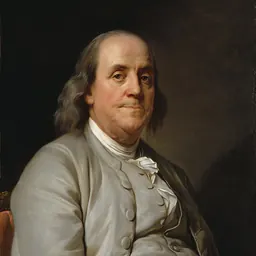

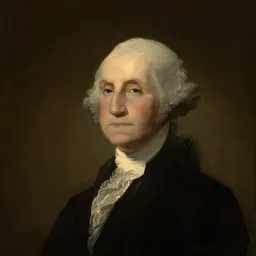
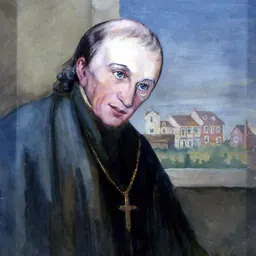



Related people
Same field, nearest in time


Contemporaries
People whose lives overlapped John Carroll's





Frequently asked questions
Who was John Carroll?
first Roman Catholic bishop and archbishop in the United States (1735–1815)
When was John Carroll born?
John Carroll was born on 8 January 1735 in Upper Marlboro.
When did John Carroll die?
John Carroll died on 3 December 1815 in Baltimore.
What was John Carroll's occupation?
John Carroll was a catholic missionary, catholic priest, catholic bishop, regular cleric and bishop.
What nationality was John Carroll?
John Carroll was American.
Sources & further reading
· DBpedia: John Carroll (archbishop of Baltimore)
Cite this page
APA: Biography.guide. (2026). John Carroll. https://biography.guide/john-carroll-catholic-missionary/
MLA: "John Carroll." Biography.guide, https://biography.guide/john-carroll-catholic-missionary/.
Chicago: "John Carroll." Biography.guide. https://biography.guide/john-carroll-catholic-missionary/.
Data last updated: 2026-09-20 · Spot an error? Report a correction.
Portrait: Wikimedia Commons · author & licence
Page generated 2026-09-27 04:57 UTC